Water conservation is an essential consideration when designing and managing Sonoma and Marin County landscapes. Our area enjoys a Mediterranean climate characterized by wet winters and long, dry summers with little rainfall. Plants that are suited or adapted to local conditions not only use less water but generally grow more successfully and robustly, with fewer insect and disease problems. They ultimately create a healthier, more beautiful and more sustainable landscape.
Below is a hand selected plant list for Sonoma and Marin counties that displays mostly native species that will thrive in our climate. You can search, filter and save specific plants to your plant list and also print plant cards.
-
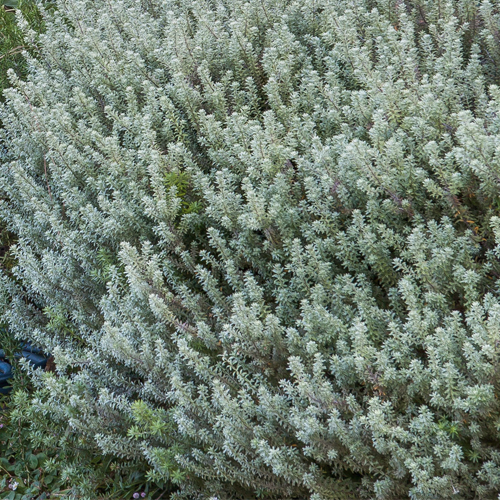
Coast Rosemary
Westringia spp -
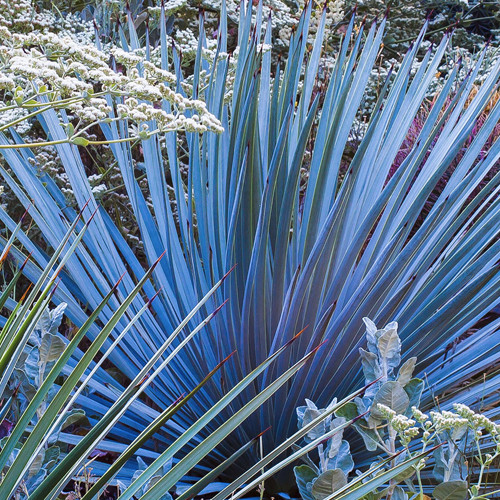
Yucca
Yucca spp -
California Native
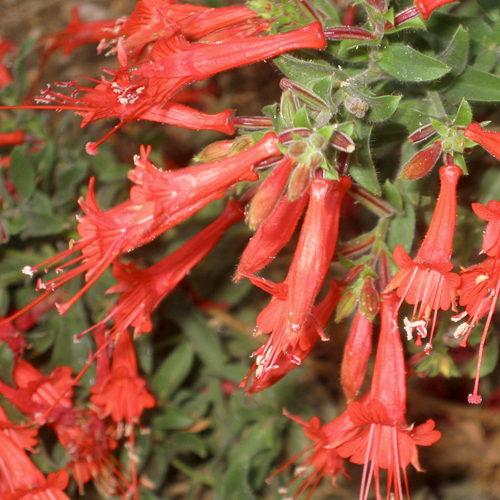
California Fuchsia
Zauschneria [Epilobium] spp

Coast Rosemary
Westringia spp
Shrub
Care:
Full Sun
Low
Most Soils
Look:
Green -Light
leaves
Variegated
leaves
Lavender
flowers
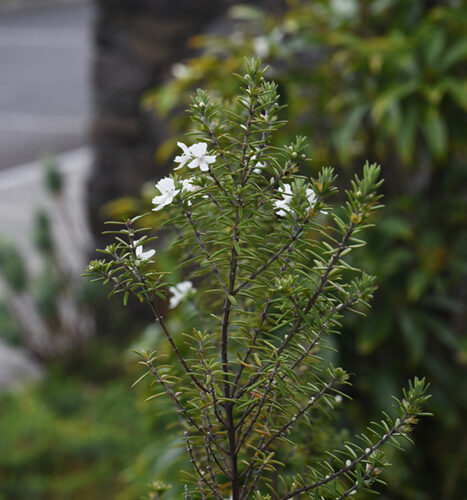
Coast Rosemary
Westringia spp
Shrub
Care:
Full Sun
Low
Most Soils
Look:
Green -Light
leaves
Variegated
leaves
Lavender
flowers
Australian evergreen shrubs that are well-adapted to California gardens. W. fruticosa (3-6’ x 5-10’) is a mounding shrub with green-to-gray-green, needle-like leaves and small white or lavender flowers from winter into spring. W. ‘Wynyabbie Gem’ (6-8’ x 6-8’) has a more upright habit and lavender-blue flowers.
Yucca
Yucca spp
Shrub
Care:
Full Sun
Partial Shade
Very Low
Low
Well Drained
Look:
Blue Gray
leaves
Blue Green
leaves
White
flowers
Yucca
Yucca spp
Shrub
Care:
Full Sun
Partial Shade
Very Low
Low
Well Drained
Look:
Blue Gray
leaves
Blue Green
leaves
White
flowers
Evergreen shrubs and perennials that grow over much of North America and feature sword-shaped leaves. Yuccas typically produce flowers on tall stalks in spring. Some yuccas are stemless while others have trunks and grow to tree size.
Examples: Banana yucca (Y. baccata, 3-4’ x 4-5’) eventually forms a short trunk. Adam’s needle (Y. filamentosa, 2-3’ x 4’) has loose fibers at the edge of leaves. Others are Spanish dagger (Y. gloriosa, 10’ x 8’), beaked yucca (Y. rostrata, 12-15’), and our Lord’s candle (Y. whipplei, 2-4’ x 3-6’), native to Southern California and Baja California.
California Fuchsia
Zauschneria [Epilobium] spp
CA Native
Care:
Full Sun
Low
Well Drained
Look:
Gray Green
leaves
Green
leaves
Orange
flowers
Pink
flowers
Red
flowers
White
flowers
California Fuchsia
Zauschneria [Epilobium] spp
CA Native
Care:
Full Sun
Low
Well Drained
Look:
Gray Green
leaves
Green
leaves
Orange
flowers
Pink
flowers
Red
flowers
White
flowers
Group of highly variable, semi-evergreen subshrubs and herbaceous perennials distributed over a wide geographic area, including California. Epilobiums bloom in late summer with tubular flowers providing a food source for hummingbirds migrating south and are also attractive to bees and butterflies. Epilobiums range from low-growing groundcovers to upright plants of several feet. Flower colors include orange-red, white, pink, and salmon. Most can be pruned back in late autumn to maintain a more compact form and be rejuvenated for the following year.
Low-growing examples: E. ‘Schieffelin’s Choice’; E. canum ‘Calistoga’, a selection from Phil Van Soelen from California Flora Nursery from the Palisades east of Calistoga; E. canum ‘Cloverdale’, a selection from U.C. Santa Cruz Arboretum from along the Russian River north of Cloverdale with exceptionally orange flowers; E. c. ‘Everett’s Choice’, E. c. ‘Summer Snow’ with white flowers, and E. septentrionale ‘Select Mattole’, a somewhat redder flowering selection that is more shade-tolerant.
Upright examples: E. c. ‘Bowman’s Hybrid’ (2-3’), E. c. ‘Catalina’ (3-4’), E. c. ‘Liz’s Choice’ (3’) selected by Milo Baker Chapter CNPS Fellow Liz Parsons, E. c. ‘Marin Pink’ (2’) with pink flowers.
Print this plant card