Petaluma Pollinator Patch

BACK TO FULL TOUR

Garden Features

1

Drought Tolerant

2

California Natives

3

Deer Resistant

4

Drip Irrigation

5

Pesticide Free

6

Rainwater Harvesting System

7

Reclaimed/Recycled Materials

8

Sheet Mulching

9

Smart Irrigation Controller

10

Lawn Conversion

11

Lawn-Free Landscaping

12

Permeable Surfaces

13

Wildlife Habitat

14

NWF Wildlife Habitat

15

Outdoor Worm Composter

We purchased our home in 2021 after living in Santa Rosa for over twenty years. We loved the idea of being in a friendly neighborhood within walking distance of a vibrant downtown. The yard, however, was not our idea of a perfect oasis, and after a year-long interior remodel, we set to work outside.

Both the front and backyards had well-watered lawns along with other thirsty plants, none of which were on our planting plan. Another problem was the vast array of invasive or weedy species. Sheet mulching was helpful, but painstaking digging out of the persistent bulbs/bulblets was (and still is) an ongoing process!

We set to work to remove almost everything in the yard. The only plants we kept were a neglected lilac (recently cut back to rejuvenate) and three crape myrtles (Lagerstromia indica).

In the backyard we dug out paths and piled the removed dirt into a center island. We upgraded to smart controllers and installed 1/2″ inline drip tubing, snaking it throughout the yard. Somewhere along the way we also installed several rain barrels, which we use for hand-watering throughout the summer.

Having experienced the force of climate change firsthand when our Santa Rosa home burned in the 2017 Tubbs Fire, our main intent with this home was to do our part to help save this precious planet. For us, that means that most of our plants are California natives, we use less water and avoid pesticides and petroleum-based fertilizers. We also committed to the National Wildlife Federation’s guidelines for providing wildlife habitat by providing food, water, cover and places to raise young and by practicing sustainable gardening practices. It’s so easy, everyone should do it!

During our short time here, we’ve seen a notable increase in the number and diversity of living things visiting. The variety of native pollinators (remember, honeybees are not native to the U.S.) is remarkable. Each has a preferred type of flower on which to feed, which is one reason you may see all different flower shapes on your tour.

Our small garden is young and ever-changing as we find some plants need more space than we have available. We are keen on stuffing as many plant species and colors into our yard as possible!

Please visit our seed library while you’re here. Every year we save the seeds from many of our plants to share with passersby, hoping to encourage others to create a friendly native habitat in their little piece of the planet, too.

Plants in this Garden

Corymb inflorescent yellow yarrow flowers on gray-green leaves and stems
White yarrow.
Purple yarrow.
Yellow and white yarrow.

Achillea spp & cvs

Yarrow
Organization

Yarrows are variable low-growing, spreading herbaceous perennials with finely divided leaves that inhabit many temperate regions in the Northern Hemisphere. Flattish clusters of flowers form in spring and well into summer and provide an important nectar source for pollinators and insects. Yarrow can help to stabilize slopes and is a good addition to the upper level of rain gardens and swales. Colors include yellow, pink, and red.

California native spp & cvs: A. millefolium (common yarrow), A. m. ‘Calistoga’, A. m. ‘Island Pink’, A. m. ‘Sonoma Coast’, A. m. ‘Terracotta’.

Other yarrows: A. filipendulina (fern leaf yarrow), A. f. ‘Coronation Gold’, A. ‘Moonshine’, A. tomentosa (woolly yarrow).

  • Water: Low
  • Light: Full SunPartial Shade
  • Soil: Most Soils
Manzanita bush with deep red fruits

Arctostaphylos spp & cvs

Manzanita, 'Dr. Hurd'
Organization

Manzanitas vary from carpet-forming groundcovers to small trees. Manzanitas have varying shades of striking, reddish brown bark and can provide structure to a garden. These plants have evergreen foliage, small white-to-pink, urn-shaped blossoms in late winter to early spring, and then small fruits that resemble tiny apples.

Groundcovers: A. ‘Emerald Carpet’ (1’ x 3-6’), A. ‘Pacific Mist’ (2-3’ x 6-8’), A. nummularia ‘Bear Belly’ (1’ x 3’), A. uva ursi ‘Radiant’ (6” x 4-6’), A. uva ursi ‘Wood’s Compct’ (1’ x 3’).

Shrubs: A. ‘Howard McMinn’ (5-7’ x 6-10’), A. ‘John Dourly’ (3-4’ x 5-6’), A. ‘Lester Rowntree’ (8-10’ x 10-15’), A. ‘Sunset‘ (5-7’), A. bakeri ‘Louis Edmunds’ (8-10’), A. manzanita ‘Sentinel’ (6-8’ x 5’), A. hookeri ‘Wayside’ (3′ x 8′).

Trees: A. manzanita ‘Dr. Hurd’ (10-15′)

  • Water: Very LowLow
  • Light: Full SunPartial Shade
  • Soil: Well Drained
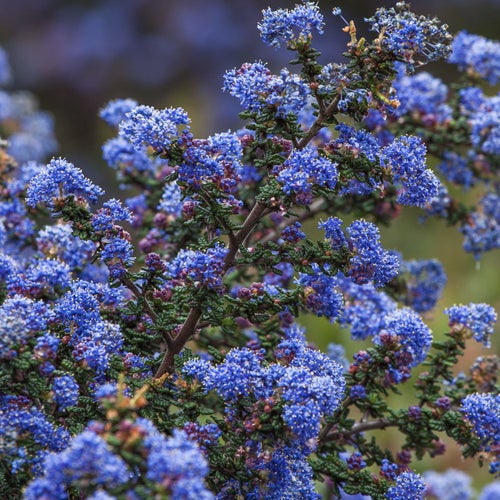
California Lilac ceanothus variety with clusters of small, vibrant blue flowers and dark green leaves

Ceanothus spp & cvs

Ceanothus
Organization

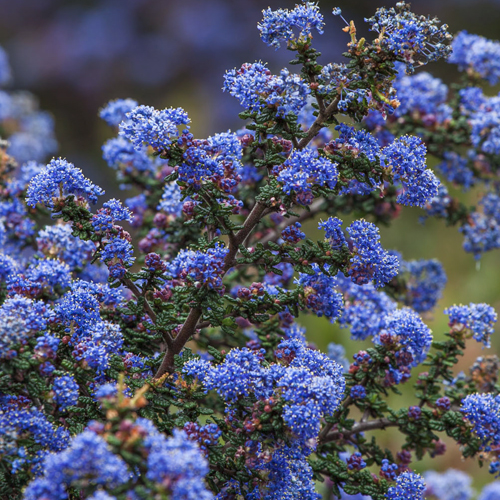
Ceanothus is a group of fast-growing, evergreen shrubs that vary from groundcovers to small trees, many of which are native to California. They provide a spectacular display of flowers in spring that will attract a multitude of pollinators. Flowers are followed by seeds that provide food for birds. The clusters of tiny flowers range from white to deep violet. Plants perform best with good drainage and minimal irrigation once established. Some do best in cooler coastal climates, but many thrive in hotter inland climates. Pay close attention to the mature size when selecting ceanothus to ensure that it has sufficient space for its natural form.

Groundcovers: C. ‘Centennial’ (1’ x 8’), C. gloriosus var. gloriosus ‘Anchor Bay’ (2’ x 8’), C. griseus var. horizontalis ‘Diamond Heights’ (variegated, 1’ x 4’), C. griseus var. horizontalis ‘Yankee Point’ (3’ x 12’), C. maritimus (2’ x 6’).

Shrubs: C. ‘Blue Jeans’ (6’ x 6’), C. Concha (6’ x 6’), C. ‘Dark Star’ (6’ x 8’), C. ‘Joyce Coulter’ (4’ x 12’), C. ‘Julia Phelps’ (8’ x 10’), C. cuneatus (8’ x 8’), C. thyrsiflorus ‘Skylark’ (4’ x 6’).

Large shrubs: C. ‘Frosty Blue’ (10’ x 12’), C. thyrsiflorus (20’ x 20’), C. t. ‘Snow Flurry’ (white flower, 20’ x 20’).

Trees: C. ‘Ray Hartman’ (15′ x 15′)

  • Water: Very LowLow
  • Light: Full SunPartial Shade
  • Soil: Well Drained
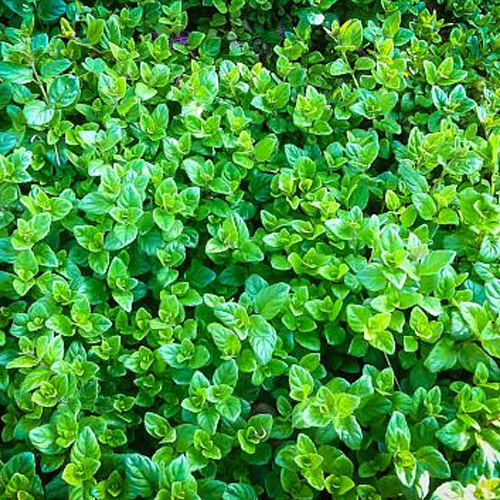
bright shiny green leaves with pointed tips cover the ground

Satureja [Clinopodium] douglasii

Yerba Buena
Organization

Yerba buena is Spanish for “good herb” due to its medicinal qualities as a tea. This trailing herbaceous perennial has a minty fragrance and is native from British Columbia to Los Angeles County. Prefers a woodland setting with light shade and well-drained soil.

  • Water: Low
  • Light: Full SunPartial Shade
  • Soil: Most Soils
A small multi-trunked shrub with light brown bark, green leaves,, and clusters of tiny star-shaped light green flowers

Rhamnus [Frangula] californica

Coffeeberry
Organization

Evergreen shrub that has insignificant flowers followed by black berries. Flowers are attractive to pollinators, especially bees, and berries provide a food source for birds. Cultivars commonly sold in nurseries have differing growth habits and are often smaller than the species which grows 5-18’ x 10-18’.

Examples: F. c. ‘Eve Case’ (6-8’ x 6-8’), R. c. ‘Leatherleaf’ (5-6’ x 5-6’), R. c. ‘Mound San Bruno’ (6-8’ x 6-8’) with a dense, mounding growth habit.

Note: California coffeeberry was formerly classified as Rhamnus californica and is now classified as Frangula californica.

  • Water: Low
  • Light: Full SunPartial Shade
  • Soil: Most Soils
Dark green oval leaves and red berry clusters on dark brown branches

Heteromeles arbutifolia

Toyon
Organization

California native, evergreen shrub or small tree often seen growing in Sonoma and Marin county wildlands. Lacy, white flower clusters in spring attract pollinators; red berries in winter provide a splash of color and an important food source for birds. The name “Hollywood” was born from the abundance of toyon in the hills of southern California and its resemblance to European holly. The cultivar ‘Davis Gold’ has yellow berries and may be more disease-resistant than the species.

  • Water: Low
  • Light: Full SunPartial Shade
  • Soil: Well Drained
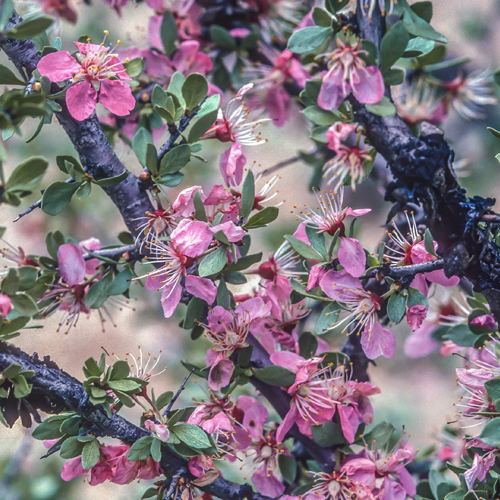
Close-up of light pink blossoms with white stamens poking out of the center.

Prunus spp

Prunus
Organization

Large group of evergreen and deciduous shrubs and trees that includes many ornamental species as well as others that produce edible fruit.

Examples:

  • Apricot, nectarine, peach, and plum trees are all classified as having low-water use in Sonoma and Marin counties. Consult local nurseries for available types and specific growing requirements.
  • Carolina laurel cherry (P. caroliniana, 20-30’ x 15-20’) is an upright, evergreen shrub from North Carolina to Texas where it grows as an understory plant. Its small, white flowers in spring are followed by small black fruit. P. c. ‘Compacta’ (10-15’ x 6-8’) is a popular smaller form.
  • Hollyleaf cherry (P. ilicifolia, 10-25’ x 10-25’) is an evergreen shrub from central California to Baja California. Creamy white flowers in narrow spikes in late spring to early summer are followed by fruits that attract many species of birds. Can be used as a hedge or screen, as well as for erosion control.
  • Catalina cherry (P. ilicifolia spp. Lyonii, 30-45’ x 20-30’) is native to the Channel Islands.
  • Water: Low
  • Light: Full Sun
  • Soil: Well Drained
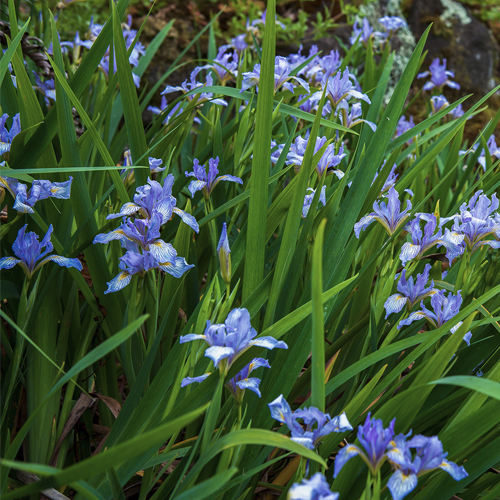
Dark green, grass-like leaves with deep blue flowers with pointy, ruffled petals

Iris douglasiana & cvs

Douglas Iris, Pacific Coast Hybrids
Organization

Iris are a large and diverse group of perennials that grow from either bulbs or rhizomes. The California native Douglas iris and cultivars known as Pacific Coast Hybrids are an excellent choice for summer-dry gardens and understory plantings. Fall rain brings new growth in the form of thin, upright leaves, followed in late winter to early spring by the first blossoms. Douglas iris commonly ranges in color from lavender to purple, but cultivars are available in a range of colors including white and yellow. Established plantings can be lifted and divided after the first significant fall rain and either replanted or put into containers to share with others.

  • Water: Low
  • Light: Partial ShadeShade
  • Soil: Most Soils
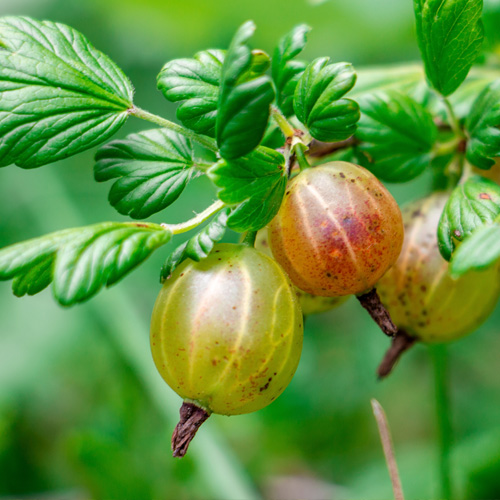
close up of yellow and red gooseberries with a dark brown spine on the bottom of each

Ribes spp

Currant, Gooseberry
Organization

Currants (without spines) and gooseberries (with spines) are grown for their graceful growth habit, attractive foliage, wonderful displays of pendulous flowers in winter-spring that are attractive to hummingbirds, and colorful fruit that provides a food source for birds. Most of the species listed are deciduous, going dormant in the summer months.

Examples: Some of the species suitable for California gardens, preferably with partial shade, are native to the Western United States:

  • aurem, golden currant (5-10’ x 3-6’), deciduous with small clusters of delicate yellow flowers and sprawling habit.
  • malvaceum, chaparral currant (4-8’ x 4-6’), deciduous with early clusters of pink flowers, a slightly vase-shaped habit, and more drought-tolerant than most species.
  • sanguineum var. glutinosum, pink-flowering currant (5-12’ x 5-12’), deciduous with maple-like leaves, a vase-shaped habit, and long pendulous clusters of pink, reddish, or white flowers in the spring; many available cultivars such as ‘Claremont’, ‘Tranquillon Ridge’, and ‘White Icicle’.
  • speciosum, fuchsia-flowered gooseberry (4-8’ x 6-10’), deciduous with spiny, arching stems and bright red fuchsia-like flowers along the stems in the spring that are attractive to hummingbirds.
  • viburnifolium, evergreen currant or Catalina perfume (2-4’ x 5-7’), evergreen groundcover that works well under oaks and can provide erosion control to slopes.
  • Water: Very LowLow
  • Light: Full SunPartial ShadeShade
  • Soil: Well Drained
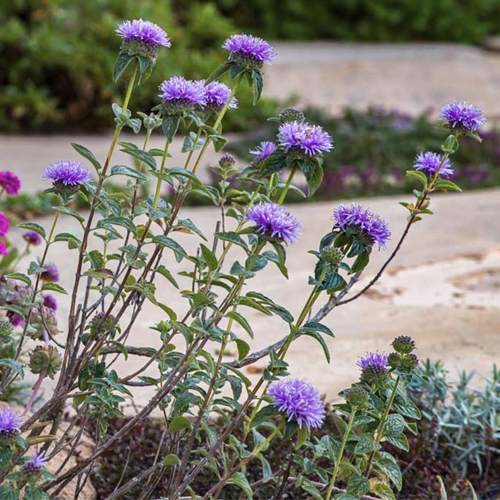
Dark brown stems with pointed green leaves and purple pompom flowers at the top of each stem

Monardella villosa

Coyote Mint
Organization

Coyote Mint is a compact perennial or sub-shrub with aromatic foliage and a sprawling habit. Dense heads of purple flowers form in spring-to-summer that are attractive to butterflies and other insects. The low-growth habit of coyote mint makes it an excellent choice for the front of a border, along the edge of a path, or beneath larger shrubs such as manzanita or ceanothus. Monardella villosa spp. franciscana ‘Russian River’ and Monardella villosa spp. villosa ‘Mark West’ are available selections from Sonoma County.

  • Water: Very Low
  • Light: Full Sun
  • Soil: Most Soils
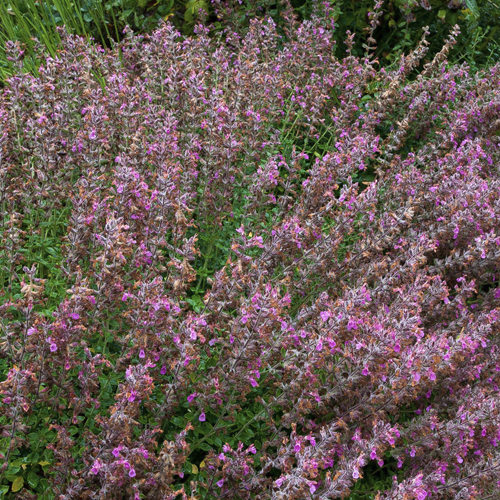
Long stems with green leaves at the base have purple-pink flowers in raceme inflorescence.

Teucrium spp

Germander
Organization

Mediterranean, flowering, shrubby perennials with aromatic foliage.

  • Wall germander (T. chamaedrys [x lucidrys], 1’ x 2’) is a popular groundcover with upright stems, dark green leaves, and red-purple or white flowers in summer.
  • Majorcan germander (T. cossonii [majoricum], 6” x 2’) is a creeping perennial that produces a profusion of rosy purple flowers in mid-to-late spring.
  • Bush germander (T. fruticans, 4-8’ x 4-8’) has silvery foliage and bears lavender-blue flower spikes from winter to spring and sporadically throughout the year.
  • Water: Very LowLow
  • Light: Full Sun
  • Soil: Well Drained
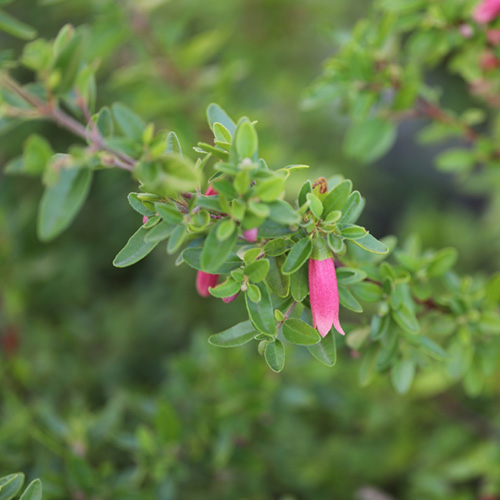
pink bell shaped flower hanging from a tall bush

Correa spp

Australian Fuchsia
Organization

South Australian evergreen, small-to-medium-sized shrubs with delicate, tubular flowers that vary from white to green and yellow to red. Typical flower time is fall through spring, providing a nectar source when many California native plants are just coming out of dormancy. All require good drainage.

Examples: C. alba (4-8’ x 4-8’) blooms with white, star-shaped flowers. C. ‘Dusky Bells’ (2-3’ x 6-8’) is a mounding shrub with deep red flowers. C. ‘Ivory Bells’ (3-4’ x 4-6’) has white flowers. C. pulchella (2-3’ x 4-8’) is a variable species with several popular cultivars. C. reflexa (1-8’ x 3-9’) ranges from prostrate to upright. C. ‘Wynn’s Wonder’ (2-3’ x 3-5’) has variegated foliage and rosy pink flowers.

  • Water: Low
  • Light: Full SunPartial Shade
  • Soil: Well Drained