Park-Like Planting for Pollinators

BACK TO FULL TOUR

Garden Features

1

Drought Tolerant

2

Edible Garden

3

California Natives

4

Drip Irrigation

5

Pesticide Free

6

Rain Garden

7

Smart Irrigation Controller

8

Permeable Surfaces

9

Wildlife Habitat

10

Berms/Swales for Stormwater Management

11

Pollinator Friendly

Partner: Town of Windsor

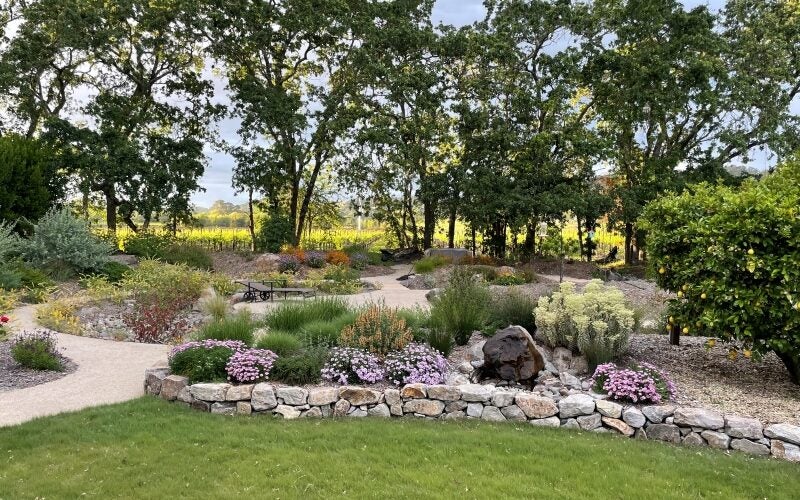
Our large backyard was a completely flat and uninspiring property covered in weeds when we purchased our house in 2019. A single lemon tree was the only significant plant other than the weeds. We decided to focus on creating an environment which was eco-friendly, interesting visually, home to pollinators and wildlife, and featured native plants. Working with Nucleus Design, a company specializing in a permaculture approach to landscaping, along with Mary Foley Gardening assisting in plant selection, we came up with a park-like design.

Our backyard now includes a very large rain garden which stores our roof rainwater runoff so that it can slowly reenter the groundwater aquifer. Paths wind around berms growing primarily with drought tolerant native plants. Watering is accomplished through drip irrigation managed efficiently by a smart irrigation controller. A “bubble rock” water feature provides water for wildlife while giving us the soothing ambiance of running water. A small lawn/meadow of UC Verde Buffalo Grass, a low-water alternative to traditional grass, provides a play area for grandchildren. Additionally, a moderate-sized vegetable garden provides fresh vegetables. We also took advantage of “borrowed landscaping” by removing a fence at the back of the property so that your eye naturally looks out past large Valley Oak trees onto lush vineyards.

We hope to see you on the Garden Tour!

Special Events
Walking Tours

Plants in this Garden
Plant Picker
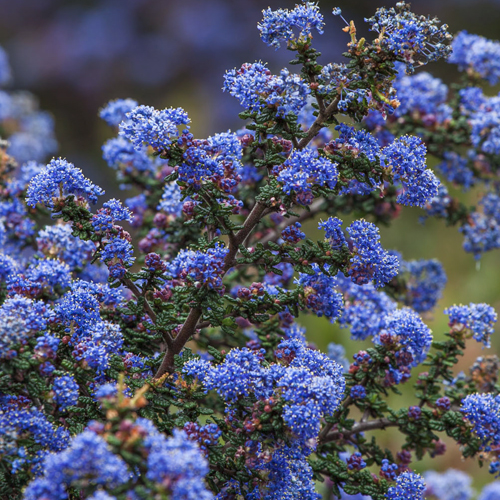
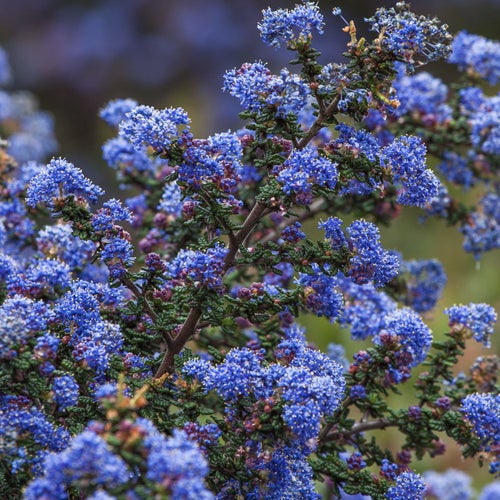
California Lilac ceanothus variety with clusters of small, vibrant blue flowers and dark green leaves

Ceanothus spp & cvs

Ceanothus
Organization

Ceanothus is a group of fast-growing, evergreen shrubs that vary from groundcovers to small trees, many of which are native to California. They provide a spectacular display of flowers in spring that will attract a multitude of pollinators. Flowers are followed by seeds that provide food for birds. The clusters of tiny flowers range from white to deep violet. Plants perform best with good drainage and minimal irrigation once established. Some do best in cooler coastal climates, but many thrive in hotter inland climates. Pay close attention to the mature size when selecting ceanothus to ensure that it has sufficient space for its natural form.

Groundcovers: C. ‘Centennial’ (1’ x 8’), C. gloriosus var. gloriosus ‘Anchor Bay’ (2’ x 8’), C. griseus var. horizontalis ‘Diamond Heights’ (variegated, 1’ x 4’), C. griseus var. horizontalis ‘Yankee Point’ (3’ x 12’), C. maritimus (2’ x 6’).

Shrubs: C. ‘Blue Jeans’ (6’ x 6’), C. Concha (6’ x 6’), C. ‘Dark Star’ (6’ x 8’), C. ‘Joyce Coulter’ (4’ x 12’), C. ‘Julia Phelps’ (8’ x 10’), C. cuneatus (8’ x 8’), C. thyrsiflorus ‘Skylark’ (4’ x 6’).

Large shrubs: C. ‘Frosty Blue’ (10’ x 12’), C. thyrsiflorus (20’ x 20’), C. t. ‘Snow Flurry’ (white flower, 20’ x 20’).

Trees: C. ‘Ray Hartman’ (15′ x 15′)

  • Water: Very LowLow
  • Light: Full SunPartial Shade
  • Soil: Well Drained
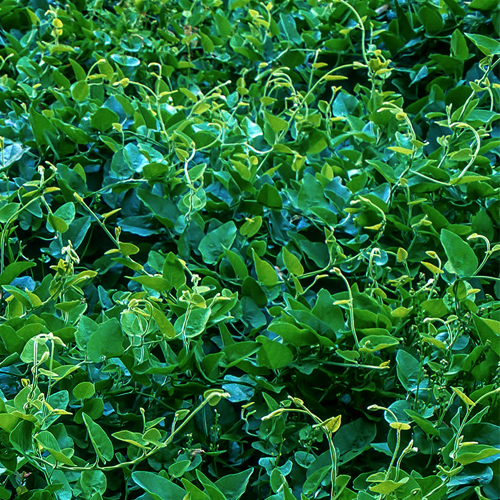
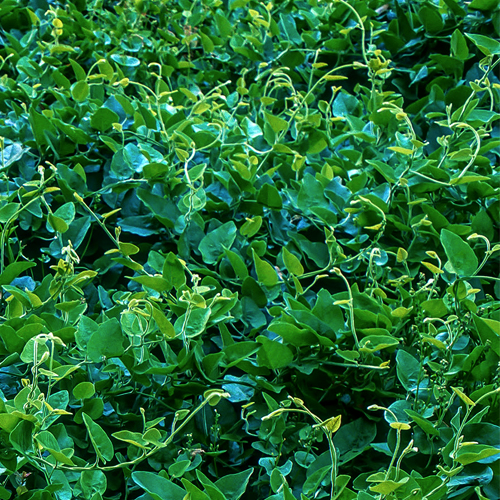
light green leaves of the California pipe vine

Aristolochia californica

California Pipevine
Organization

Important northern California native habitat plant that is the sole larval food source for the pipevine swallowtail butterfly. This deciduous vine grows naturally along stream banks and in woodlands and performs well under native oaks. Dutchman’s pipevine is relatively slow-growing and takes a few years to establish. Pendulous pipe-shaped flowers bloom in early spring, followed by soft, bright green, heart-shaped leaves. Best grown as a groundcover to provide protection for pipevine swallowtail larvae but will also twine up other plants and structures. The real show comes in late spring as larvae feed on the plant and grow into spectacular horned, black caterpillars with red spots!

  • Water: Low
  • Light: Partial ShadeShade
  • Soil: Most Soils
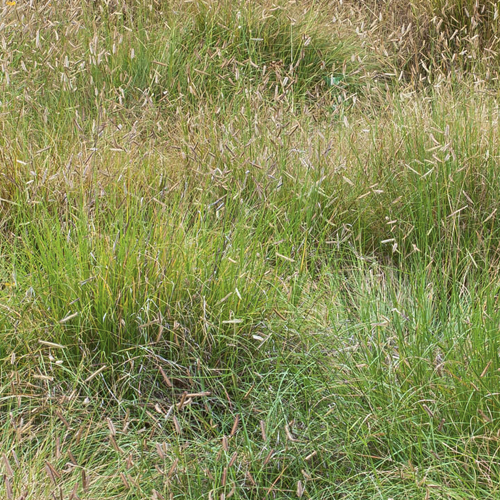
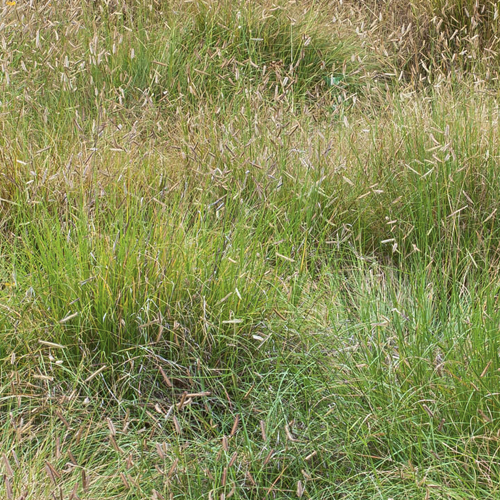
light green blue grama grass with light brown tips

Bouteloua gracilis

Blue Grama Grass
Organization

North American native, warm-season bunchgrass with narrow, grayish green leaves. Ornamental flowers like small brushes form at right angles to slender stems during the summer and persist for many months. Blue grama is adapted to heat, drought, cold, and foot traffic. It does not thrive in shade or wet soils. Blue grama can be used in small clumps among other plants, in a mass as part of a meadow, or even as a lawn substitute. B. g. ‘Blonde Ambition’ is a popular and robust cultivar.

  • Water: Low
  • Light: Full Sun
  • Soil: Well Drained
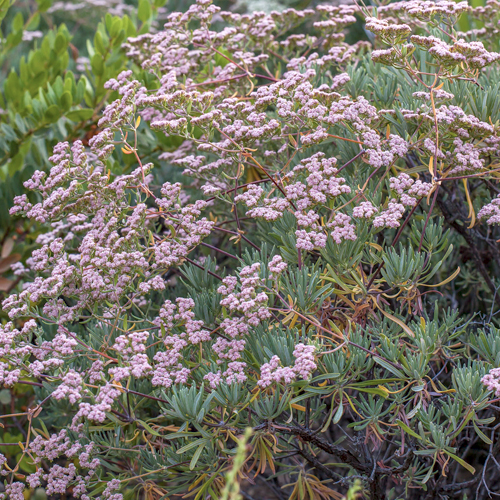
Gray green spiney leaves with dark stems forming clusters of small, light pink flowers

Eriogonum spp

Buckwheat
Organization

Diverse group of flowering, evergreen shrubs and perennials and annuals found throughout the western United States. Most available in nurseries are native to California and generally prefer drier sites. Flowers colors include yellow, white, pink, and red and are held above foliage in umbels that dry over time and are popular in flower arrangements. Buckwheats provide pollen and nectar for bees and butterflies, larval food for butterflies, seeds for birds, and cover for many creatures.

Examples:

  • Santa Cruz Island buckwheat (E. arborescens, 3-4’ x 4-5’) densely mounded with white flowers.
  • Saffron buckwheat (E. crocatum, 1-2’ x 2-3’) with chartreuse-yellow flowers and pale leaves.
  • California buckwheat (E. fasciculatum, 2-3’ x 3’) and its low-growing cultivars such as E. f. ‘Warriner Lytle.’
  • Catherine’s lace (E. giganteum, 4-8’ x 6-10’) with delicate, white flowers and soft pale leaves.
  • Red-flowered buckwheat (E. grande var. Rubescens, 1-2’ x 2-3’) low-mounding perennial with rose-pink flowers, coastal bluff buckwheat (E. latifolium, up to 12” x 1-2’.)
  • Sulfur buckwheat (E. umbellatum, 6-18” x 1-3’) with intense yellow flowers and cultivars E. u. var. aureum ‘Kannah Creek’ and E. u. Var. ‘Shasta Sulphur’.
  • Water: Very LowLow
  • Light: Full SunPartial Shade
  • Soil: Well Drained
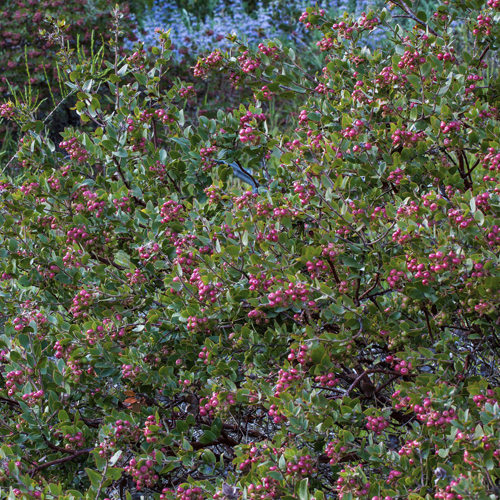
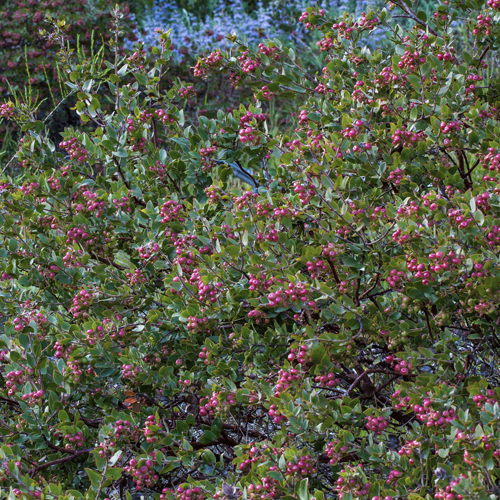
Manzanita bush with deep red fruits

Arctostaphylos spp & cvs

Manzanita, 'Dr. Hurd'
Organization

Manzanitas vary from carpet-forming groundcovers to small trees. Manzanitas have varying shades of striking, reddish brown bark and can provide structure to a garden. These plants have evergreen foliage, small white-to-pink, urn-shaped blossoms in late winter to early spring, and then small fruits that resemble tiny apples.

Groundcovers: A. ‘Emerald Carpet’ (1’ x 3-6’), A. ‘Pacific Mist’ (2-3’ x 6-8’), A. nummularia ‘Bear Belly’ (1’ x 3’), A. uva ursi ‘Radiant’ (6” x 4-6’), A. uva ursi ‘Wood’s Compct’ (1’ x 3’).

Shrubs: A. ‘Howard McMinn’ (5-7’ x 6-10’), A. ‘John Dourly’ (3-4’ x 5-6’), A. ‘Lester Rowntree’ (8-10’ x 10-15’), A. ‘Sunset‘ (5-7’), A. bakeri ‘Louis Edmunds’ (8-10’), A. manzanita ‘Sentinel’ (6-8’ x 5’), A. hookeri ‘Wayside’ (3′ x 8′).

Trees: A. manzanita ‘Dr. Hurd’ (10-15′)

  • Water: Very LowLow
  • Light: Full SunPartial Shade
  • Soil: Well Drained
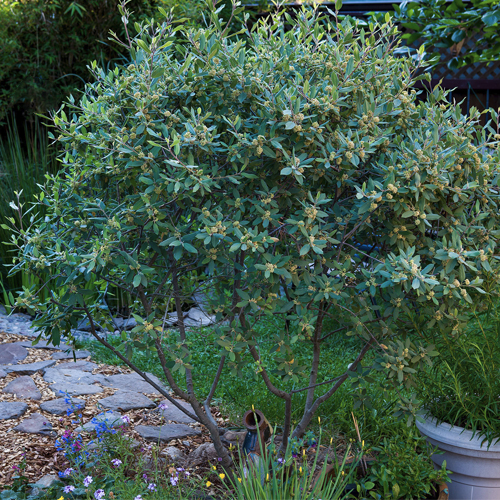
A small multi-trunked shrub with light brown bark, green leaves,, and clusters of tiny star-shaped light green flowers

Rhamnus [Frangula] californica

Coffeeberry
Organization

Evergreen shrub that has insignificant flowers followed by black berries. Flowers are attractive to pollinators, especially bees, and berries provide a food source for birds. Cultivars commonly sold in nurseries have differing growth habits and are often smaller than the species which grows 5-18’ x 10-18’.

Examples: F. c. ‘Eve Case’ (6-8’ x 6-8’), R. c. ‘Leatherleaf’ (5-6’ x 5-6’), R. c. ‘Mound San Bruno’ (6-8’ x 6-8’) with a dense, mounding growth habit.

Note: California coffeeberry was formerly classified as Rhamnus californica and is now classified as Frangula californica.

  • Water: Low
  • Light: Full SunPartial Shade
  • Soil: Most Soils
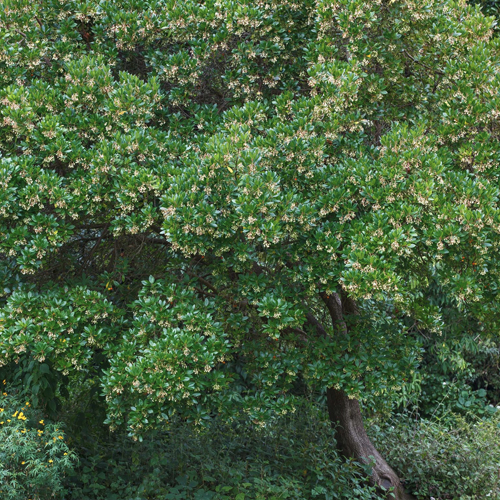
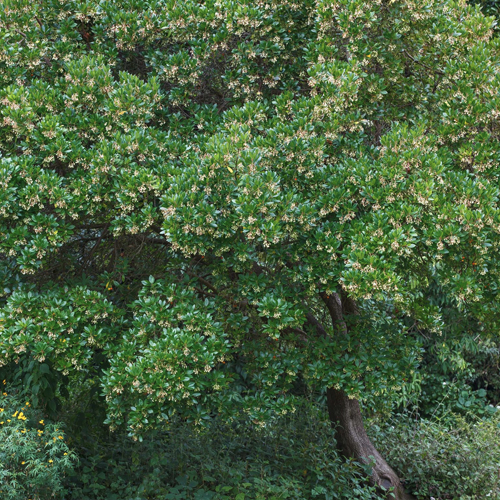
Strawberry tree with green leaves and light brown blossoms

Arbutus spp & hybrids

Arbutus, Strawberry Tree
Organization

Group of evergreen trees and large shrubs with attractive foliage and bark, small urn-shaped flowers, and reddish fruit. Prefer sunny locations and well-drained soil. A. ‘Marina’ (20-30’ – 15-30’) and A. unedo (strawberry tree, 15-30’ x 15-30’) are most commonly planted in California landscapes, either as multi-stemmed or single-stemmed, large shrubs or trees. While the two trees are similar in appearance, A. ‘Marina’ has cinnamon-brown shedding bark, whereas the bark of A. unedo is more brown. A. menziesii (madrone, 20-100’) is native to the west coast of North America, including the foothills of Sonoma and Marin counties. A. menziesii is less common in landscapes as it is notoriously difficult to establish.

  • Water: Low
  • Light: Full SunPartial Shade
  • Soil: Well Drained
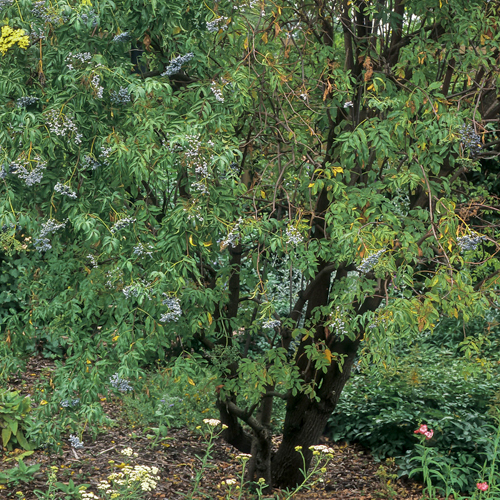
A tree with dark brown bark and willowy green leaves and blue elderberries

Sambucus spp

Elderberry
Organization

Fast-growing shrubs and small trees for sun or part shade that attract pollinators from far and wide to large clusters of cream flowers in spring, followed by berries in summer that provide food to many types of birds. Fruit can also be used for culinary purposes. While naturally fairly wild-looking, elderberries can handle being cut back to the ground in the winter or pruned to maintain size and shape.

Examples:

  • Blue elderberry (S. mexicana [nigra] spp. caerulea, 8-25’) is native from Oregon to Baja California and beyond.
  • Black elderberry (S. nigra, 20-30’) is native to Europe, North Africa, and Asia, and is available in nurseries in the form of many named cultivars. Cut leaf black elderberry (S. n. ‘Black Lace’, 8’ x 8’) has intense dark, fine foliage. Cut leaf elderberry (S. n. ‘Laciniata’, 10’ x 10’) has green leaves, and variegated black elderberry (S. n. ‘Marginata’, 6-12’) has variegated leaves.
  • Water: Low
  • Light: Full SunPartial Shade
  • Soil: Well Drained

Favorite Plants

1

Soaproot

Chlorogalum spp.

2

California Poppy

Eschscholzia californica

3

Salvia spp. & cvs.

Salvia spp. & cvs.

4

Madrone

Arbutus menziesii

5

Sticky Monkey Flower

Mimulus aurantiacus

Favorite Garden Suppliers

Emerisa Gardens

555 Irwin Lane Santa Rosa

Urban Tree Farm Nursery

3010 Fulton Road Fulton

Recommended Resources

Gardening Tips

1

Weeding

Pull weeds early and often.