Natives on Parade
BACK TO FULL TOUR
Garden Features
Drought Tolerant
California Natives
Pesticide Free
Lawn-Free Landscaping
Partner: Santa Rosa Water
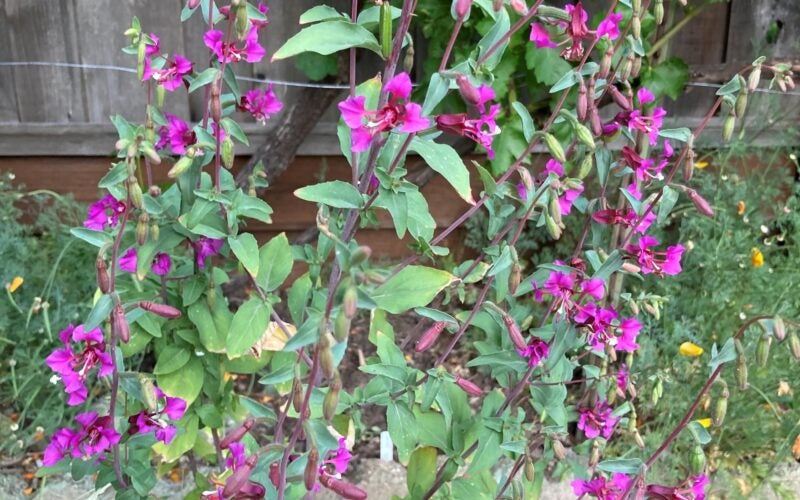
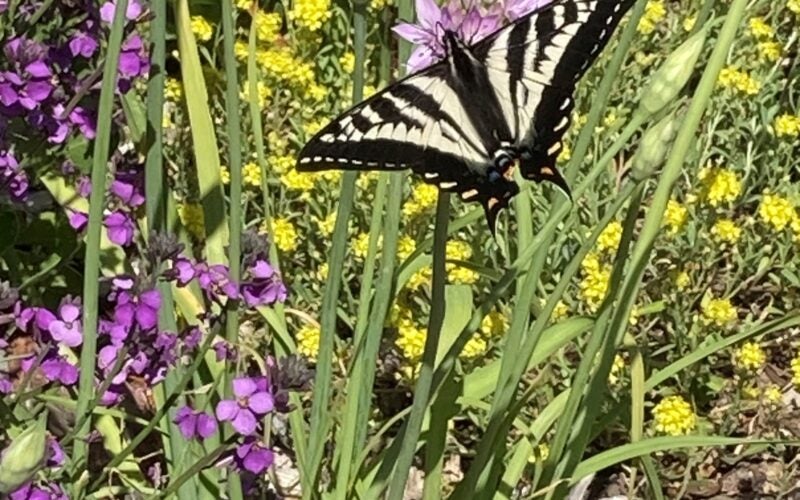
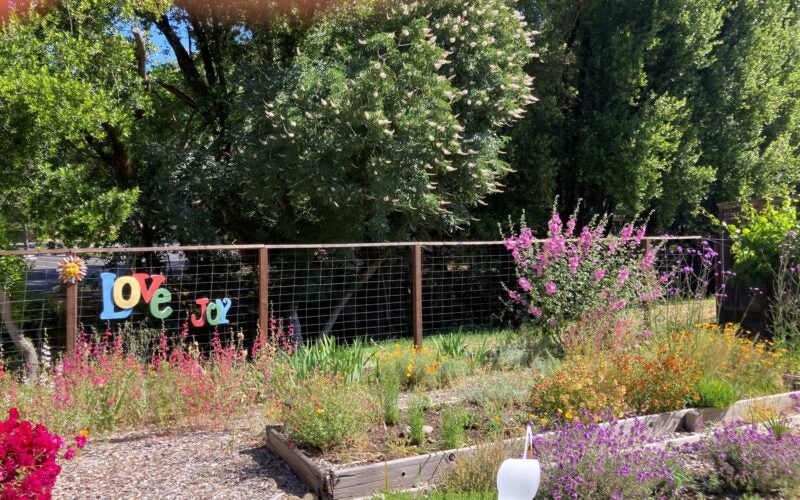
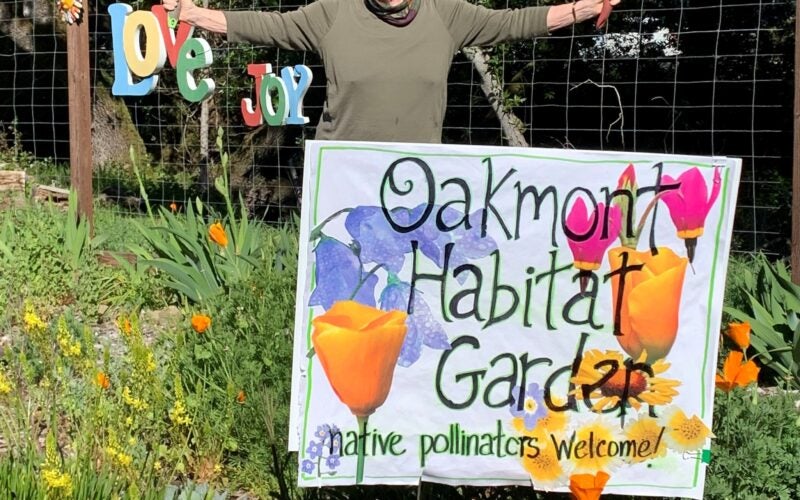
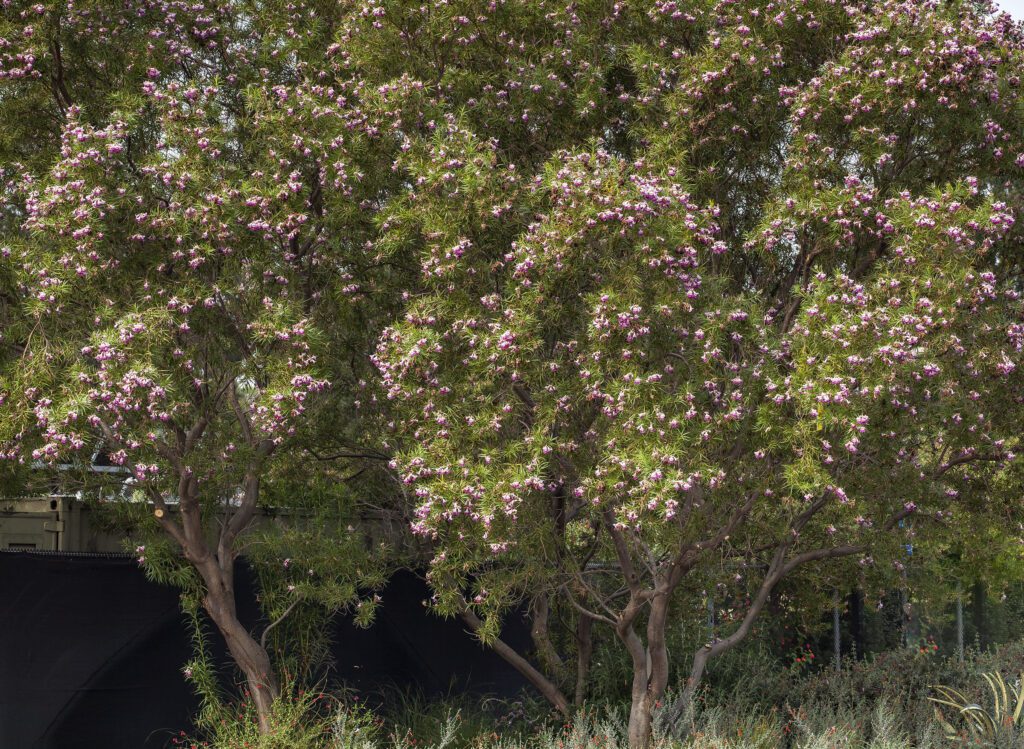
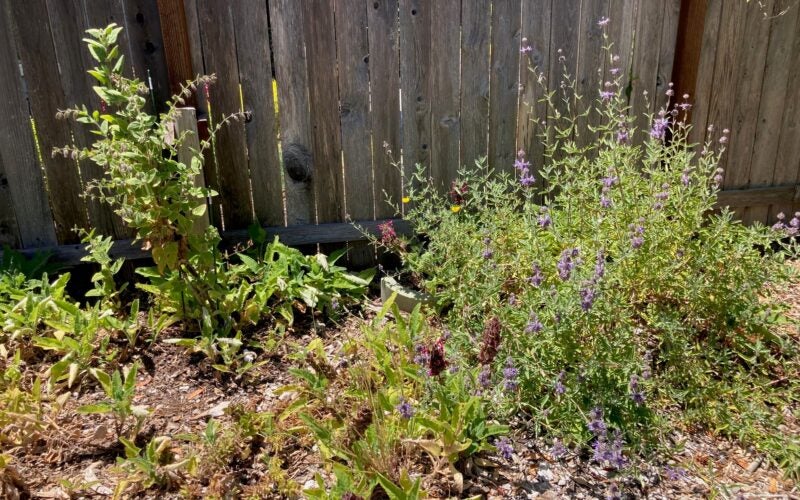
The front of the house is dominated by a huge heritage Coast Live Oak (Quercus agrifolia). Enter through the east side gate and you will soon be in a beautiful habitat garden. Birds, bees and butterflies abound. The pipevine butterfly is the main butterfly, but the anise swallowtail is often seen nectaring on the Erysimum ‘Bowles Mauve’. Anna’s hummingbirds and the little titmouse are attracted by the feeders that I put out for them.
I moved into the house in 2022 and have been adding California natives and Mediterranean plants to the garden. Most of my plants have been purchased at the Milo Baker Chapter of the CA Native Plant Society plant sale.
When I moved in the edible grape vines had been growing there for years. They dominate the east side. The beautiful old lilac was also there. By the house there was a native spice bush (Calycanthus occidentalis) and the snowberry (Symphoricarpos mollis) when I moved in. The previous tenants had planted some native plants! They liked iris and so do I so there are many bearded iris in one bed.
I have improved the soil and worked by hard to create a beautiful garden in four and a half years.
Plants in this Garden
-
Symphoricarpos albus ssp. Snowberry
-
Erysimum spp Wallflower
-
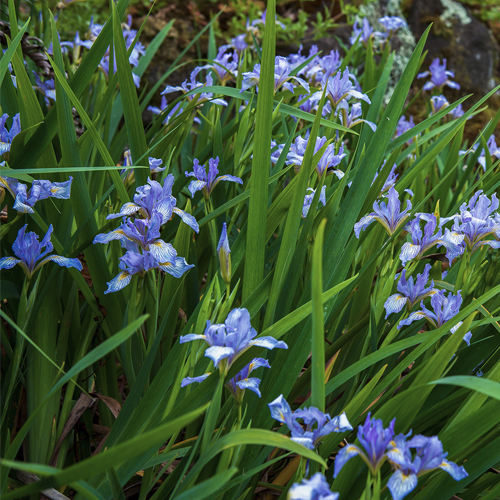
Iris douglasiana & cvs Douglas Iris, Pacific Coast Hybrids
-
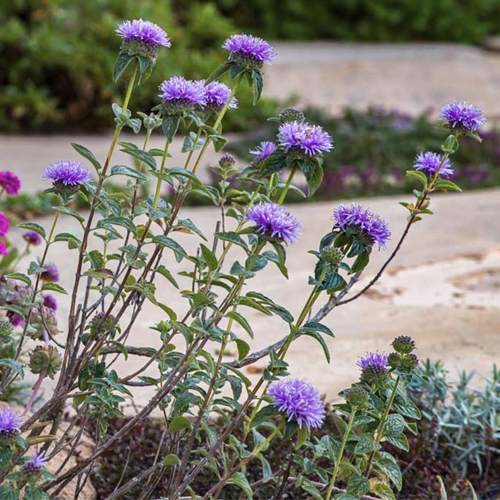
Zauschneria [Epilobium] spp California Fuchsia
-
Monardella villosa Coyote Mint
-
Thymus spp Thyme
-
Verbena spp Verbena
-
Chilopsis linearis Desert Willow
-
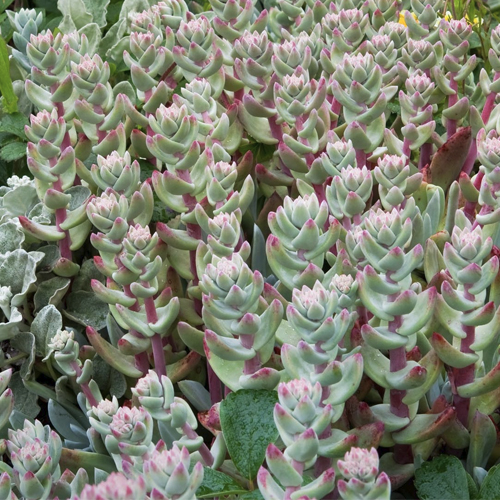
Eriogonum spp Buckwheat
-
Dudleya spp Cliff Lettuce, Live Forever
-
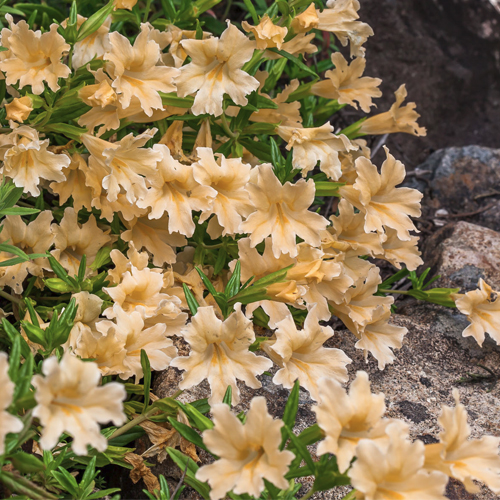
Arctostaphylos spp & cvs Manzanita, 'Dr. Hurd'
-
Rhamnus [Frangula] californica Coffeeberry
-
Penstemon heterophyllus Blue Foothill Penstemon, California Penstemon
-
Lepechinia calycina Pitcher Sage
-
Salvia spp Sage
-
Mimulus aurantiacus and hybrids Sticky Monkey Flower
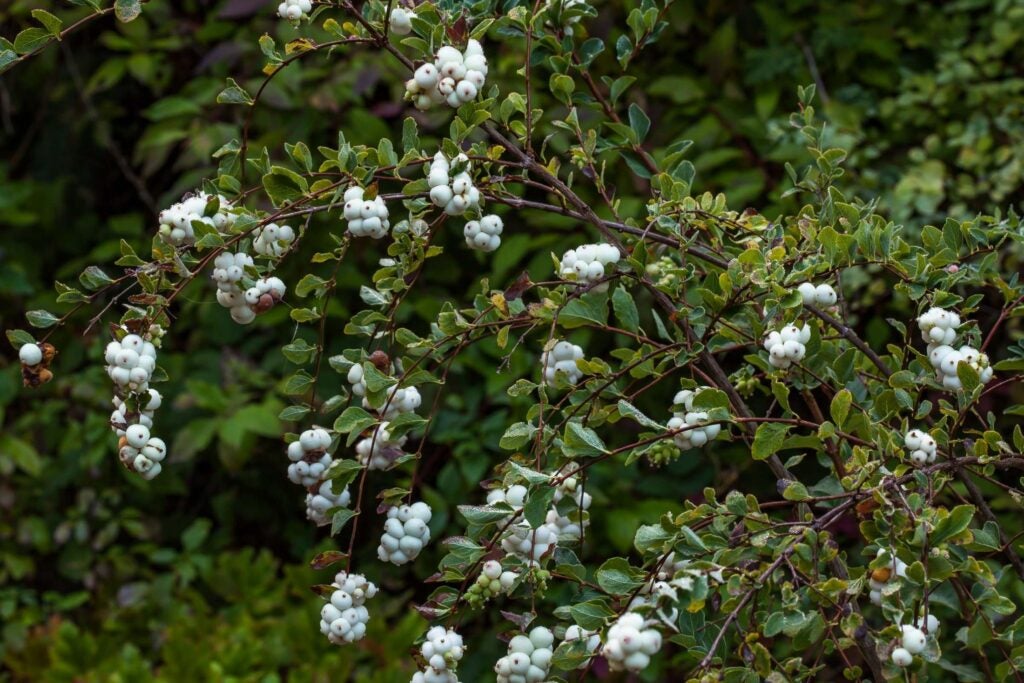
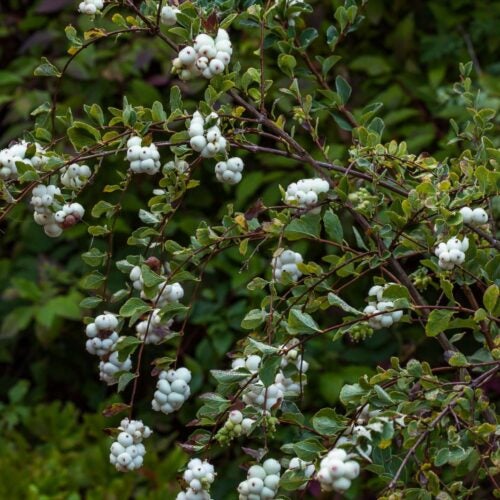
The snowberry bush is an adaptable California native that enjoys moist or dry shade and most well-drained soils. It will also do well in cool sun. It can grow 3-6 feet wide and 3 feet tall. Its spring and summer blooms of bell-shaped pinkish-white flowers attract pollinators, while its fall and winter white snowberries will feed the birds. The berries are mildly toxic to humans, cats, and dogs but safe for most other animals.
- Water: Low
- Light: Full SunPartial ShadeShade
- Soil: Well Drained
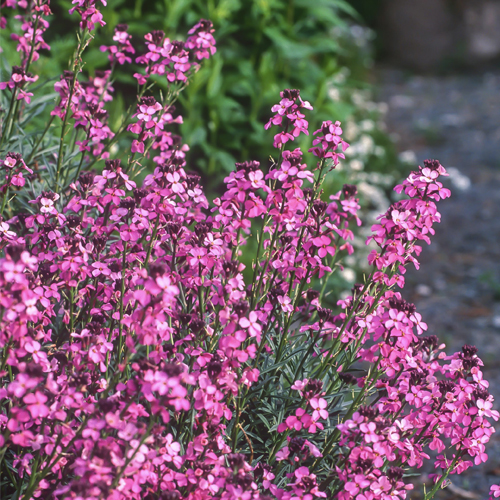
Short-lived perennials with differing growth habits with flower spikes of small flowers. Erysimum ‘Bowles Mauve’ is a popular hybrid that grows 3’ x 3-4’ and blooms from winter and into spring. Many hybrids with different flower colors are available.
- Water: Low
- Light: Full SunPartial Shade
- Soil: Most Soils
Iris are a large and diverse group of perennials that grow from either bulbs or rhizomes. The California native Douglas iris and cultivars known as Pacific Coast Hybrids are an excellent choice for summer-dry gardens and understory plantings. Fall rain brings new growth in the form of thin, upright leaves, followed in late winter to early spring by the first blossoms. Douglas iris commonly ranges in color from lavender to purple, but cultivars are available in a range of colors including white and yellow. Established plantings can be lifted and divided after the first significant fall rain and either replanted or put into containers to share with others.
- Water: Low
- Light: Partial ShadeShade
- Soil: Most Soils
Group of highly variable, semi-evergreen subshrubs and herbaceous perennials distributed over a wide geographic area, including California. Epilobiums bloom in late summer with tubular flowers providing a food source for hummingbirds migrating south and are also attractive to bees and butterflies. Epilobiums range from low-growing groundcovers to upright plants of several feet. Flower colors include orange-red, white, pink, and salmon. Most can be pruned back in late autumn to maintain a more compact form and be rejuvenated for the following year.
Low-growing examples: E. ‘Schieffelin’s Choice’; E. canum ‘Calistoga’, a selection from Phil Van Soelen from California Flora Nursery from the Palisades east of Calistoga; E. canum ‘Cloverdale’, a selection from U.C. Santa Cruz Arboretum from along the Russian River north of Cloverdale with exceptionally orange flowers; E. c. ‘Everett’s Choice’, E. c. ‘Summer Snow’ with white flowers, and E. septentrionale ‘Select Mattole’, a somewhat redder flowering selection that is more shade-tolerant.
Upright examples: E. c. ‘Bowman’s Hybrid’ (2-3’), E. c. ‘Catalina’ (3-4’), E. c. ‘Liz’s Choice’ (3’) selected by Milo Baker Chapter CNPS Fellow Liz Parsons, E. c. ‘Marin Pink’ (2’) with pink flowers.
- Water: Low
- Light: Full Sun
- Soil: Well Drained
Coyote Mint is a compact perennial or sub-shrub with aromatic foliage and a sprawling habit. Dense heads of purple flowers form in spring-to-summer that are attractive to butterflies and other insects. The low-growth habit of coyote mint makes it an excellent choice for the front of a border, along the edge of a path, or beneath larger shrubs such as manzanita or ceanothus. Monardella villosa spp. franciscana ‘Russian River’ and Monardella villosa spp. villosa ‘Mark West’ are available selections from Sonoma County.
- Water: Very Low
- Light: Full Sun
- Soil: Most Soils
These aromatic Mediterranean perennials and sub-shrubs include many types used for culinary purposes, as well as others used as ornamental groundcovers.
Examples: The following examples are all available in many named varieties.
- Lemon thyme (T. x citriodorus, 1’ x 2’) has a lemony fragrance.
- Creeping thyme (T. praecox, 2-6” x 2-3’) provides an excellent groundcover between stepping stones.
- Woolly thyme (T. pseudolanuginosus [lanuginosus], 2-4” x 3’) has wooly gray leaves.
- Elfin thyme (T. serpyllum ‘Elfin’, 1-2” x 6-12”) is one of the smallest thymes with tiny leaves and a very compact growth habit.
- Common thyme (T. vulgaris, 1’ x 2’) and named varieties are most commonly used for culinary purposes.
- Water: Low
- Light: Full SunPartial Shade
- Soil: Well Drained
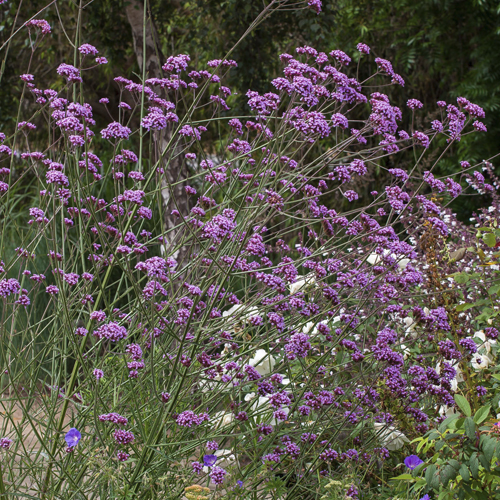
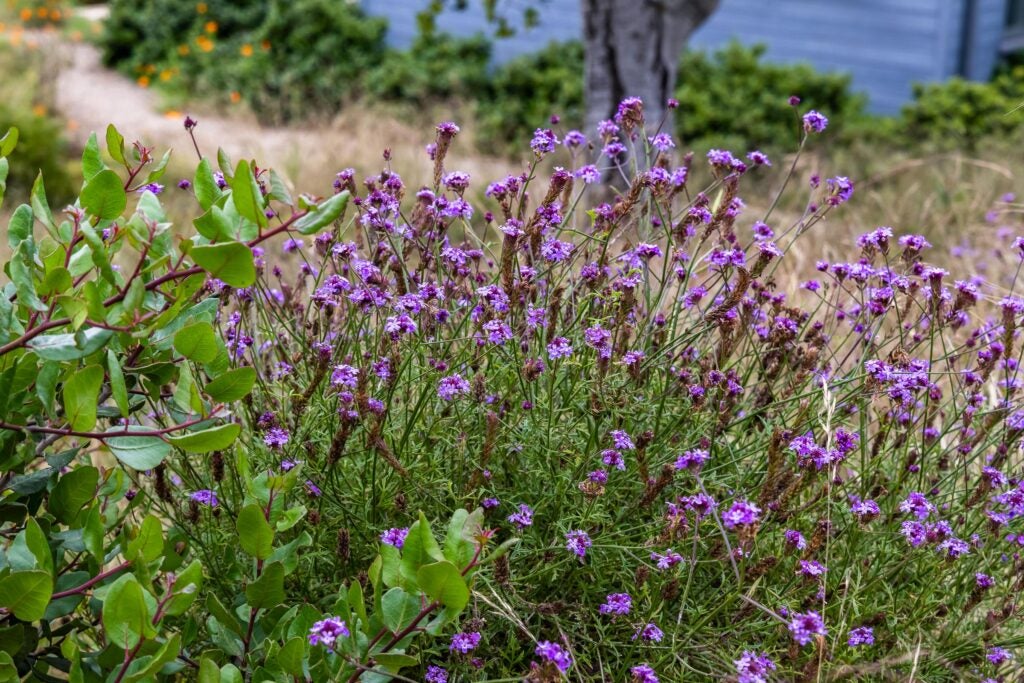
Fast-growing perennials that thrive in hot locations and produce clusters of small, showy flowers in summer.
Examples:
- V. bonariensis (3-6’ x 2-3’) is an upright perennial from South America with long, airy flower stalks. Reseeds readily and should not be planted near riparian areas where it can be invasive.
- Garden verbena (V. x hybrida, 6-12” x 2-3’) is a popular and showy groundcover available in many colors.
- Cedros Island verbena (V. lilacina ‘De La Mina’, 1-2’ x 2-3’) from the Cedros Island off the coast of Baja California is a popular native for its deep purple flower color and uniform growth habit.
- Water: Very LowLow
- Light: Full Sun
- Soil: Well Drained
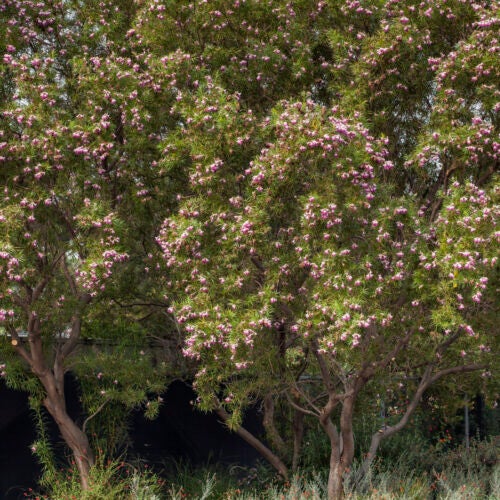
Chilopsis linearis is a deciduous shrub or small tree. Noted for fragrant, showy flowers in the spring and summer seasons. They are often multitrunked and fast-growing getting up to 15-30 feet tall and 10-20 feet wide. Holds foliage with occasional summer irrigation.
- Water: Very LowLow
- Light: Full Sun
- Soil: Well Drained
Diverse group of flowering, evergreen shrubs and perennials and annuals found throughout the western United States. Most available in nurseries are native to California and generally prefer drier sites. Flowers colors include yellow, white, pink, and red and are held above foliage in umbels that dry over time and are popular in flower arrangements. Buckwheats provide pollen and nectar for bees and butterflies, larval food for butterflies, seeds for birds, and cover for many creatures.
Examples:
- Santa Cruz Island buckwheat (E. arborescens, 3-4’ x 4-5’) densely mounded with white flowers.
- Saffron buckwheat (E. crocatum, 1-2’ x 2-3’) with chartreuse-yellow flowers and pale leaves.
- California buckwheat (E. fasciculatum, 2-3’ x 3’) and its low-growing cultivars such as E. f. ‘Warriner Lytle.’
- Catherine’s lace (E. giganteum, 4-8’ x 6-10’) with delicate, white flowers and soft pale leaves.
- Red-flowered buckwheat (E. grande var. Rubescens, 1-2’ x 2-3’) low-mounding perennial with rose-pink flowers, coastal bluff buckwheat (E. latifolium, up to 12” x 1-2’.)
- Sulfur buckwheat (E. umbellatum, 6-18” x 1-3’) with intense yellow flowers and cultivars E. u. var. aureum ‘Kannah Creek’ and E. u. Var. ‘Shasta Sulphur’.
- Water: Very LowLow
- Light: Full SunPartial Shade
- Soil: Well Drained
Group of succulent perennials with a characteristic rosette shape and chalky appearance that are mostly native to central and southern California where they grow on rocky outcroppings and coastal cliffs. Provide these plants with good drainage and afternoon shade in hotter areas. Larger forms can provide a striking accent plant in summer-dry gardens. Plant dudleyas at a slight angle to help water drain away.
Examples: giant chalk dudleya (D. brittonii, 12-18”), sand lettuce (D. caespitosa, up to 8”), bluff lettuce (D. farinosa, 4”, forms small colonies), chalk liveforever (D. pulverulenta, up to 2’).
- Water: Low
- Light: Full SunPartial Shade
- Soil: Well Drained
Manzanitas vary from carpet-forming groundcovers to small trees. Manzanitas have varying shades of striking, reddish brown bark and can provide structure to a garden. These plants have evergreen foliage, small white-to-pink, urn-shaped blossoms in late winter to early spring, and then small fruits that resemble tiny apples.
Groundcovers: A. ‘Emerald Carpet’ (1’ x 3-6’), A. ‘Pacific Mist’ (2-3’ x 6-8’), A. nummularia ‘Bear Belly’ (1’ x 3’), A. uva ursi ‘Radiant’ (6” x 4-6’), A. uva ursi ‘Wood’s Compct’ (1’ x 3’).
Shrubs: A. ‘Howard McMinn’ (5-7’ x 6-10’), A. ‘John Dourly’ (3-4’ x 5-6’), A. ‘Lester Rowntree’ (8-10’ x 10-15’), A. ‘Sunset‘ (5-7’), A. bakeri ‘Louis Edmunds’ (8-10’), A. manzanita ‘Sentinel’ (6-8’ x 5’), A. hookeri ‘Wayside’ (3′ x 8′).
Trees: A. manzanita ‘Dr. Hurd’ (10-15′)
- Water: Very LowLow
- Light: Full SunPartial Shade
- Soil: Well Drained
Evergreen shrub that has insignificant flowers followed by black berries. Flowers are attractive to pollinators, especially bees, and berries provide a food source for birds. Cultivars commonly sold in nurseries have differing growth habits and are often smaller than the species which grows 5-18’ x 10-18’.
Examples: F. c. ‘Eve Case’ (6-8’ x 6-8’), R. c. ‘Leatherleaf’ (5-6’ x 5-6’), R. c. ‘Mound San Bruno’ (6-8’ x 6-8’) with a dense, mounding growth habit.
Note: California coffeeberry was formerly classified as Rhamnus californica and is now classified as Frangula californica.
- Water: Low
- Light: Full SunPartial Shade
- Soil: Most Soils
Penstemons are a large group of woody or herbaceous perennials with narrow leaves and tubular flowers. Foothill penstemon is a widely known and grown California native with iridescent purple-blue flowers during spring and early summer that are attractive to hummingbirds. The cultivar known as ‘Margarita BOP’ is widely available, reliable, and garden- tolerant. Remove spent flower spikes to encourage more flowers.
- Water: Low
- Light: Full SunPartial Shade
- Soil: Well Drained
This native shrub has aromatic, softly hairy, lance-shaped to oval, gray-green to yellowish green leaves. Its flowers, which bloom in spring, are white with a lavendar tint. It grows 3-8 feet tall and 3-6 feet wide. If kept dry, it may drop leaves in the summer. It prefers sun along the coast but light shade inland and thrives in most well-drained soils.
- Water: Low
- Light: Full SunPartial Shade
- Soil: Well Drained
Salvias are a huge group of more than 900 species that include annuals, perennials, and shrubs adapted to a variety of climates and have varying water requirements. Salvias are attractive to hummingbirds, butterflies, and bees, and are generally ignored by deer. Sages that are native to California are generally drought-tolerant, prefer full sun, and little to no fertilizer. Annual pruning in late summer or fall generally helps to keep plants tidy and healthy.
CA native sages:
- S. apiana, white sage (3-4’ x 4-6’), silvery-white, aromatic leaves with tall flower spikes of white flowers, popular for honey production and in bundles as a natural incense.
- ‘Bee’s Bliss’ (1-2’ x 6-8’), superb, light gray groundcover with light purple flowers on long spikes; damp conditions can cause mildew which will clear with warm weather and sunny conditions.
- S. clevelandii, Cleveland sage (3-5’ x 3-5’), medium-sized shrub for hot, dry locations known for pleasant fragrance and deep blue whorls of flowers; popular cultivars include S. c. ‘Allen Chickering’, S. c. ‘Pozo Blue’, and S. c. ‘Winnifred Gilman’.
- S. leucophylla, purple sage, includes plants with both an upright growth habit, such as S. l. ‘Amethyst Bluff’ (3-5’ x 3-5’) and others with a sprawling form, such as S. l. ‘Point Sal’ (2-3’ x 6’), both of which are from Santa Barbara county.
- S. sonomaensis, Sonoma sage (1-2’ x 3-4’), groundcover that prefers light shade and will not tolerate damp conditions; cultivars include S. s. ‘Dara’s Choice’, S. s. ‘Greenberg Gray’, and S. s. ‘Hobbit Toes’.
- S. spathacaea, hummingbird sage (1-2’ spreading), herbaceous groundcover that grows well in dry shade and spreads slowly by underground rhizomes; large leaves have a wonderful fruity fragrance; the only red-flowered native sage.
- S. mellifera, black sage (6′ x 10′), evergreen shrub that grows well in full sun and well drained soils. Dark green leaves with pale purple flowers in late spring and early summer.
Non-native sages:
- S. chamaedryoides, germander sage (2-3’)
- S. chiapensis, Chiapas sage (1-2’ x 3-4’)
- S. greggii, autumn sage (1-4’ x 1-4’)
- S. leucantha, Mexican bush sage (3-4’ x 3-6’)
- S. microphylla, cherry sage (3-4’ x 3-6’)
- S. officinalis, garden sage (1-3’ x 1-3’)
- Water: Very LowLowModerate
- Light: Full SunPartial Shade
- Soil: Well Drained
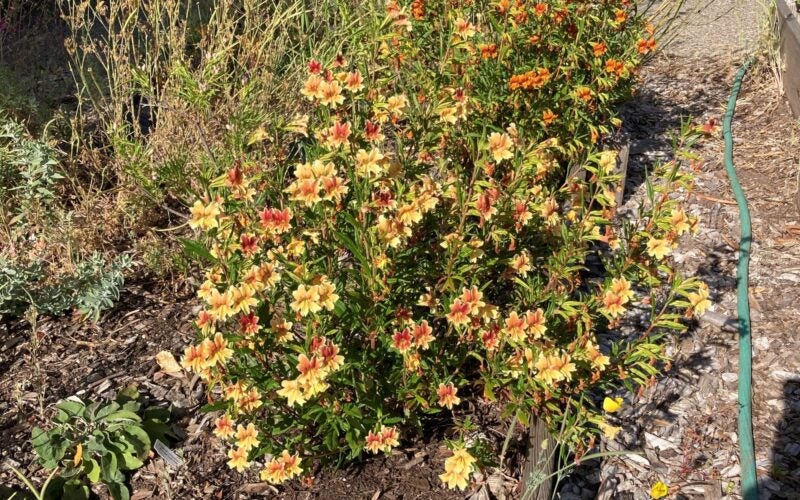
The orange, tubular flowers of sticky monkey flower can be enjoyed in many locations throughout Sonoma and Marin counties in spring and summer, a testament to how well this plant is adapted to hot and dry conditions. The slightly sticky leaves benefit from light pinching and pruning to maintain an attractive appearance and support for the beautiful flowers. Many hybrids provide color variation. Do not confuse this plant with the red-flowered scarlet monkey flower (Mimulus cardinalis), an herbaceous riparian plant that requires regular water to thrive.
- Water: Very Low
- Light: Full SunPartial Shade
- Soil: Sandy