Sonoma Garden Park
BACK TO FULL TOUR
Garden Features
Drought Tolerant
Edible Garden
California Natives
Drip Irrigation
Pesticide Free
Rainwater Harvesting System
Rain Garden
Sheet Mulching
Wildlife Habitat
Partner: Sonoma Ecology Center
At Sonoma Garden Park, our dedication to cultivating a vibrant and sustainable environment is evident in every corner. Over the years, we have meticulously developed the garden, blending organic principles with community engagement. Visitors will find themselves immersed in a diverse tapestry of plant life, from native species to carefully curated botanical wonders. Our garden development emphasizes biodiversity, creating a harmonious ecosystem that supports local flora and fauna.
Sonoma Garden Park is more than just a collection of plants; it’s a living showcase of sustainable practices and educational opportunities. Wander through themed gardens that celebrate the richness of Sonoma’s agricultural heritage. Engage with our knowledgeable staff and volunteers who are passionate about sharing insights on permaculture, water conservation, and eco-friendly gardening. The park features interactive workshops, events, and demonstrations, inviting individuals of all ages to deepen their connection with nature.
Explore the labyrinth of pathways adorned with vibrant blooms, leading you to hidden nooks designed for quiet contemplation. The community gathering spaces provide a backdrop for shared experiences, fostering connections among neighbors and friends. As you meander through Sonoma Garden Park, you’ll discover the perfect blend of serenity and inspiration.
Central to our ethos is a commitment to responsible water use. Sonoma Garden Park exemplifies water-wise gardening practices, showcasing how lush landscapes can coexist with conservation efforts. Through innovative irrigation systems, rainwater harvesting, and drought-resistant plant selections, we demonstrate that sustainable landscaping is not just a concept but a thriving reality. Our educational programs emphasize the importance of water conservation, empowering visitors to implement eco-conscious practices in their own homes.
Special Events
Plants in this Garden
-
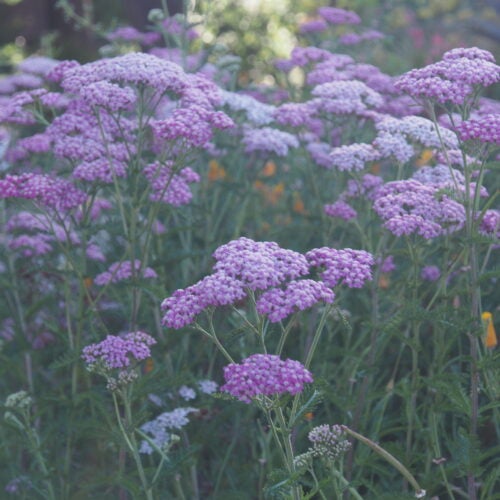
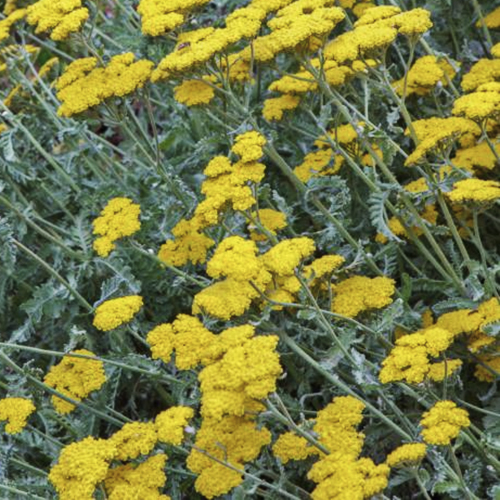
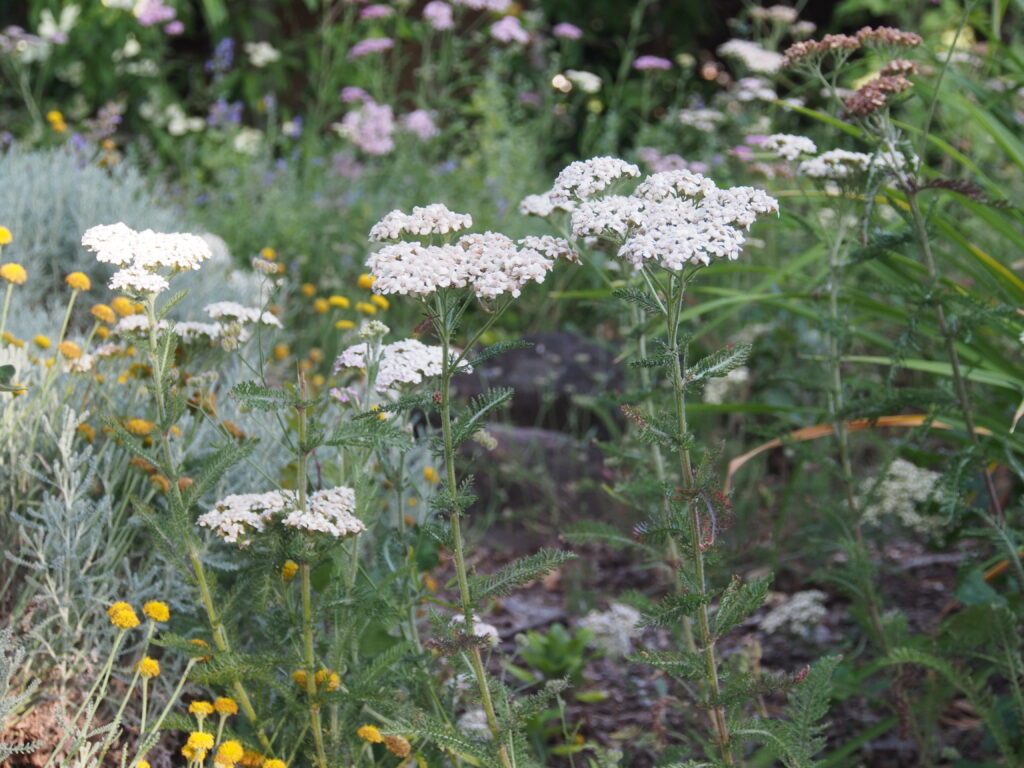
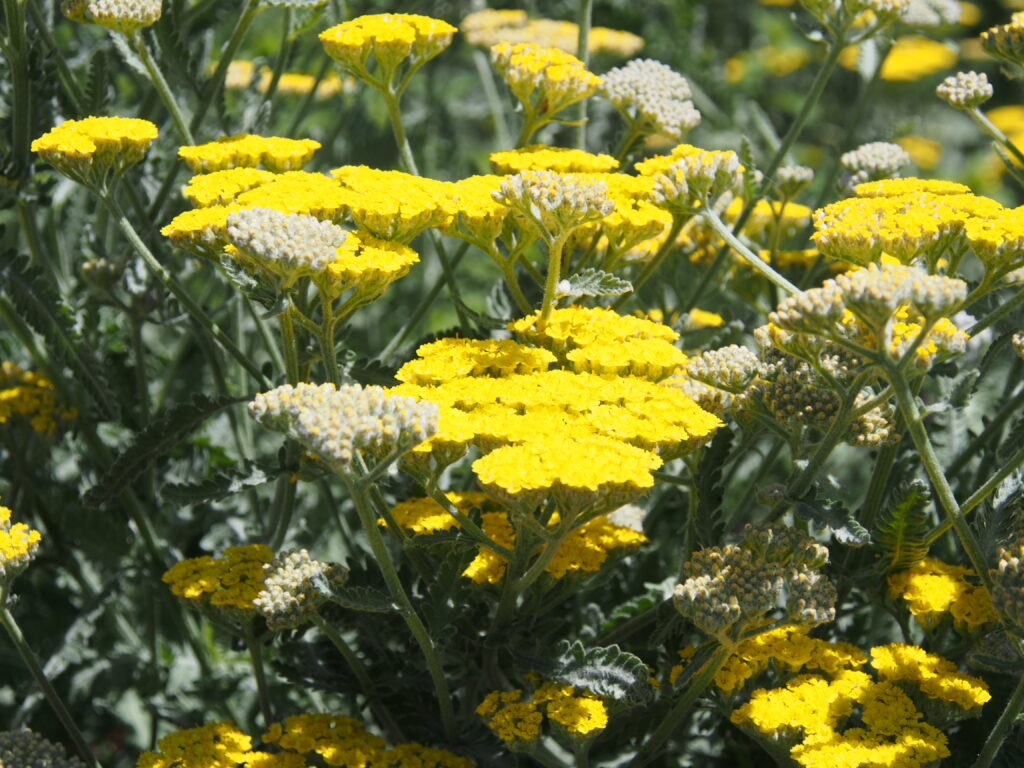
Achillea spp & cvs Yarrow
-
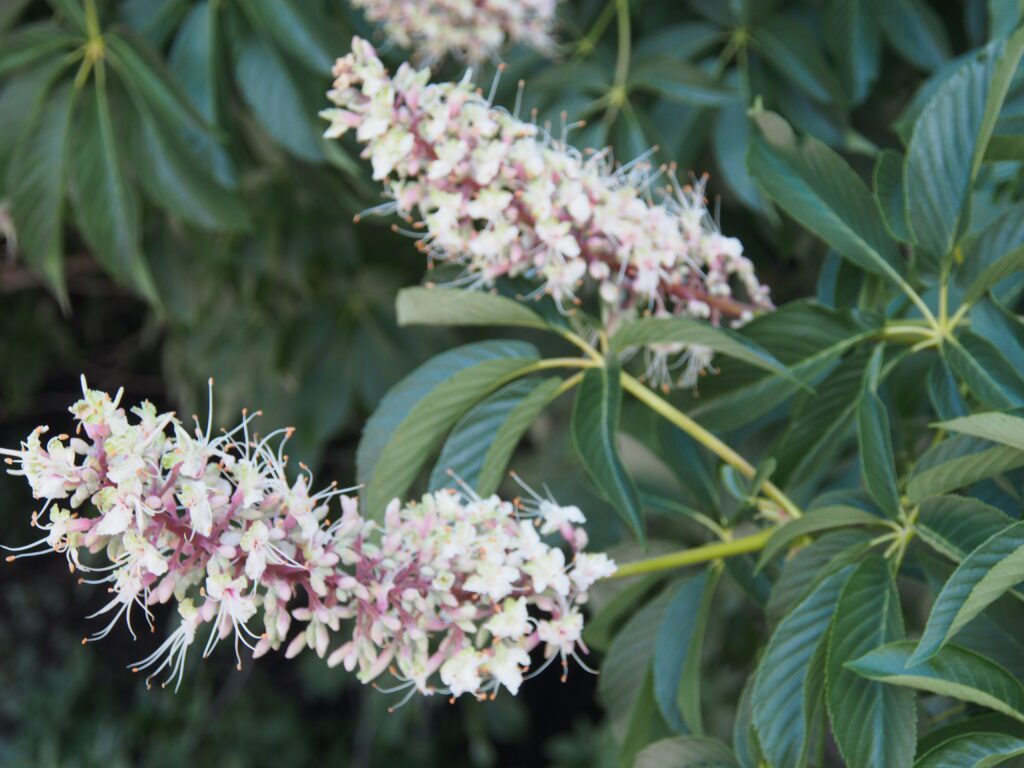
Aesculus californica California Buckeye
-
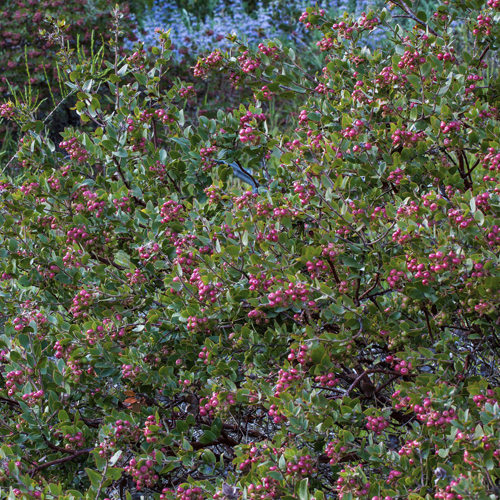
Arctostaphylos spp & cvs Manzanita, 'Dr. Hurd'
-
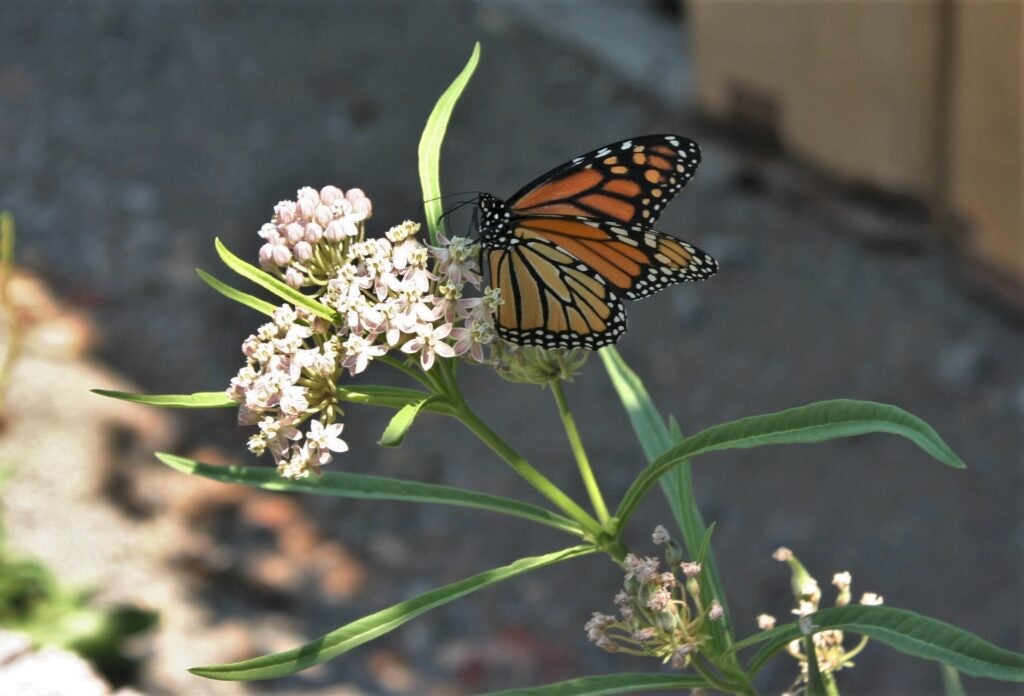
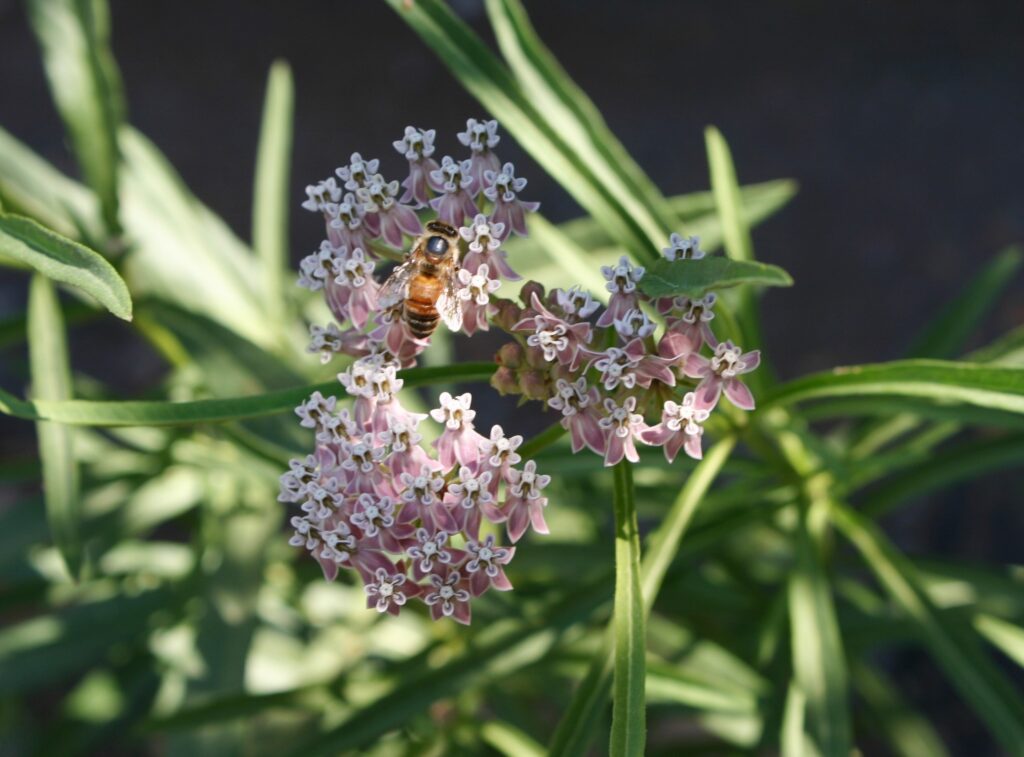
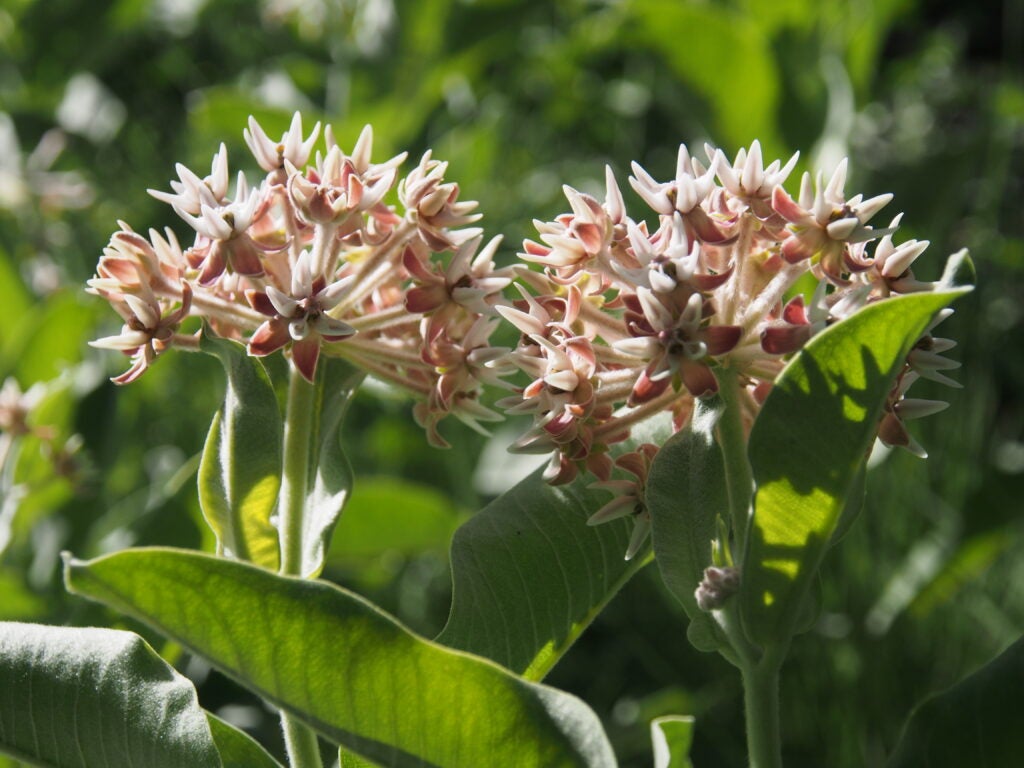
Asclepias spp Milkweed
-
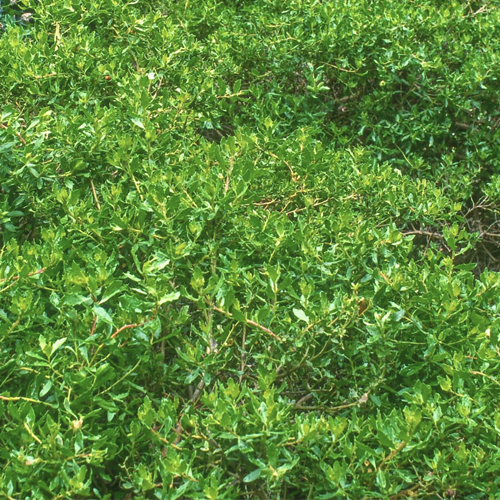
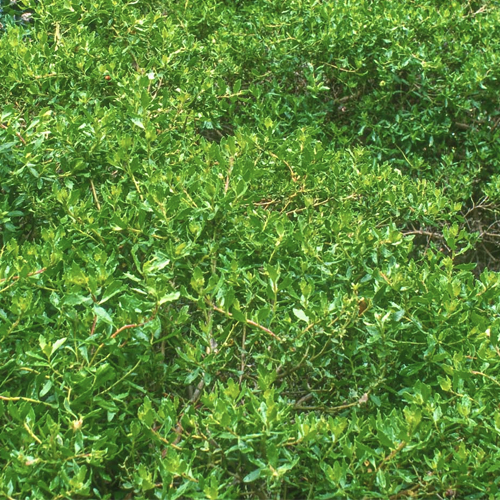
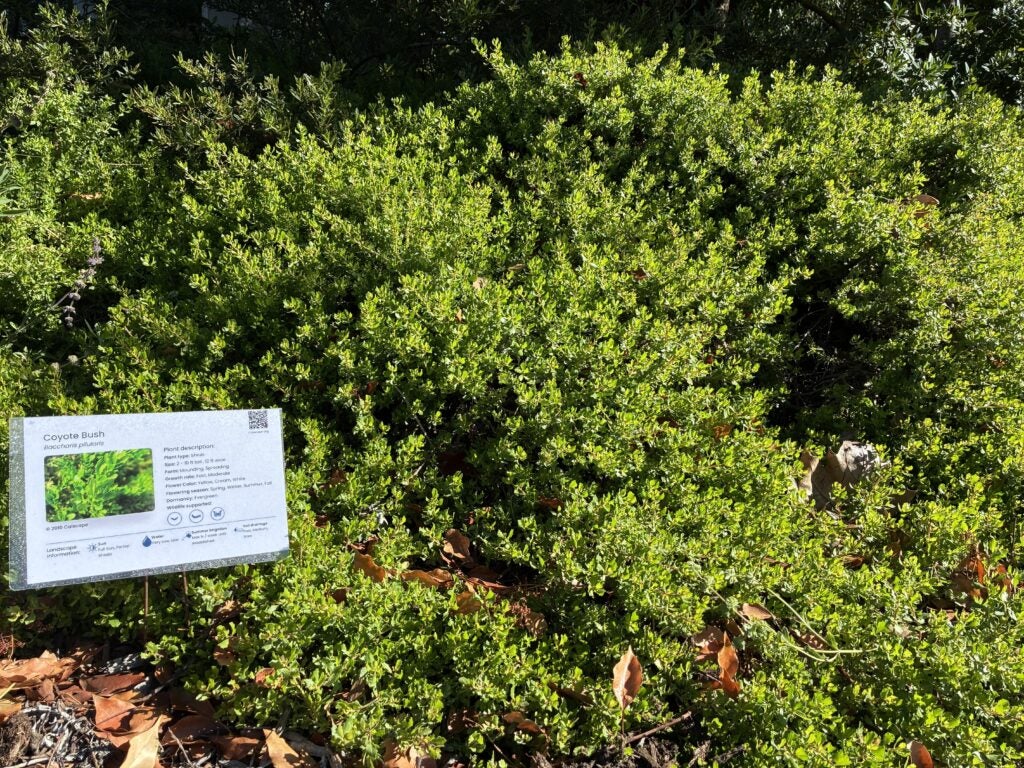
Baccharis pilularis & cvs Dwarf Coyote Bush
-
Festuca spp Fescue
-
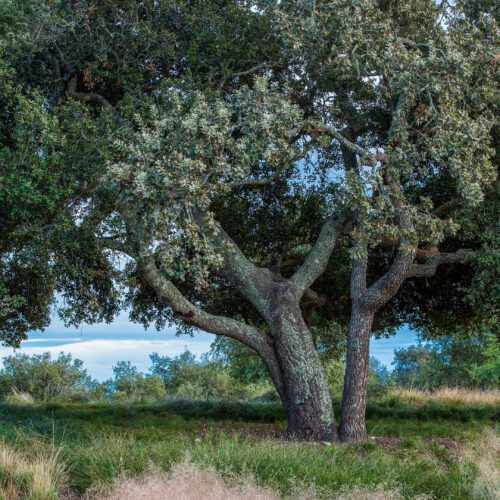
Quercus agrifolia Coast Live Oak
-
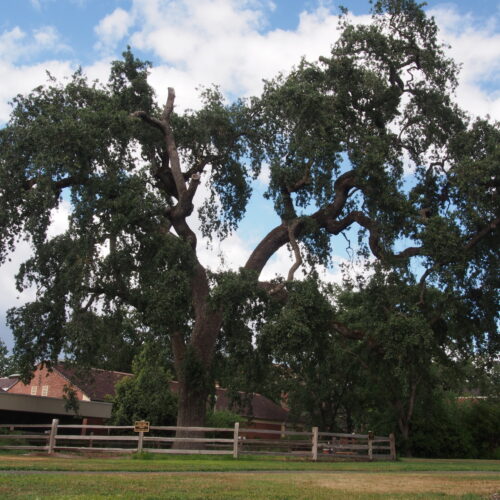
Quercus lobata Valley Oak
-
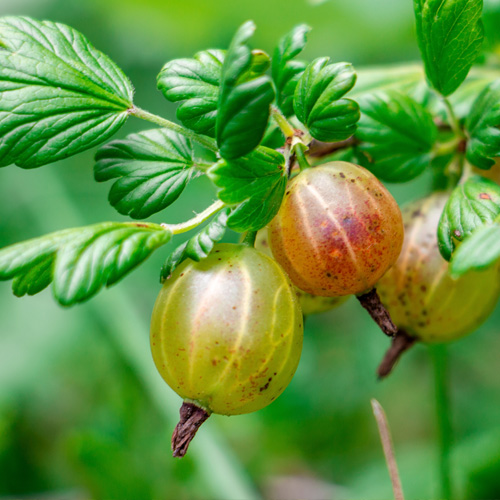
Ribes spp Currant, Gooseberry
-
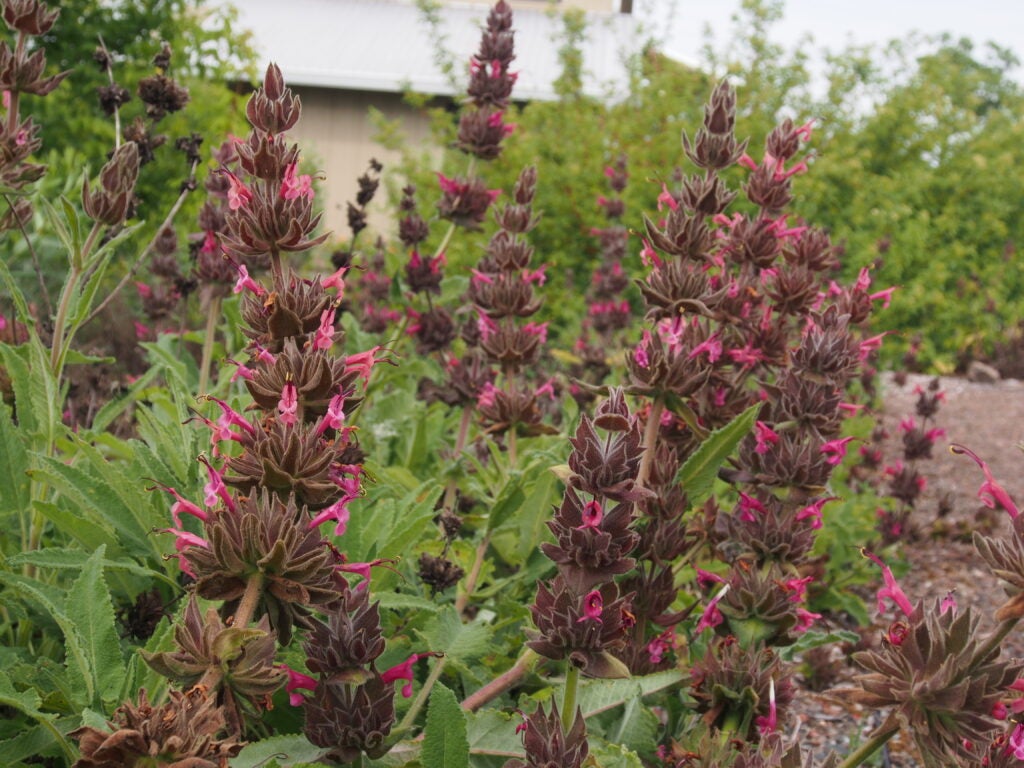
Salvia spp Sage
-
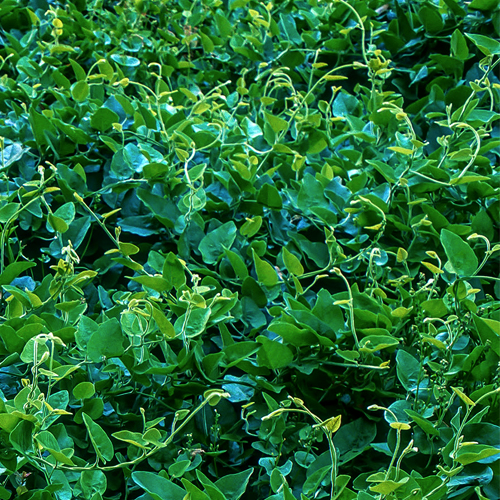
Aristolochia californica California Pipevine
-
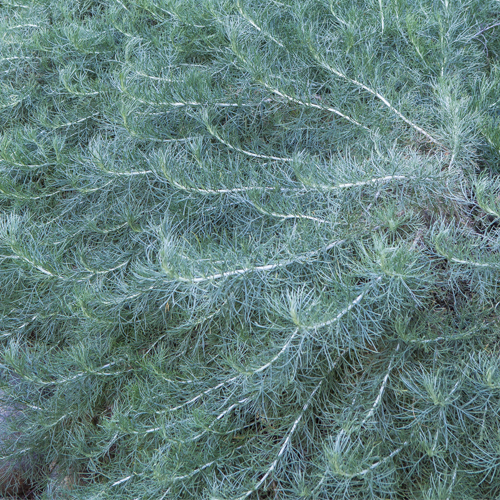
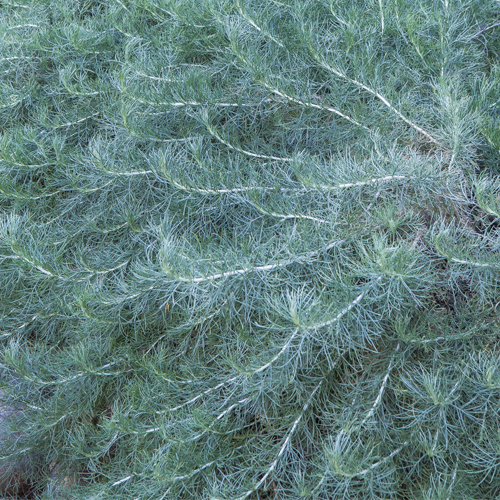
Artemisia ssp Sagebrush, Wormwood
-
Ceanothus spp & cvs Ceanothus
-
Zauschneria [Epilobium] spp California Fuchsia
-
Eriogonum spp Buckwheat
-
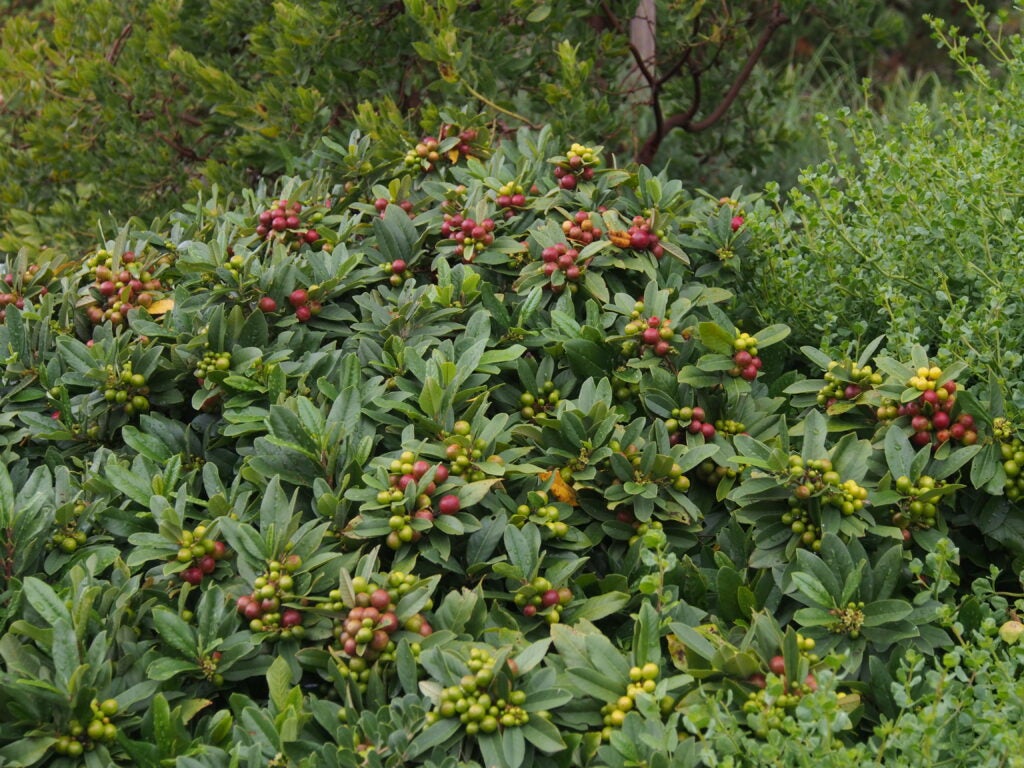
Rhamnus [Frangula] californica Coffeeberry
-
Heteromeles arbutifolia Toyon
-
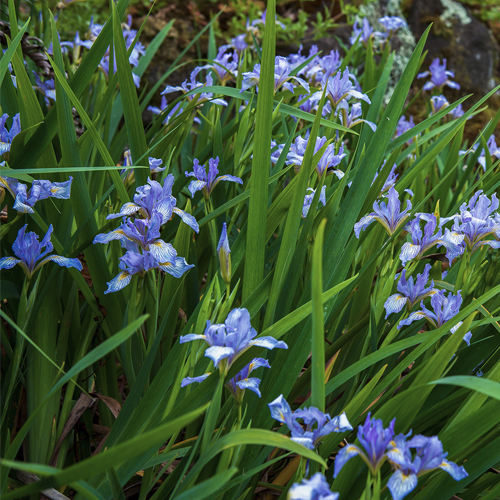
Iris douglasiana & cvs Douglas Iris, Pacific Coast Hybrids
-
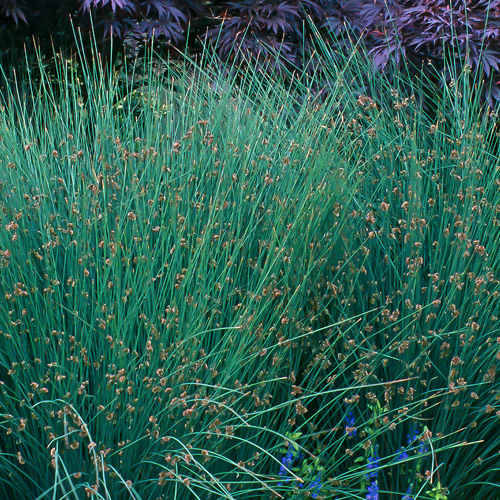
Juncus patens California Grey Rush
-
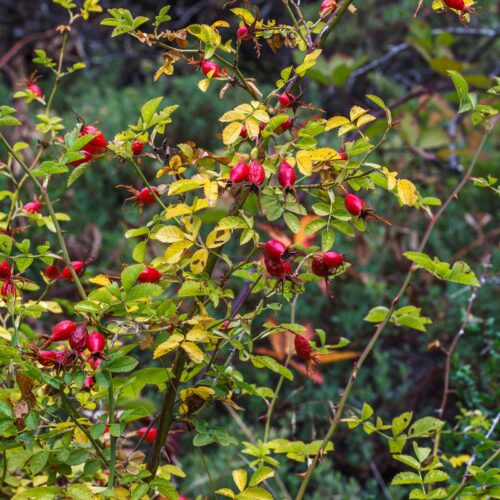
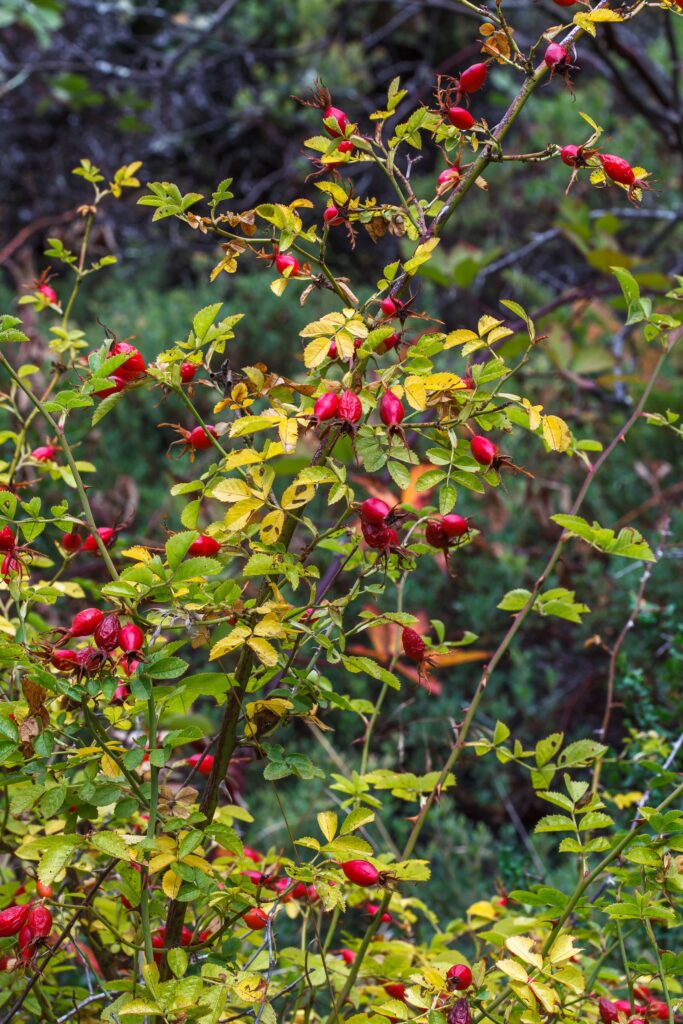
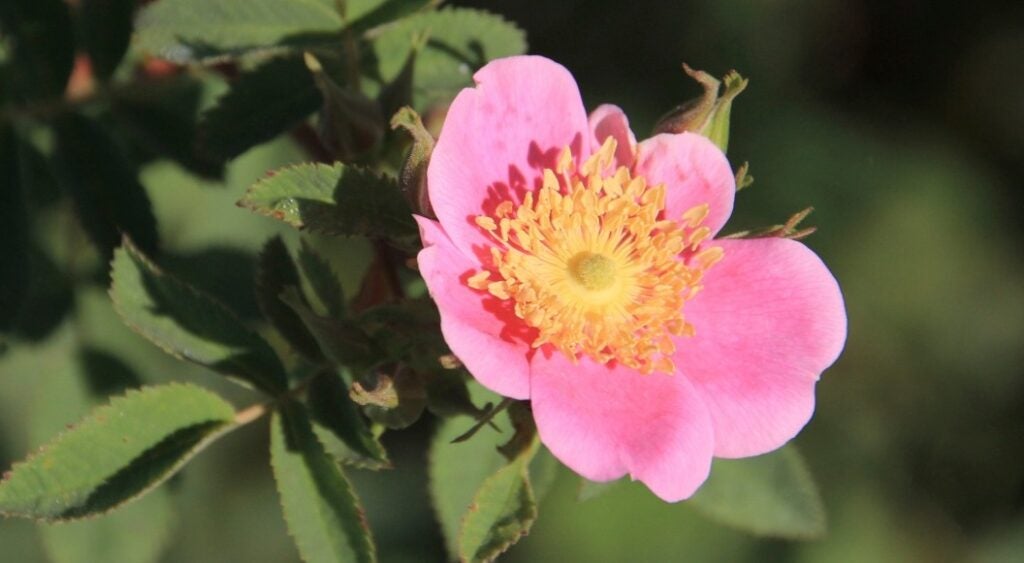
Rosa californica California Wild Rose
-
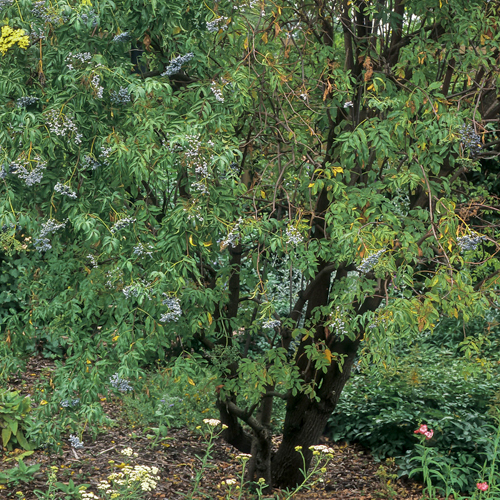
Sambucus spp Elderberry
-
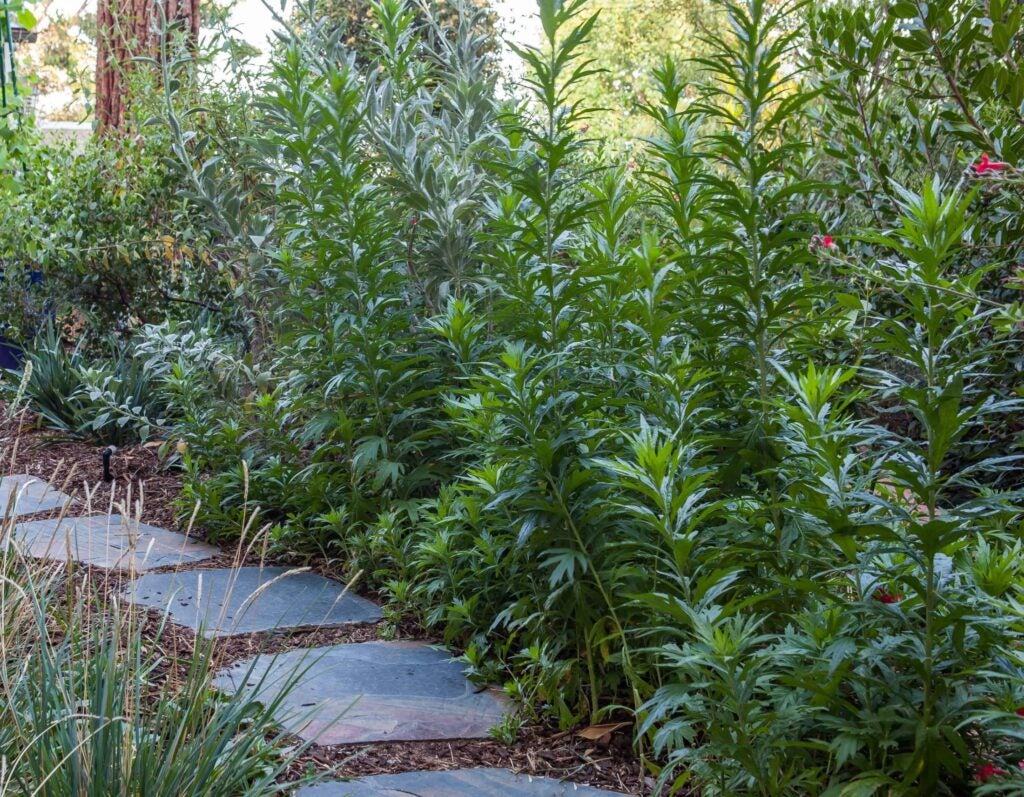
Solidago velutina californica California Goldenrod
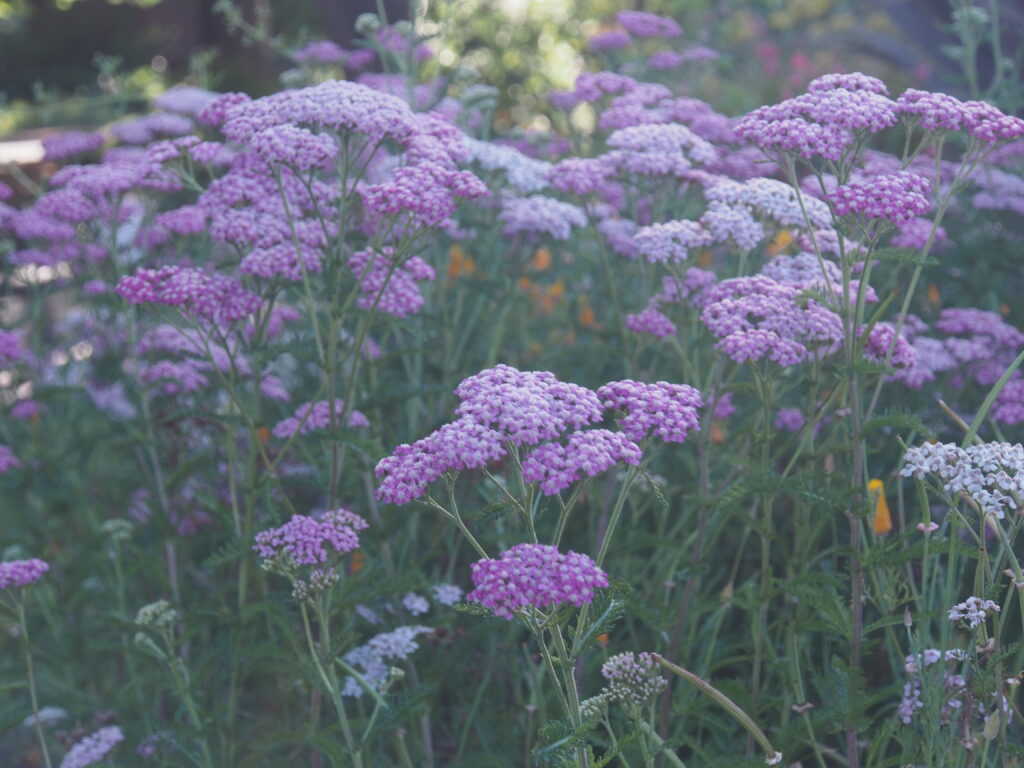
Yarrows are variable low-growing, spreading herbaceous perennials with finely divided leaves that inhabit many temperate regions in the Northern Hemisphere. Flattish clusters of flowers form in spring and well into summer and provide an important nectar source for pollinators and insects. Yarrow can help to stabilize slopes and is a good addition to the upper level of rain gardens and swales. Colors include yellow, pink, and red.
California native spp & cvs: A. millefolium (common yarrow), A. m. ‘Calistoga’, A. m. ‘Island Pink’, A. m. ‘Sonoma Coast’, A. m. ‘Terracotta’.
Other yarrows: A. filipendulina (fern leaf yarrow), A. f. ‘Coronation Gold’, A. ‘Moonshine’, A. tomentosa (woolly yarrow).
- Water: Low
- Light: Full SunPartial Shade
- Soil: Most Soils
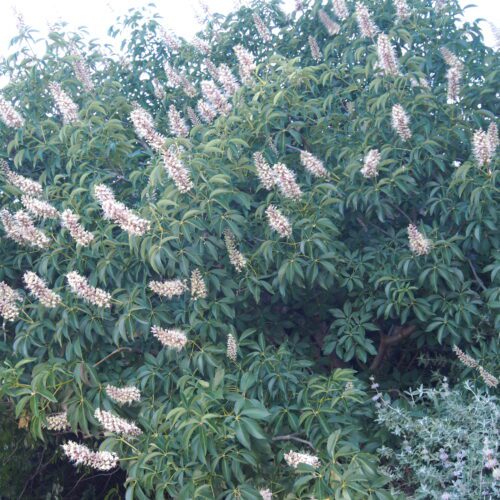
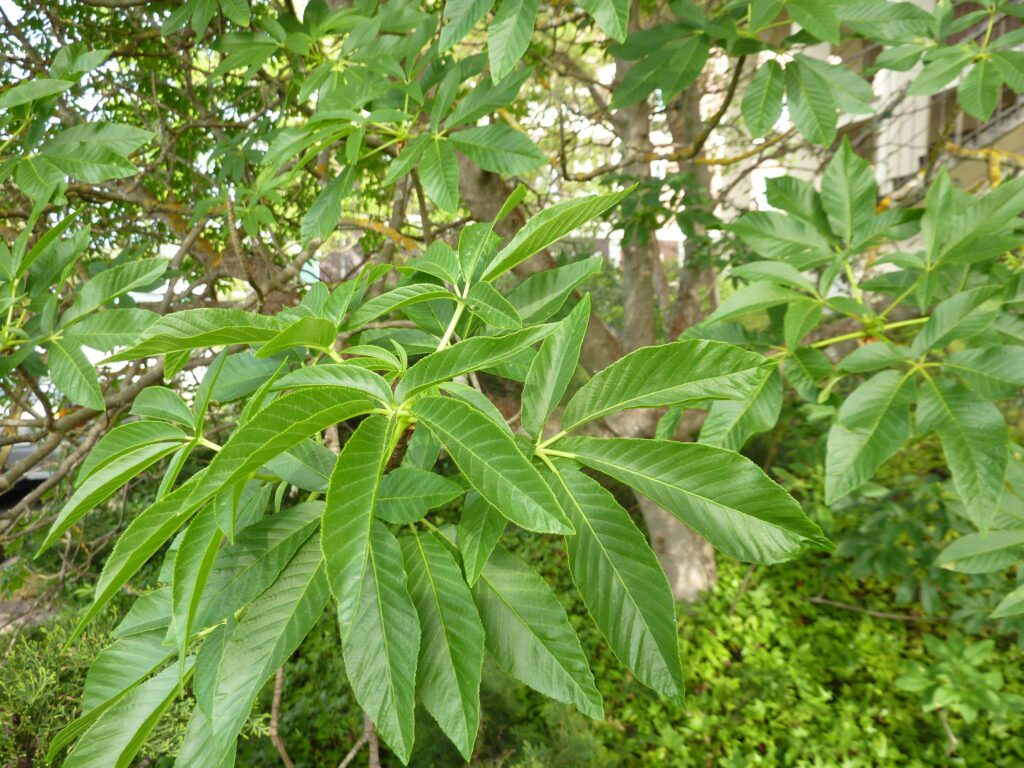
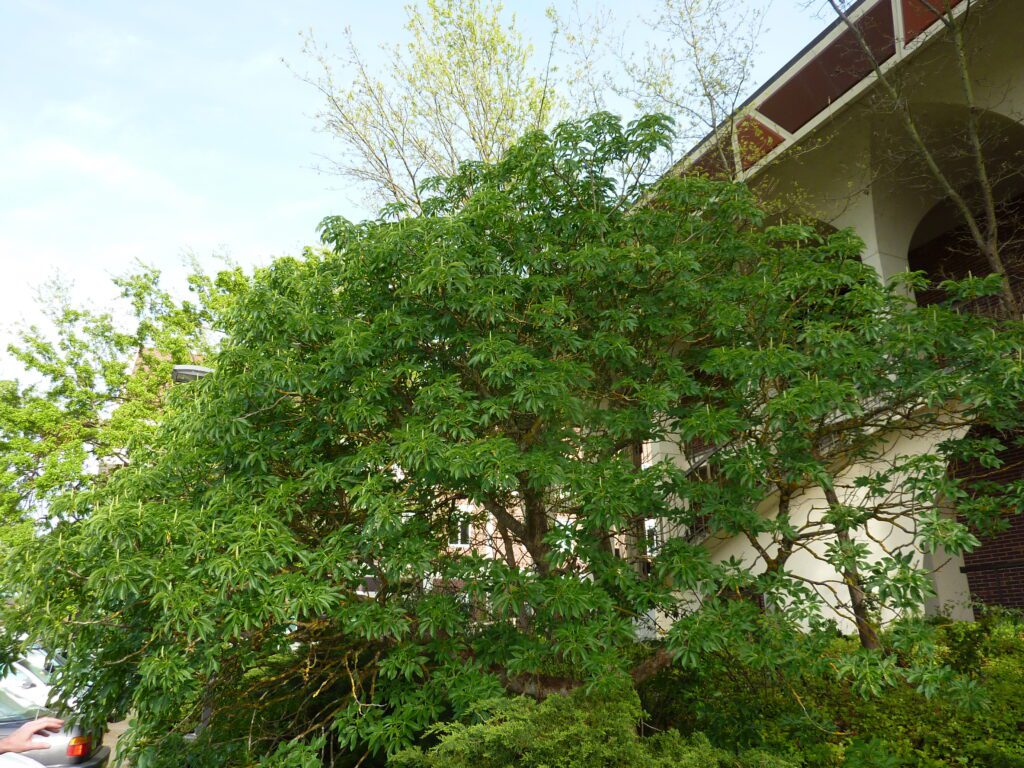
Large, multi-trunked shrub or small tree. Silvery gray bark with green leaves and clusters of fragrant white flowers. Summer deciduous, defoliating in early July and growing during wet winter and spring months. Only buckeye native to California, small trees are found in Southern regions while large shrubs are found in Northern regions.
- Water: Very Low
- Light: Full Sun
- Soil: Well Drained
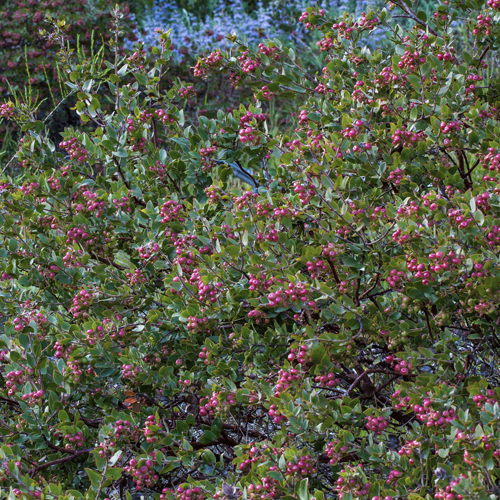
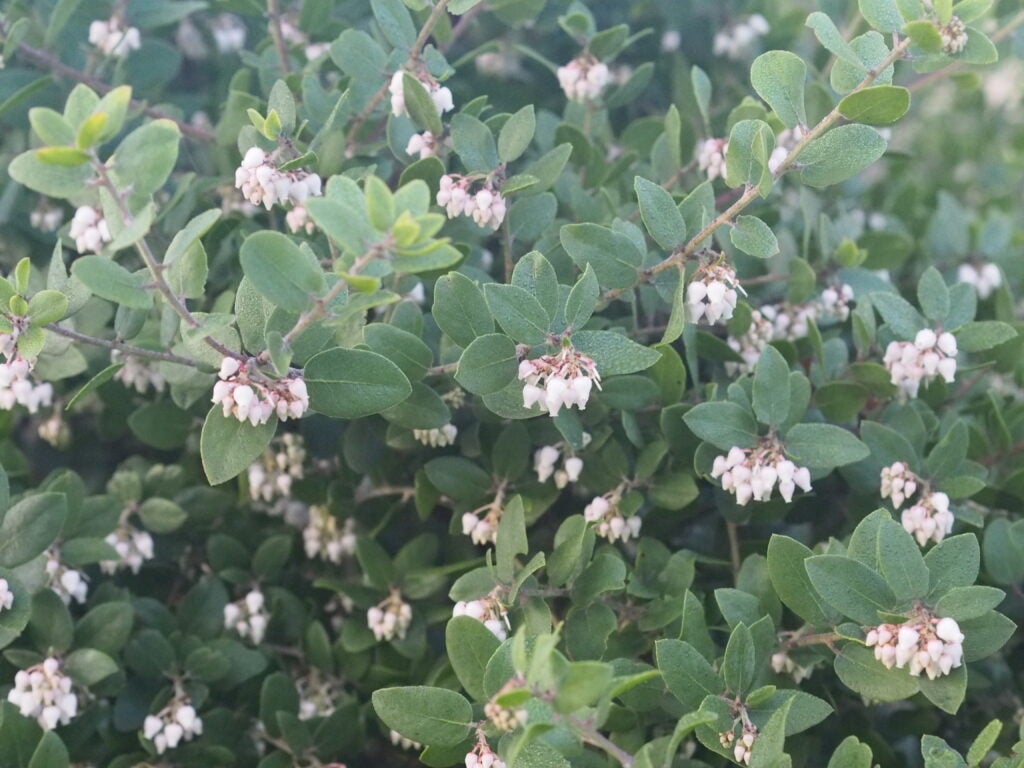
Manzanitas vary from carpet-forming groundcovers to small trees. Manzanitas have varying shades of striking, reddish brown bark and can provide structure to a garden. These plants have evergreen foliage, small white-to-pink, urn-shaped blossoms in late winter to early spring, and then small fruits that resemble tiny apples.
Groundcovers: A. ‘Emerald Carpet’ (1’ x 3-6’), A. ‘Pacific Mist’ (2-3’ x 6-8’), A. nummularia ‘Bear Belly’ (1’ x 3’), A. uva ursi ‘Radiant’ (6” x 4-6’), A. uva ursi ‘Wood’s Compct’ (1’ x 3’).
Shrubs: A. ‘Howard McMinn’ (5-7’ x 6-10’), A. ‘John Dourly’ (3-4’ x 5-6’), A. ‘Lester Rowntree’ (8-10’ x 10-15’), A. ‘Sunset‘ (5-7’), A. bakeri ‘Louis Edmunds’ (8-10’), A. manzanita ‘Sentinel’ (6-8’ x 5’), A. hookeri ‘Wayside’ (3′ x 8′).
Trees: A. manzanita ‘Dr. Hurd’ (10-15′)
- Water: Very LowLow
- Light: Full SunPartial Shade
- Soil: Well Drained
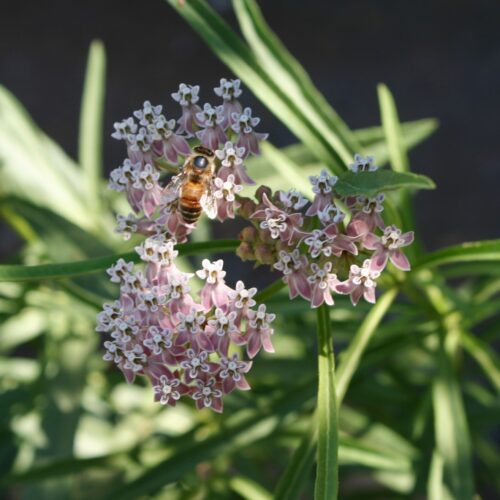
Colony-forming, herbaceous perennials with several species providing important habitat and larval food sources for the monarch butterfly while attracting a diverse array of insects.
California milkweeds remain dormant during the colder months. Stems that emerge in April or May bear clusters of small, star-like flowers in summer followed by silky-tailed seeds that are dispersed by wind. A. fascicularis (narrow-leaved milkweed, 1-3’) is the preferred food source for monarch larvae. A. speciosa (showy milkweed, 2-4’) has larger, soft foliage, showier flower clusters, and is also a food source for monarch larvae. A. cordifolia (heart leaf milkweed, 1-2′) has heart-shaped leaves and is also a food source for monarch larvae.
- Water: Low
- Light: Full SunPartial Shade
- Soil: Most Soils
Flowers are inconspicuous but provide a source of pollen, nectar, and seeds for wildlife. Shrubby varieties can be cut back to maintain a more tidy and compact appearance. Perennial varieties can be divided in fall or early spring. Excellent choice as support for more showy plants in the garden.
- Water: Low
- Light: Full Sun
- Soil: Most Soils
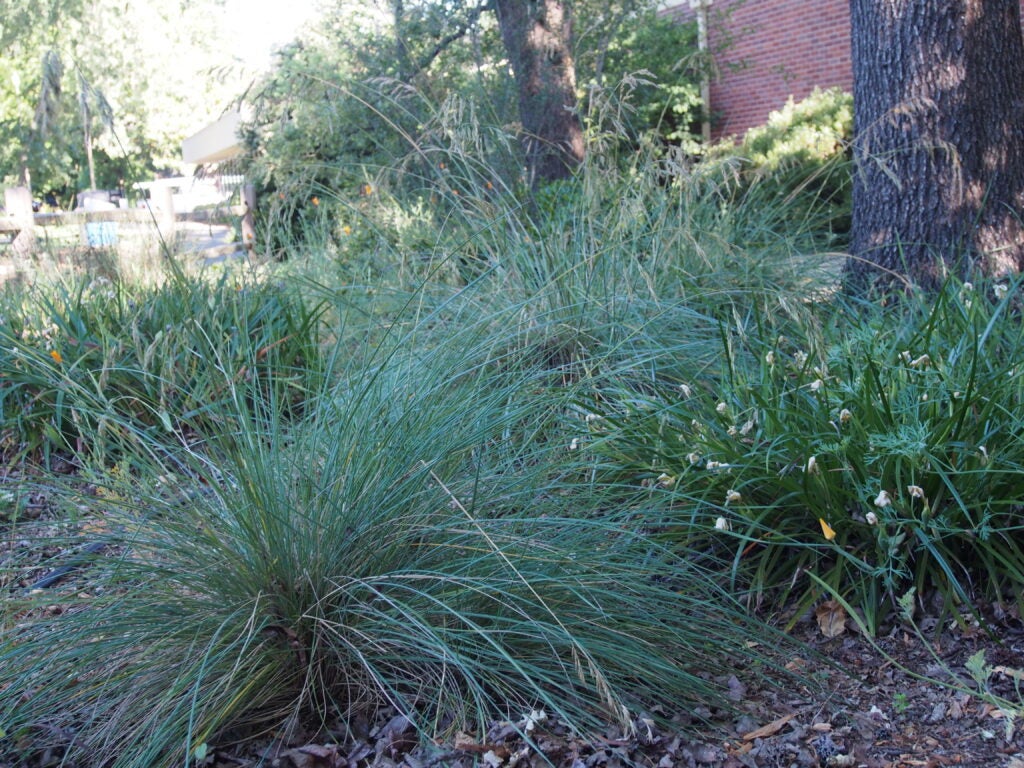
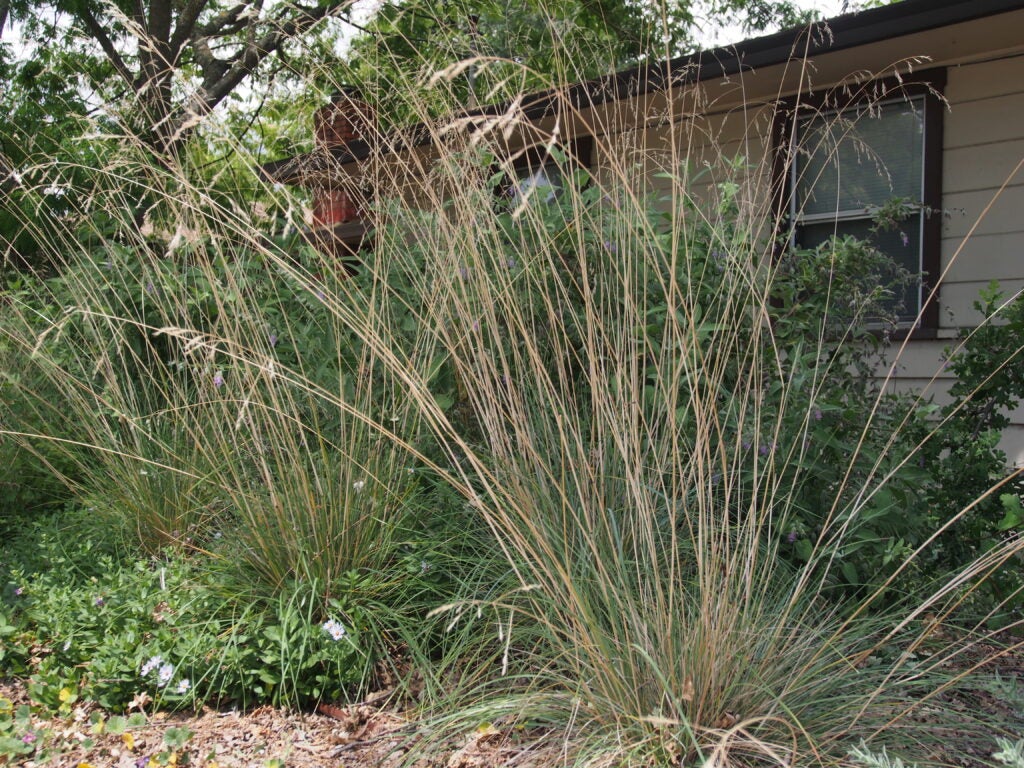
Large group of mostly cool-season, perennial, bunching or spreading grasses. Bunch grass varieties can be used as a no-mow lawn replacement, help to stabilize slopes, and have ornamental value. Festuca californica (California fescue, 1-2’ wide x 2’) prefers part shade and works wonderfully massed under the dry shade of native oaks. Festuca glauca (blue fescue, 1’ x 1’) is a small, clumping grass with bluish gray-green leaves. Festuca idahoenis (Idaho fescue, 1-2’ wide x 1’) also has bluish gray-green leaves and is more drought-tolerant and longer lived than blue fescue. Festuca rubra (red fescue) grows from rhizomes and has long, fine-textured leaves that lay over to form a pleasing drift effect as a no-mow lawn.
- Water: Very LowLow
- Light: Full SunPartial Shade
- Soil: Well Drained
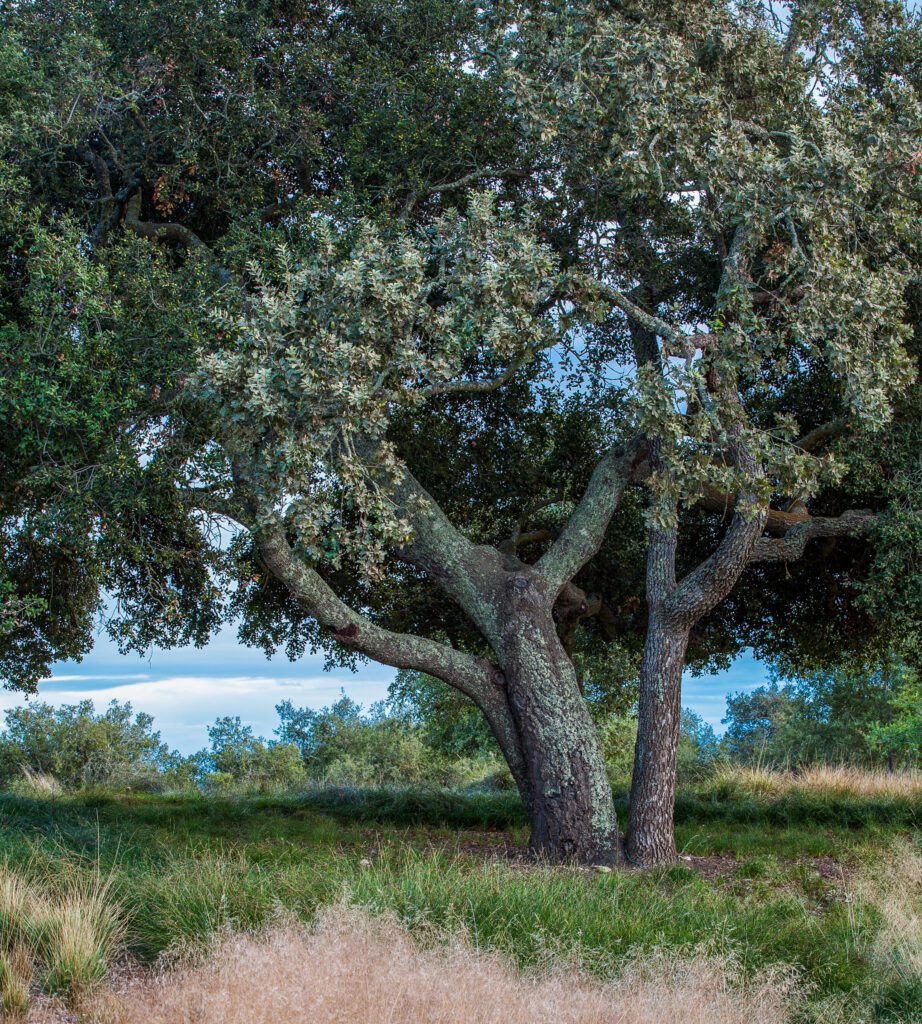
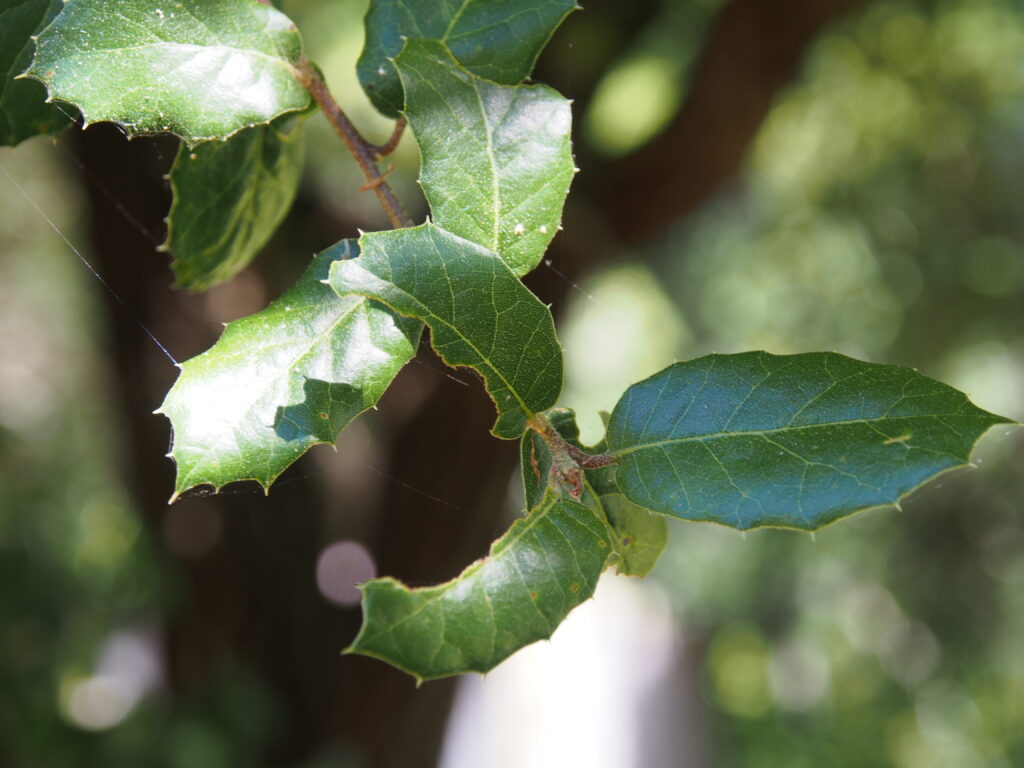
Woody perennial, evergreen tree. Large, dense and broadly rounded with green, spiny margin leaves. Native along coast and coastal mountains from Northern California. One of the best local natives for large properties. Susceptible to Sudden Oak Death.
- Water: Very Low
- Light: Full Sun
- Soil: Well Drained
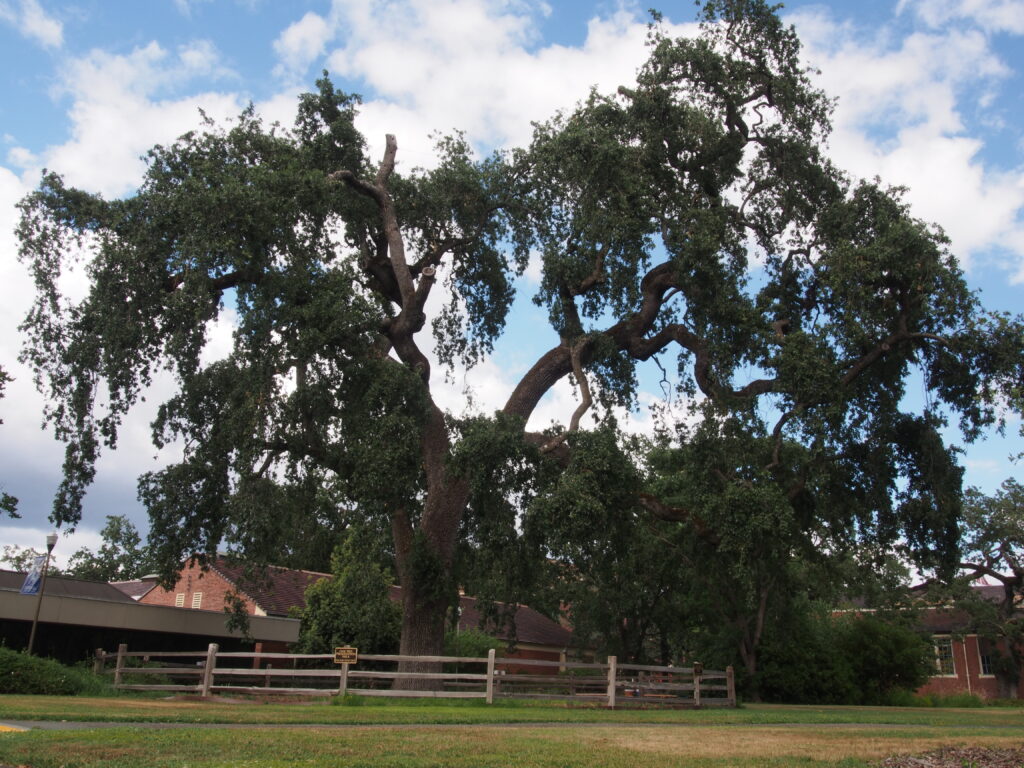
Woody perennial, deciduous tree. Fast growing and one of the best local natives for large properties. Dark green leaves and dark brown to pale gray, ridged bark. Not susceptible to Sudden Oak Death.
- Water: Low
- Light: Full Sun
- Soil: Well Drained
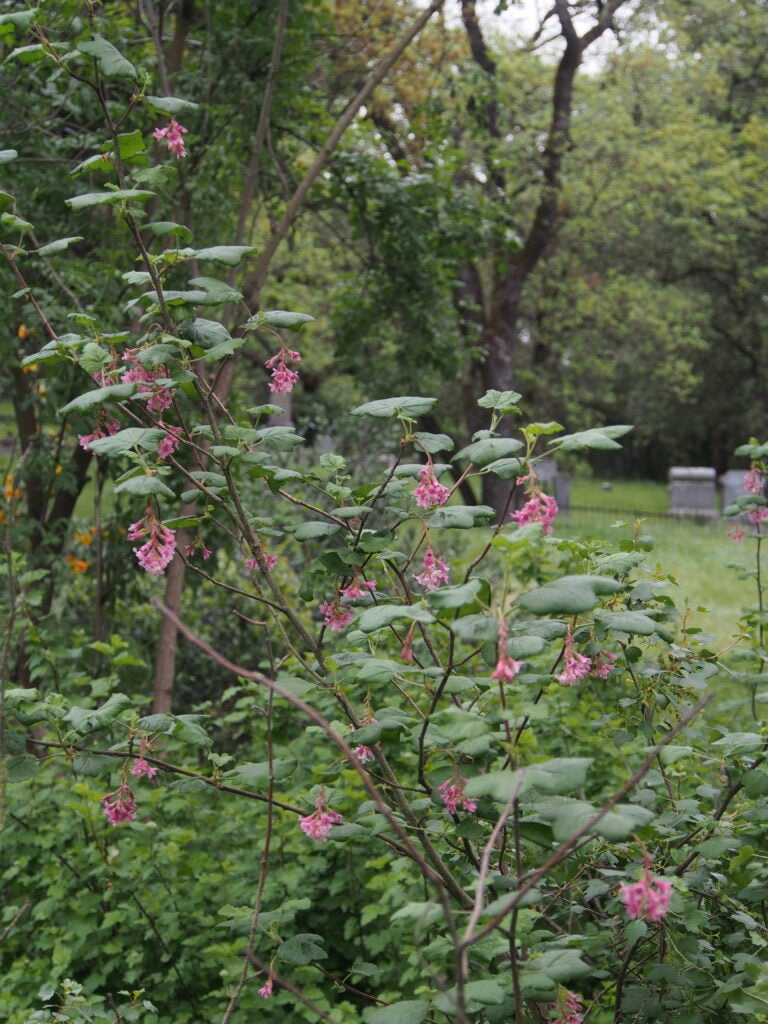
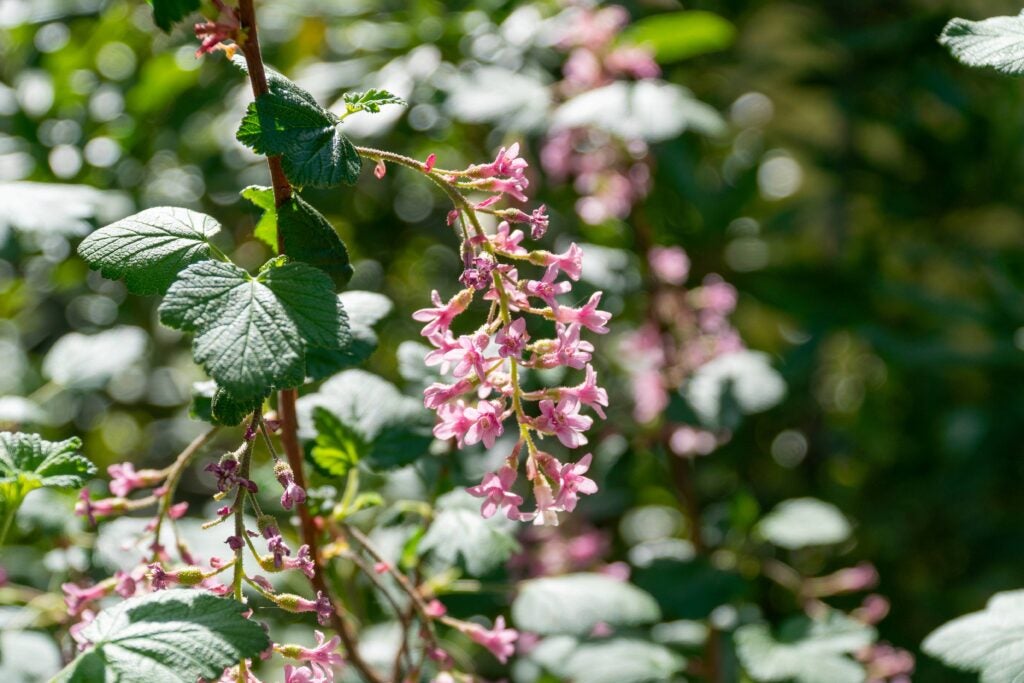
Currants (without spines) and gooseberries (with spines) are grown for their graceful growth habit, attractive foliage, wonderful displays of pendulous flowers in winter-spring that are attractive to hummingbirds, and colorful fruit that provides a food source for birds. Most of the species listed are deciduous, going dormant in the summer months.
Examples: Some of the species suitable for California gardens, preferably with partial shade, are native to the Western United States:
- aurem, golden currant (5-10’ x 3-6’), deciduous with small clusters of delicate yellow flowers and sprawling habit.
- malvaceum, chaparral currant (4-8’ x 4-6’), deciduous with early clusters of pink flowers, a slightly vase-shaped habit, and more drought-tolerant than most species.
- sanguineum var. glutinosum, pink-flowering currant (5-12’ x 5-12’), deciduous with maple-like leaves, a vase-shaped habit, and long pendulous clusters of pink, reddish, or white flowers in the spring; many available cultivars such as ‘Claremont’, ‘Tranquillon Ridge’, and ‘White Icicle’.
- speciosum, fuchsia-flowered gooseberry (4-8’ x 6-10’), deciduous with spiny, arching stems and bright red fuchsia-like flowers along the stems in the spring that are attractive to hummingbirds.
- viburnifolium, evergreen currant or Catalina perfume (2-4’ x 5-7’), evergreen groundcover that works well under oaks and can provide erosion control to slopes.
- Water: Very LowLow
- Light: Full SunPartial ShadeShade
- Soil: Well Drained
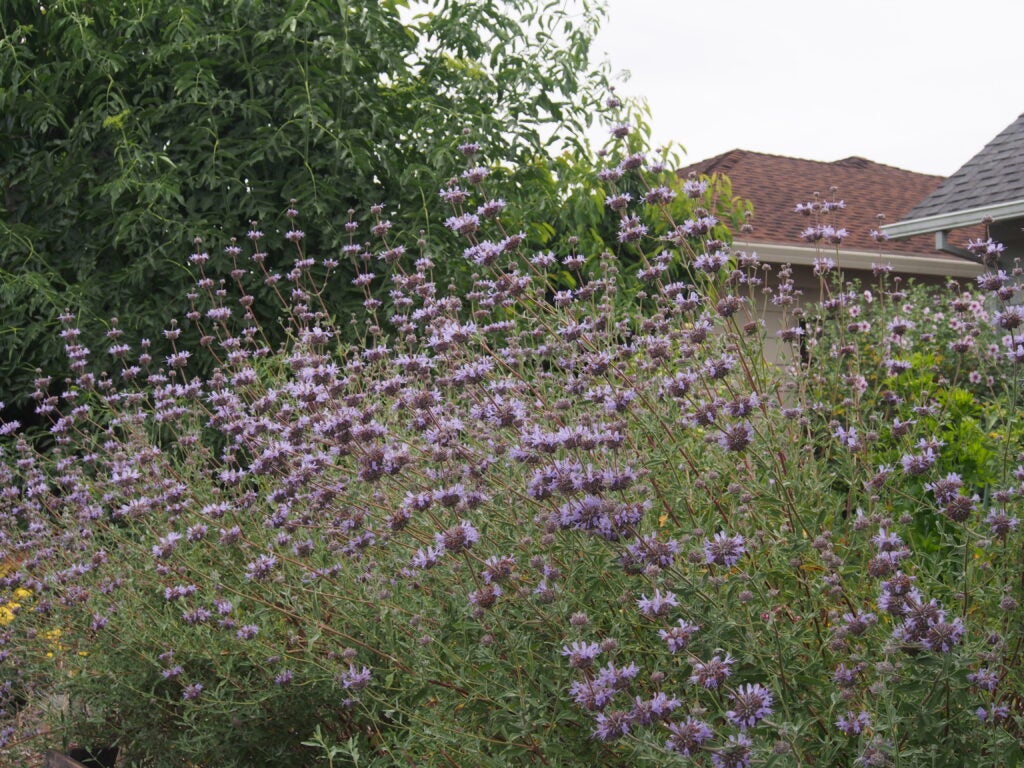
Salvias are a huge group of more than 900 species that include annuals, perennials, and shrubs adapted to a variety of climates and have varying water requirements. Salvias are attractive to hummingbirds, butterflies, and bees, and are generally ignored by deer. Sages that are native to California are generally drought-tolerant, prefer full sun, and little to no fertilizer. Annual pruning in late summer or fall generally helps to keep plants tidy and healthy.
CA native sages:
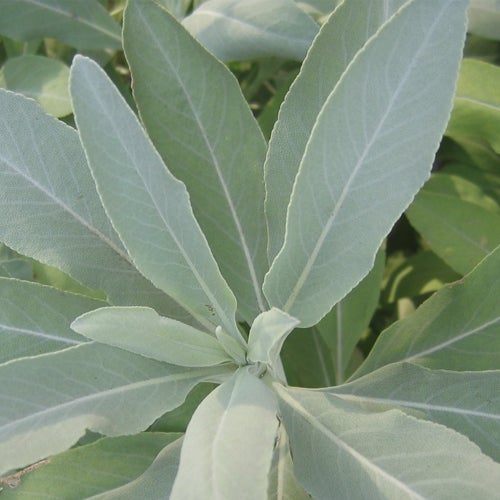
- S. apiana, white sage (3-4’ x 4-6’), silvery-white, aromatic leaves with tall flower spikes of white flowers, popular for honey production and in bundles as a natural incense.
- ‘Bee’s Bliss’ (1-2’ x 6-8’), superb, light gray groundcover with light purple flowers on long spikes; damp conditions can cause mildew which will clear with warm weather and sunny conditions.
- S. clevelandii, Cleveland sage (3-5’ x 3-5’), medium-sized shrub for hot, dry locations known for pleasant fragrance and deep blue whorls of flowers; popular cultivars include S. c. ‘Allen Chickering’, S. c. ‘Pozo Blue’, and S. c. ‘Winnifred Gilman’.
- S. leucophylla, purple sage, includes plants with both an upright growth habit, such as S. l. ‘Amethyst Bluff’ (3-5’ x 3-5’) and others with a sprawling form, such as S. l. ‘Point Sal’ (2-3’ x 6’), both of which are from Santa Barbara county.
- S. sonomaensis, Sonoma sage (1-2’ x 3-4’), groundcover that prefers light shade and will not tolerate damp conditions; cultivars include S. s. ‘Dara’s Choice’, S. s. ‘Greenberg Gray’, and S. s. ‘Hobbit Toes’.
- S. spathacaea, hummingbird sage (1-2’ spreading), herbaceous groundcover that grows well in dry shade and spreads slowly by underground rhizomes; large leaves have a wonderful fruity fragrance; the only red-flowered native sage.
- S. mellifera, black sage (6′ x 10′), evergreen shrub that grows well in full sun and well drained soils. Dark green leaves with pale purple flowers in late spring and early summer.
Non-native sages:
- S. chamaedryoides, germander sage (2-3’)
- S. chiapensis, Chiapas sage (1-2’ x 3-4’)
- S. greggii, autumn sage (1-4’ x 1-4’)
- S. leucantha, Mexican bush sage (3-4’ x 3-6’)
- S. microphylla, cherry sage (3-4’ x 3-6’)
- S. officinalis, garden sage (1-3’ x 1-3’)
- Water: Very LowLowModerate
- Light: Full SunPartial Shade
- Soil: Well Drained
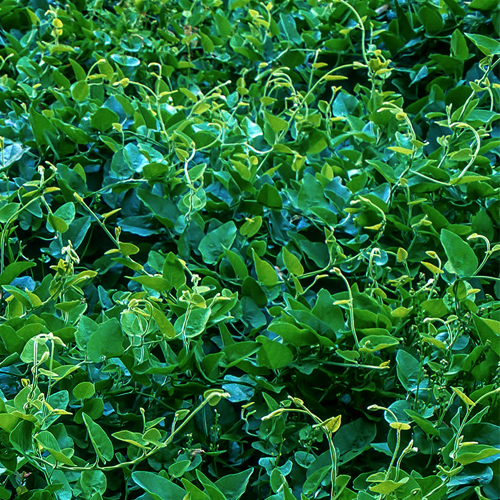
Important northern California native habitat plant that is the sole larval food source for the pipevine swallowtail butterfly. This deciduous vine grows naturally along stream banks and in woodlands and performs well under native oaks. Dutchman’s pipevine is relatively slow-growing and takes a few years to establish. Pendulous pipe-shaped flowers bloom in early spring, followed by soft, bright green, heart-shaped leaves. Best grown as a groundcover to provide protection for pipevine swallowtail larvae but will also twine up other plants and structures. The real show comes in late spring as larvae feed on the plant and grow into spectacular horned, black caterpillars with red spots!
- Water: Low
- Light: Partial ShadeShade
- Soil: Most Soils
Large group of plants that includes annuals, perennials, and shrubs grown for fine, soft-textured, aromatic, gray-green foliage. Flowers are inconspicuous but provide a source of pollen, nectar, and seeds for wildlife. Shrubby varieties can be cut back to maintain a more tidy and compact appearance. Perennial varieties can be divided in fall or early spring. Excellent choice as support for more showy plants in the garden.
Examples: A. ‘Powis Castle’ (3’ x 6’), A. californica (2-5’ x 4-5’, low-growing cultivars ‘Canyon Gray’ and ‘Montara’), A. pycnocephala ‘David’s Choice’ (6” x 2’).
- Water: Very LowLow
- Light: Full Sun
- Soil: Most Soils
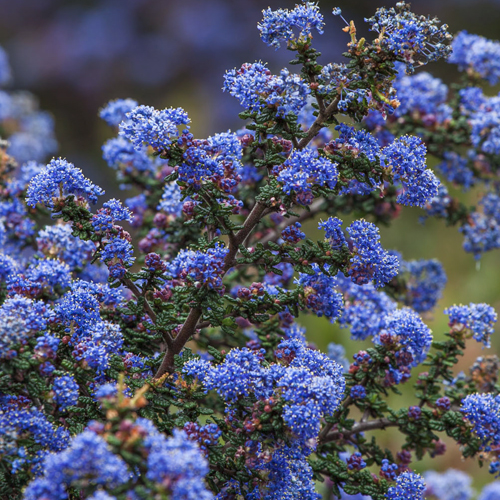
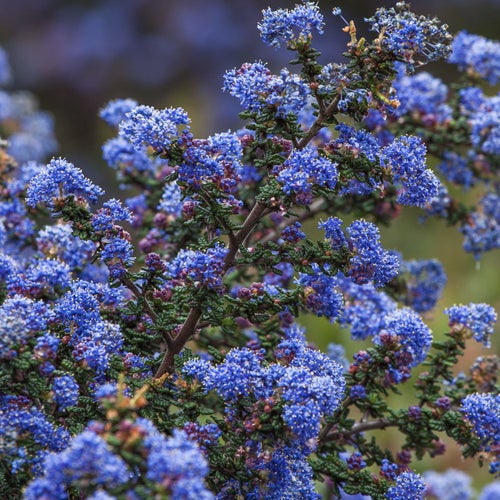
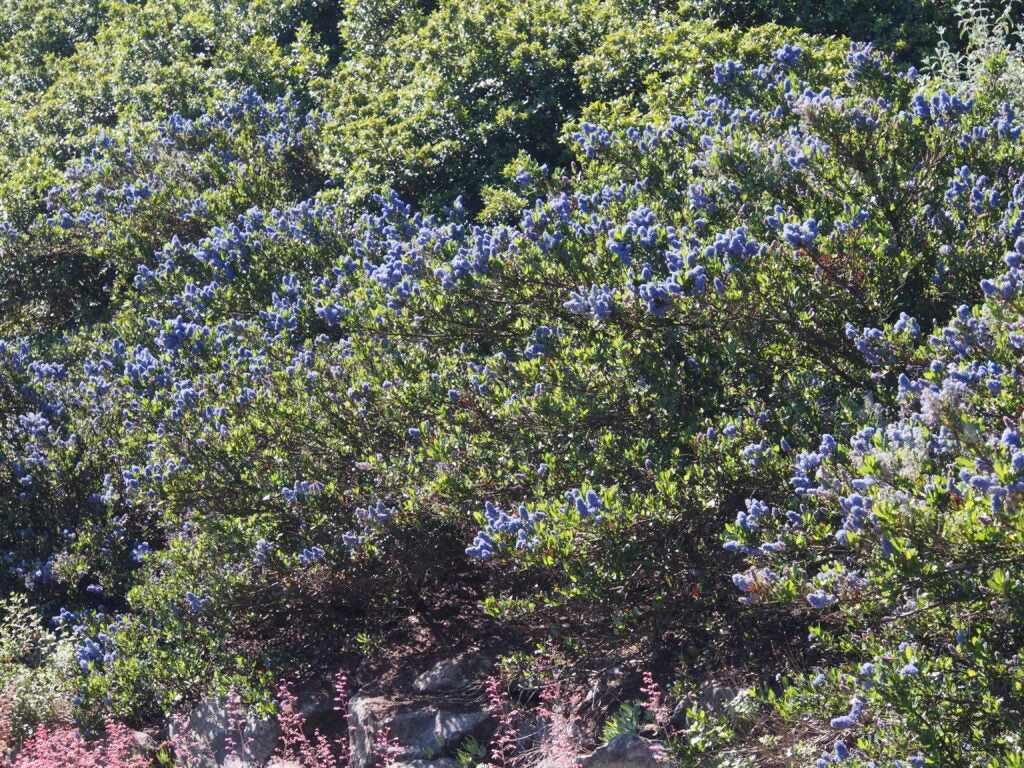
Ceanothus is a group of fast-growing, evergreen shrubs that vary from groundcovers to small trees, many of which are native to California. They provide a spectacular display of flowers in spring that will attract a multitude of pollinators. Flowers are followed by seeds that provide food for birds. The clusters of tiny flowers range from white to deep violet. Plants perform best with good drainage and minimal irrigation once established. Some do best in cooler coastal climates, but many thrive in hotter inland climates. Pay close attention to the mature size when selecting ceanothus to ensure that it has sufficient space for its natural form.
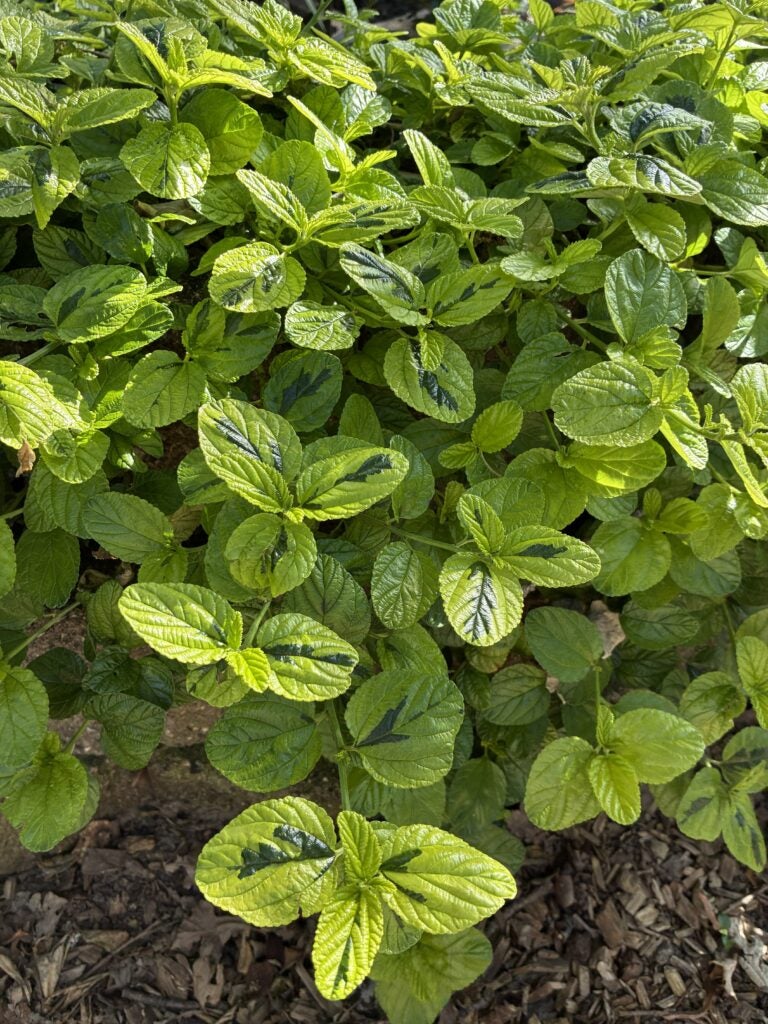
Groundcovers: C. ‘Centennial’ (1’ x 8’), C. gloriosus var. gloriosus ‘Anchor Bay’ (2’ x 8’), C. griseus var. horizontalis ‘Diamond Heights’ (variegated, 1’ x 4’), C. griseus var. horizontalis ‘Yankee Point’ (3’ x 12’), C. maritimus (2’ x 6’).
Shrubs: C. ‘Blue Jeans’ (6’ x 6’), C. Concha (6’ x 6’), C. ‘Dark Star’ (6’ x 8’), C. ‘Joyce Coulter’ (4’ x 12’), C. ‘Julia Phelps’ (8’ x 10’), C. cuneatus (8’ x 8’), C. thyrsiflorus ‘Skylark’ (4’ x 6’).
Large shrubs: C. ‘Frosty Blue’ (10’ x 12’), C. thyrsiflorus (20’ x 20’), C. t. ‘Snow Flurry’ (white flower, 20’ x 20’).
Trees: C. ‘Ray Hartman’ (15′ x 15′)
- Water: Very LowLow
- Light: Full SunPartial Shade
- Soil: Well Drained
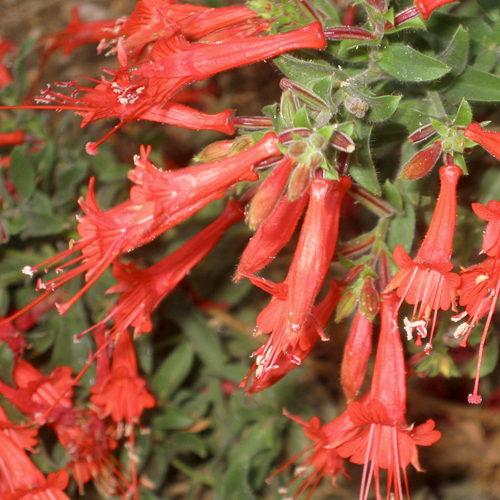
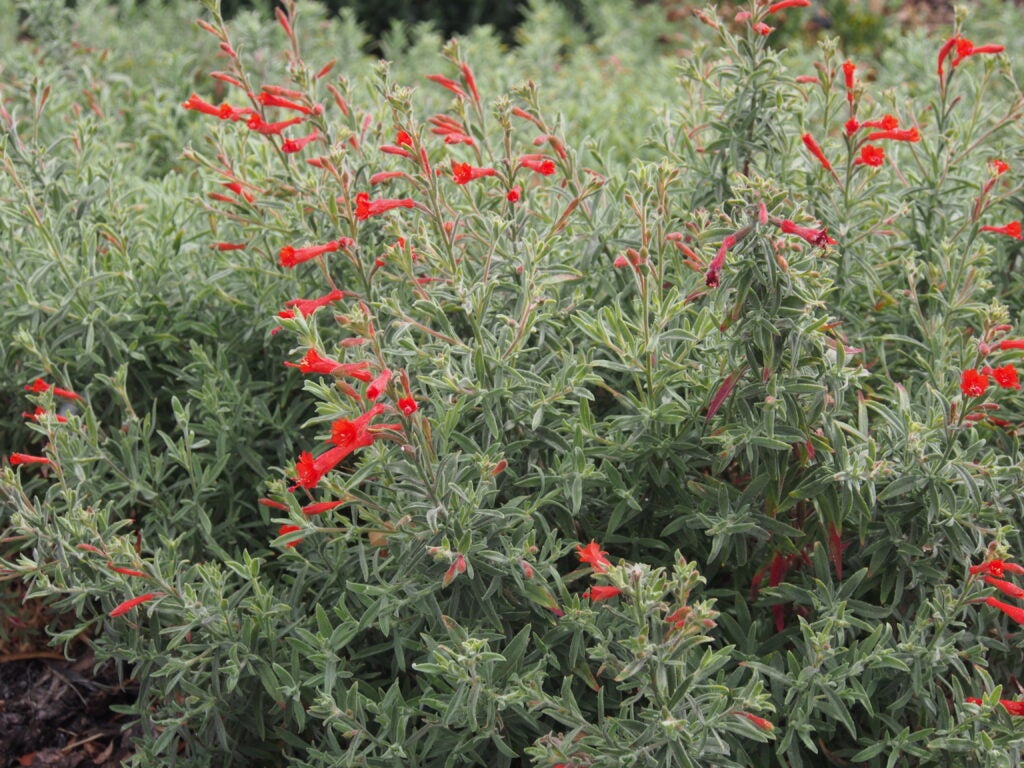
Group of highly variable, semi-evergreen subshrubs and herbaceous perennials distributed over a wide geographic area, including California. Epilobiums bloom in late summer with tubular flowers providing a food source for hummingbirds migrating south and are also attractive to bees and butterflies. Epilobiums range from low-growing groundcovers to upright plants of several feet. Flower colors include orange-red, white, pink, and salmon. Most can be pruned back in late autumn to maintain a more compact form and be rejuvenated for the following year.
Low-growing examples: E. ‘Schieffelin’s Choice’; E. canum ‘Calistoga’, a selection from Phil Van Soelen from California Flora Nursery from the Palisades east of Calistoga; E. canum ‘Cloverdale’, a selection from U.C. Santa Cruz Arboretum from along the Russian River north of Cloverdale with exceptionally orange flowers; E. c. ‘Everett’s Choice’, E. c. ‘Summer Snow’ with white flowers, and E. septentrionale ‘Select Mattole’, a somewhat redder flowering selection that is more shade-tolerant.
Upright examples: E. c. ‘Bowman’s Hybrid’ (2-3’), E. c. ‘Catalina’ (3-4’), E. c. ‘Liz’s Choice’ (3’) selected by Milo Baker Chapter CNPS Fellow Liz Parsons, E. c. ‘Marin Pink’ (2’) with pink flowers.
- Water: Low
- Light: Full Sun
- Soil: Well Drained
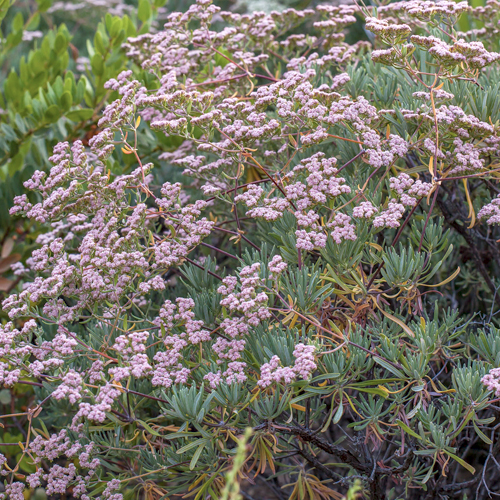
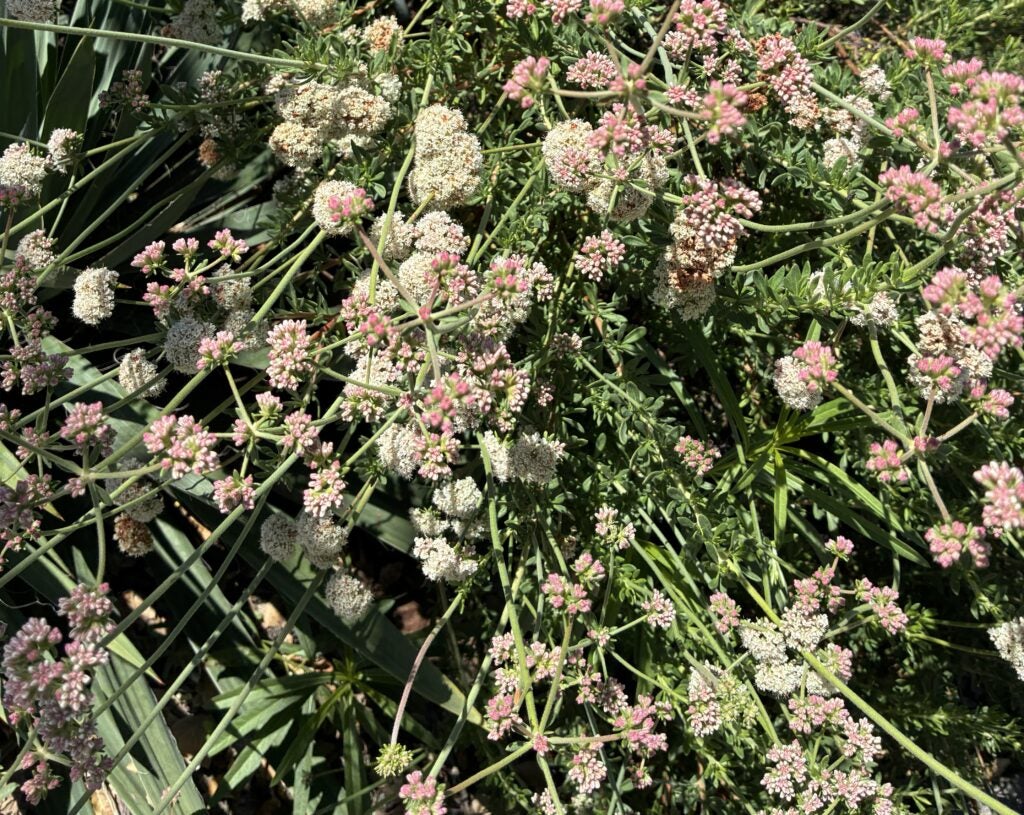
Diverse group of flowering, evergreen shrubs and perennials and annuals found throughout the western United States. Most available in nurseries are native to California and generally prefer drier sites. Flowers colors include yellow, white, pink, and red and are held above foliage in umbels that dry over time and are popular in flower arrangements. Buckwheats provide pollen and nectar for bees and butterflies, larval food for butterflies, seeds for birds, and cover for many creatures.
Examples:
- Santa Cruz Island buckwheat (E. arborescens, 3-4’ x 4-5’) densely mounded with white flowers.
- Saffron buckwheat (E. crocatum, 1-2’ x 2-3’) with chartreuse-yellow flowers and pale leaves.
- California buckwheat (E. fasciculatum, 2-3’ x 3’) and its low-growing cultivars such as E. f. ‘Warriner Lytle.’
- Catherine’s lace (E. giganteum, 4-8’ x 6-10’) with delicate, white flowers and soft pale leaves.
- Red-flowered buckwheat (E. grande var. Rubescens, 1-2’ x 2-3’) low-mounding perennial with rose-pink flowers, coastal bluff buckwheat (E. latifolium, up to 12” x 1-2’.)
- Sulfur buckwheat (E. umbellatum, 6-18” x 1-3’) with intense yellow flowers and cultivars E. u. var. aureum ‘Kannah Creek’ and E. u. Var. ‘Shasta Sulphur’.
- Water: Very LowLow
- Light: Full SunPartial Shade
- Soil: Well Drained
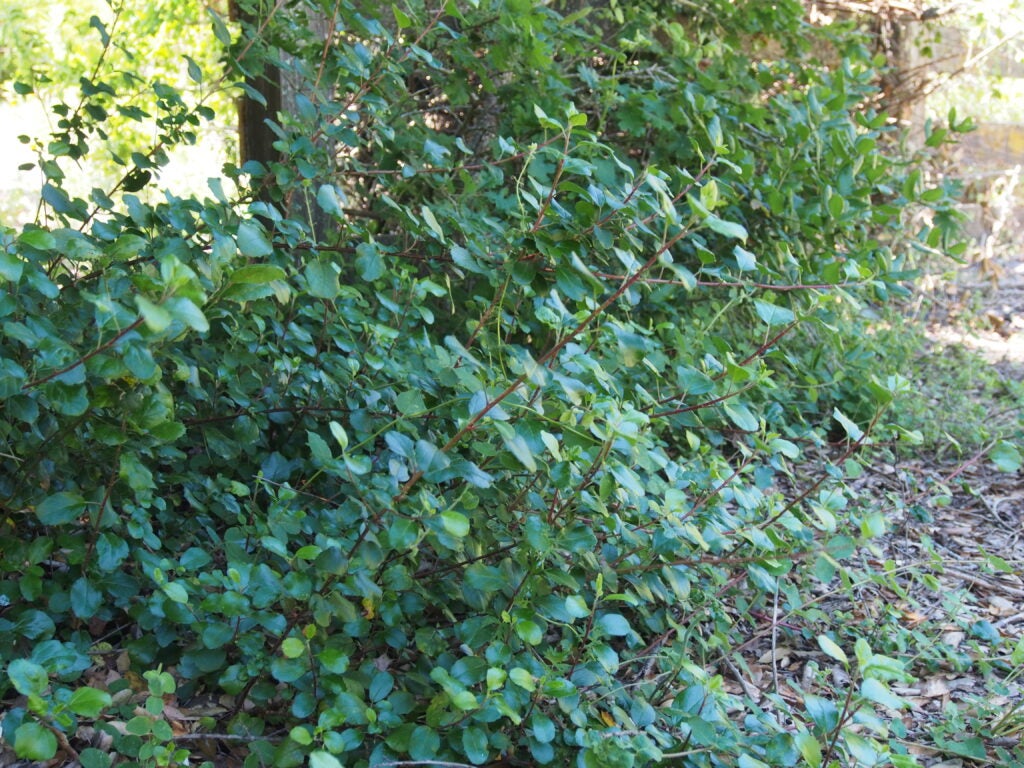
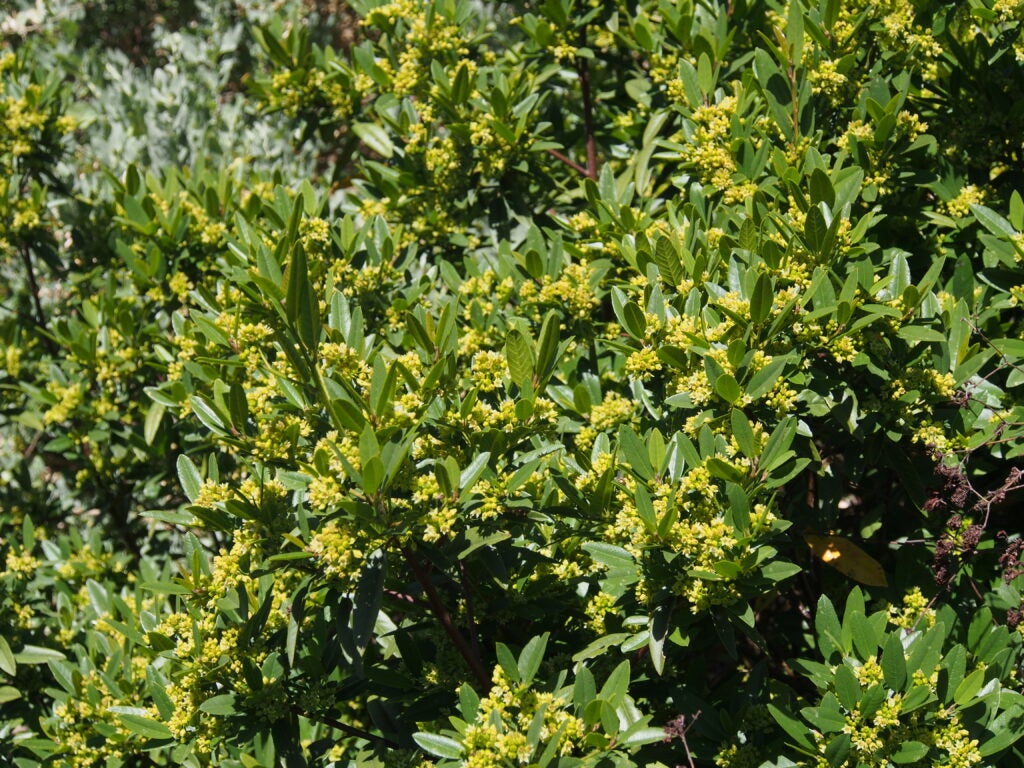
Evergreen shrub that has insignificant flowers followed by black berries. Flowers are attractive to pollinators, especially bees, and berries provide a food source for birds. Cultivars commonly sold in nurseries have differing growth habits and are often smaller than the species which grows 5-18’ x 10-18’.
Examples: F. c. ‘Eve Case’ (6-8’ x 6-8’), R. c. ‘Leatherleaf’ (5-6’ x 5-6’), R. c. ‘Mound San Bruno’ (6-8’ x 6-8’) with a dense, mounding growth habit.
Note: California coffeeberry was formerly classified as Rhamnus californica and is now classified as Frangula californica.
- Water: Low
- Light: Full SunPartial Shade
- Soil: Most Soils
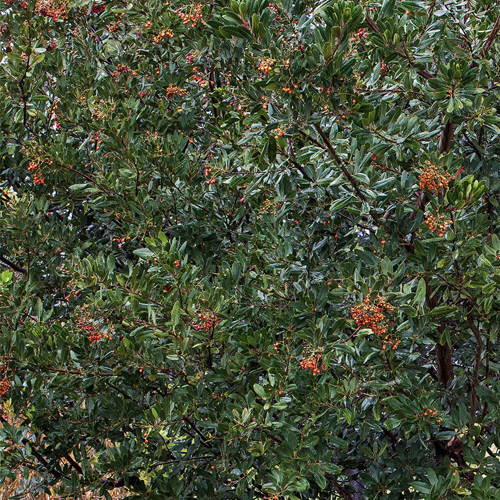
California native, evergreen shrub or small tree often seen growing in Sonoma and Marin county wildlands. Lacy, white flower clusters in spring attract pollinators; red berries in winter provide a splash of color and an important food source for birds. The name “Hollywood” was born from the abundance of toyon in the hills of southern California and its resemblance to European holly. The cultivar ‘Davis Gold’ has yellow berries and may be more disease-resistant than the species.
- Water: Low
- Light: Full SunPartial Shade
- Soil: Well Drained
Iris are a large and diverse group of perennials that grow from either bulbs or rhizomes. The California native Douglas iris and cultivars known as Pacific Coast Hybrids are an excellent choice for summer-dry gardens and understory plantings. Fall rain brings new growth in the form of thin, upright leaves, followed in late winter to early spring by the first blossoms. Douglas iris commonly ranges in color from lavender to purple, but cultivars are available in a range of colors including white and yellow. Established plantings can be lifted and divided after the first significant fall rain and either replanted or put into containers to share with others.
- Water: Low
- Light: Partial ShadeShade
- Soil: Most Soils
California gray rush is a go-to species for the summer-dry rain garden. It will thrive in moist conditions and its roots will help stabilize soil and filter stormwater runoff. It is also tolerant of extended periods of drought. Clumps of stiff, upright foliage provide an interesting contrast among other perennials. ‘Elk Blue’ is a widely available selection from Mendocino County. Its bluish gray foliage is shorter than the typical gray rush.
- Water: Low
- Light: Full SunPartial Shade
- Soil: Well Drained
A native, perennial, deciduous shrub with dark green leaves divided into coarsely toothed leaflets. Rose to pink colored flowers containing yellow seeds and grows abundantly in moist soils. Natural habitat for birds and pollinator insects.
- Water: Low
- Light: Full SunPartial Shade
- Soil: Loam
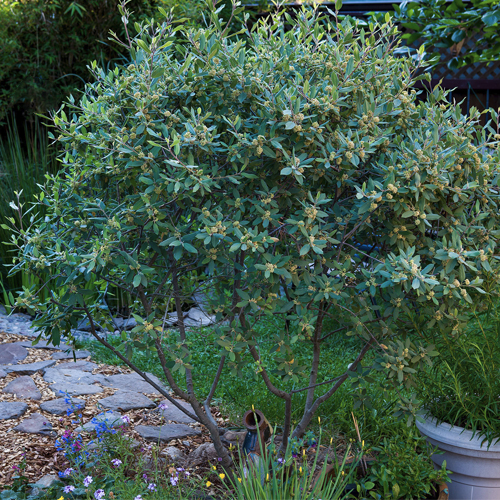
Fast-growing shrubs and small trees for sun or part shade that attract pollinators from far and wide to large clusters of cream flowers in spring, followed by berries in summer that provide food to many types of birds. Fruit can also be used for culinary purposes. While naturally fairly wild-looking, elderberries can handle being cut back to the ground in the winter or pruned to maintain size and shape.
Examples:
- Blue elderberry (S. mexicana [nigra] spp. caerulea, 8-25’) is native from Oregon to Baja California and beyond.
- Black elderberry (S. nigra, 20-30’) is native to Europe, North Africa, and Asia, and is available in nurseries in the form of many named cultivars. Cut leaf black elderberry (S. n. ‘Black Lace’, 8’ x 8’) has intense dark, fine foliage. Cut leaf elderberry (S. n. ‘Laciniata’, 10’ x 10’) has green leaves, and variegated black elderberry (S. n. ‘Marginata’, 6-12’) has variegated leaves.
- Water: Low
- Light: Full SunPartial Shade
- Soil: Well Drained
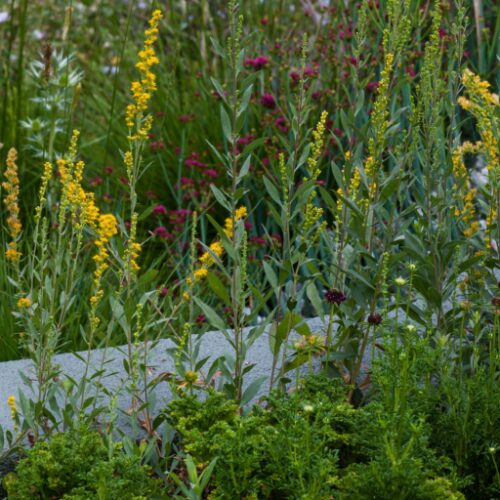
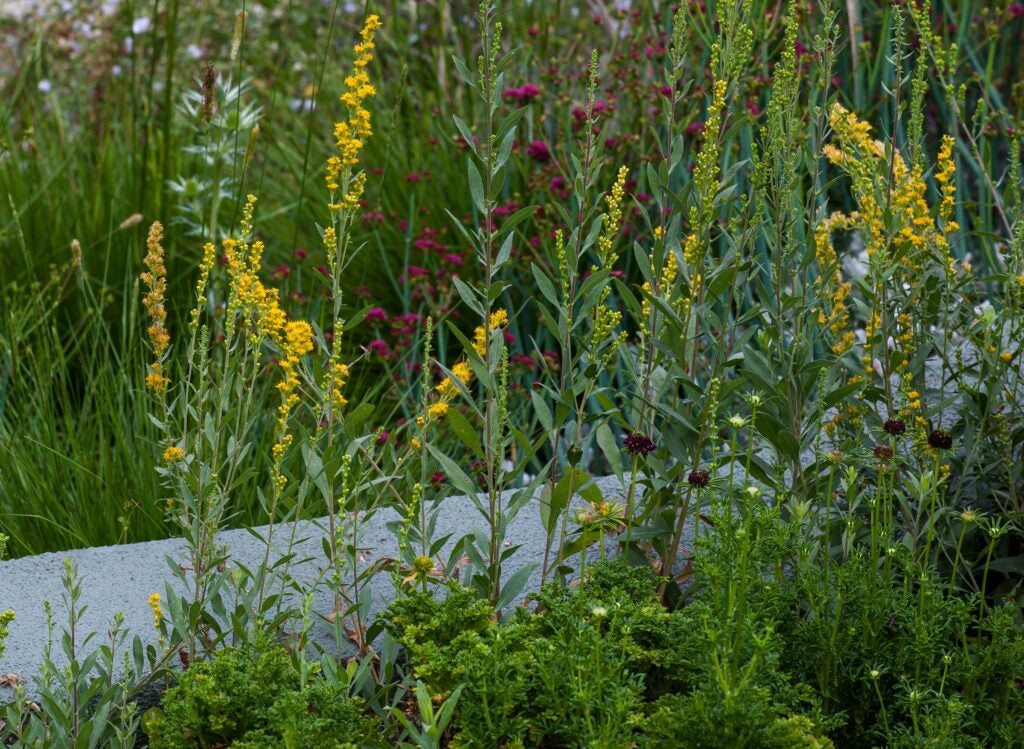
California native perennial herb with oval shaped, gray-green leaves. Yellow flowers will appear in the summer and early fall. Natural habitat for birds and pollinating insects and tolerates a wide variety of soils.
- Water: Moderate
- Light: Full SunPartial Shade
- Soil: Most Soils
Favorite Plants
Douglas Iris
Iris douglasiana
California Poppy
Eschscholzia californica
Redwood Sorrel
Oxalis oregana
Coast Redwood
Sequoia sempervirens
California Buckeye
Aesculus californica
Favorite Garden Suppliers
Sonoma Garden Park Native Plant Nursery
19996 7th Street East Sonoma
Recommended Resources
Calflora.org
Calflora provides a platform for discovering information about California's wild plant life, including both native species and weeds.California Bees and Blooms: A Guide for Gardeners and Naturalists
Written by Dr. Gordon FrankieGardening Tips
Start small, less is more, and fail forward!
Enjoy the process and don’t get overwhelmed.
Late Winter is the perfect time to plant natives!
Take advantage of the rain before the dry summer heat sets in.