Magical Mystery Tour

BACK TO FULL TOUR

Garden Features

1

Drought Tolerant

2

Edible Garden

3

California Natives

4

Pesticide Free

5

Rainwater Harvesting System

6

Reclaimed/Recycled Materials

7

Lawn-Free Landscaping

8

Wildlife Habitat

Partner: Marin Water

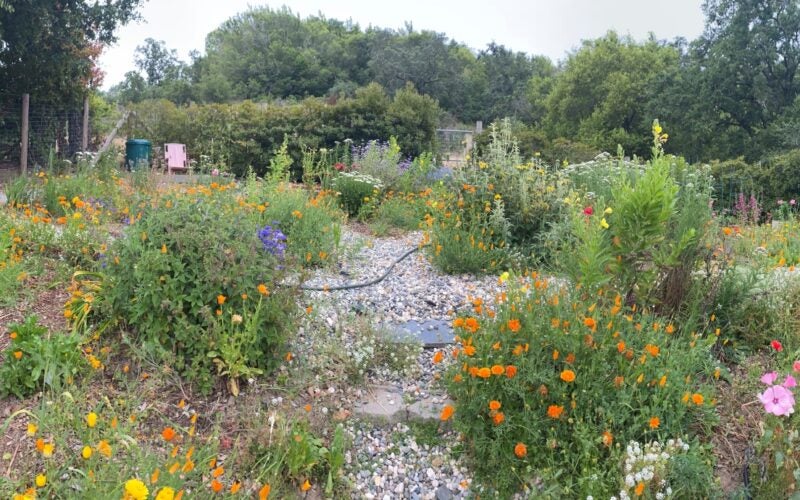
We moved to our home in September 2020 and within days, I realized that our backyard was simply a huge mudslide waiting to happen. Our 3,000 square foot yard was simply dirt that sloped upwards at a 30° angle. The area was prepped to be sold, not to be gardened. Above our property loomed a large hill, so once the weather turned, rainwater would simply cascade downhill and transform our backyard into muddy mush.

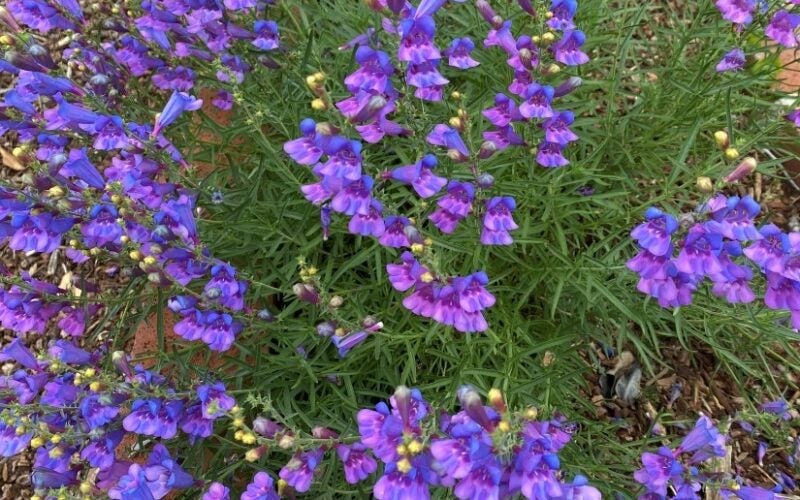
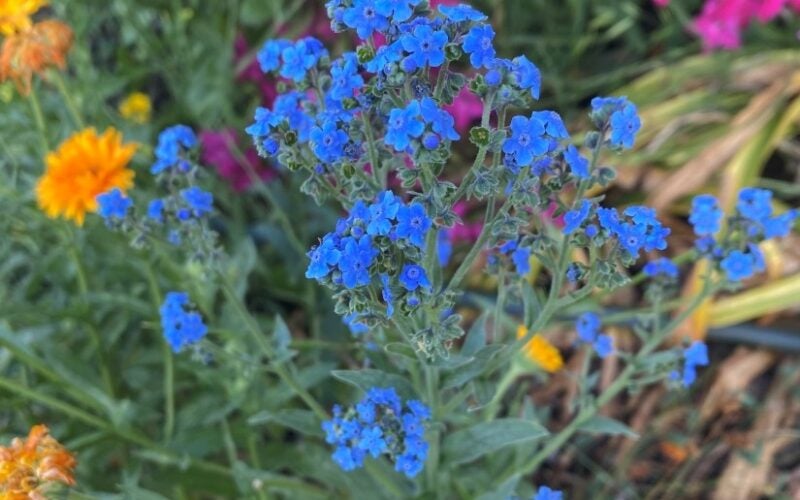
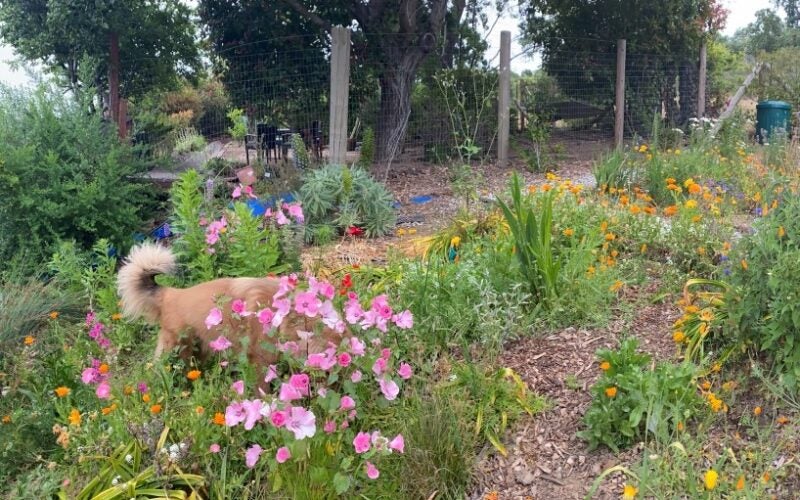
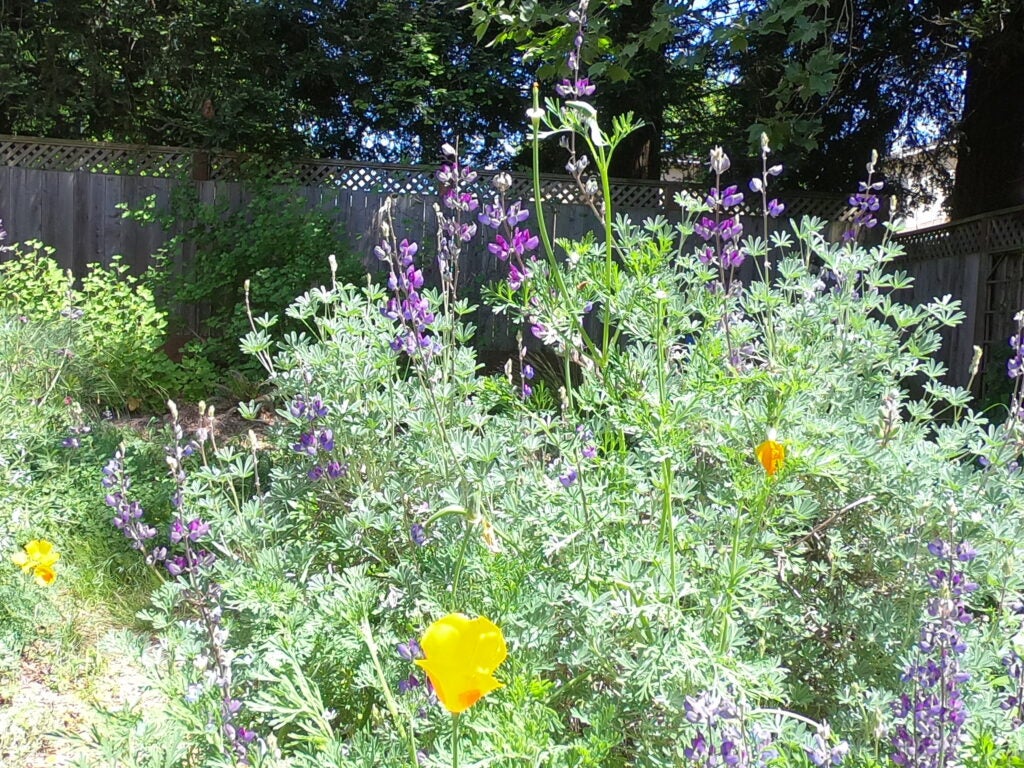
I didn’t have time to properly landscape the yard, so I added roughly 200 cubic feet of soil and scattered thousands of native seeds. When spring arrived, an amazing explosion of plants appeared, many of which I had never seen in person until that moment! Once the wildflowers began to bloom, pollinators of every shape and form descended upon my garden. In other words, the proverbial “birds and the bees” were thriving in the garden. The garden began to develop an eclectic flair with a range of colors that would have made any rainbow jealous. Since the vast majority of plants are annual wildflowers, the various blooming cycles keep the garden colorful from February to October.

I quickly realized that the garden needed shaping, so I divided it into quadrants and added roughly a dozen key anchor plants and 7 fruit trees. I then carved steps into the hillside and built rock pathways around the quadrants. All material was acquired at no cost from throwaway construction material or Craiglist and Nextdoor. About 15,000 pounds of gravel was carried up the hillside—one bucket at a time—to build the steps and pathways!

I then added a rainwater catchment system that pumps water up the hill to be stored in a large rain barrel, which sits at the highest point on the hill. Using simple gravity, water is directed via hose to irrigate the anchor plants and fruit trees during the summer months. Now that the garden is 4 years old, I only need to water the fruit trees, thus saving water and money. During extremely hot periods, I will water the garden using an oscillating sprinkler. Other than that, rain water and nature take care of the rest.

The garden itself evolves from year to year with Mother Nature doing as she pleases . . . a true Magical Mystery Tour!

Special Events
Walking Tours
Food and drink in the afternoon

Plants in this Garden
Plant Picker
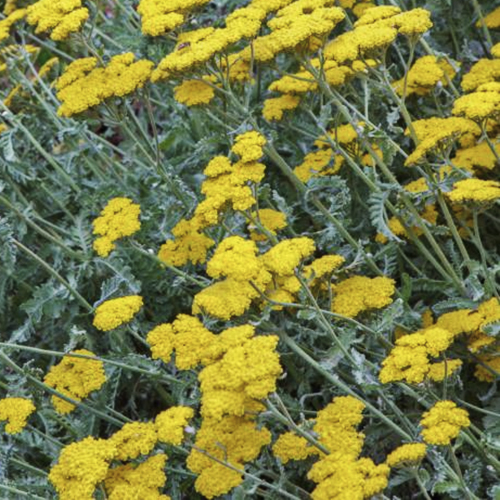
Corymb inflorescent yellow yarrow flowers on gray-green leaves and stems
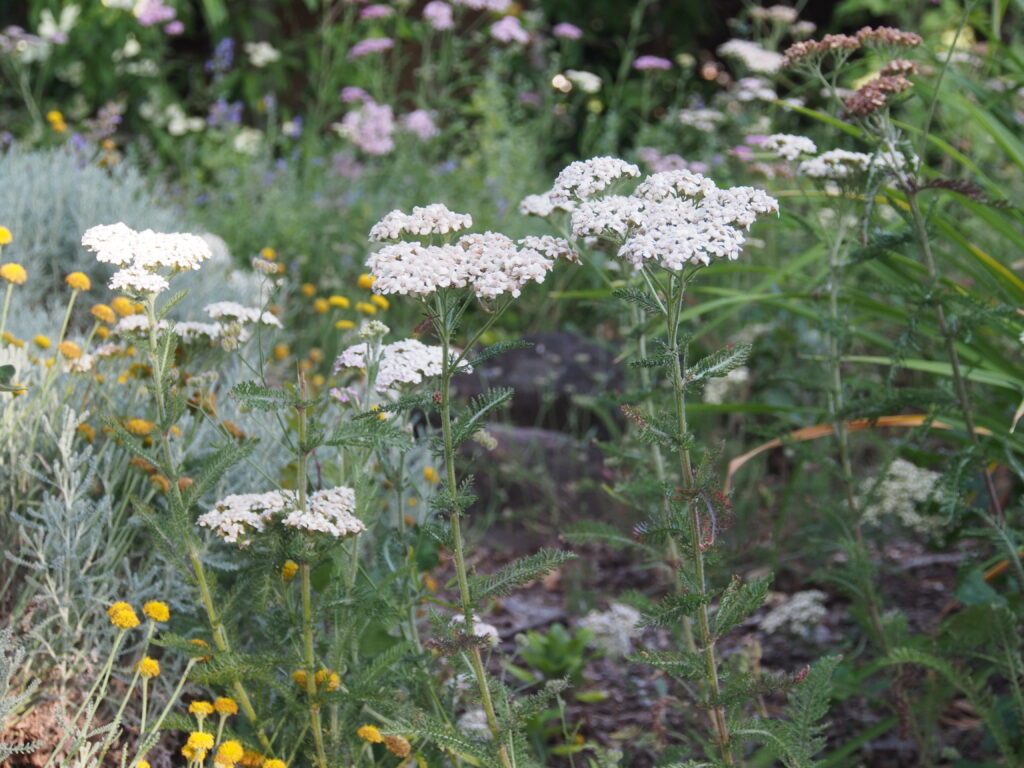
White yarrow.
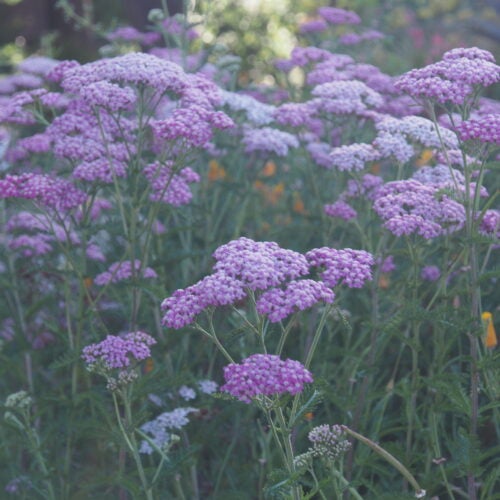
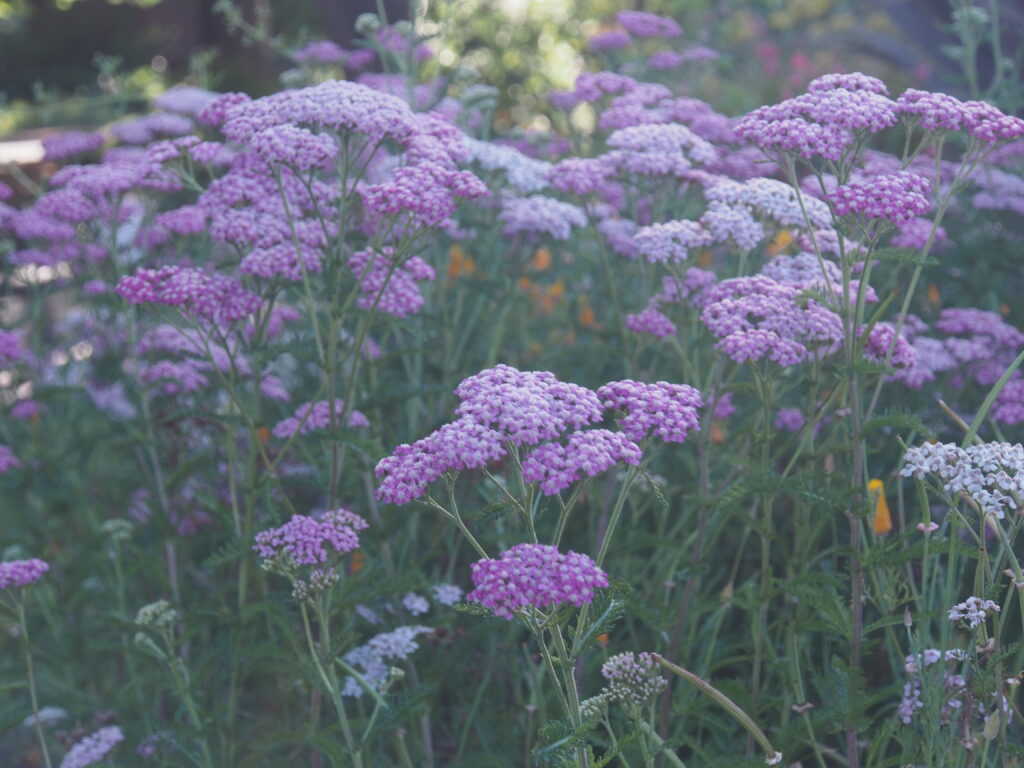
Purple yarrow.
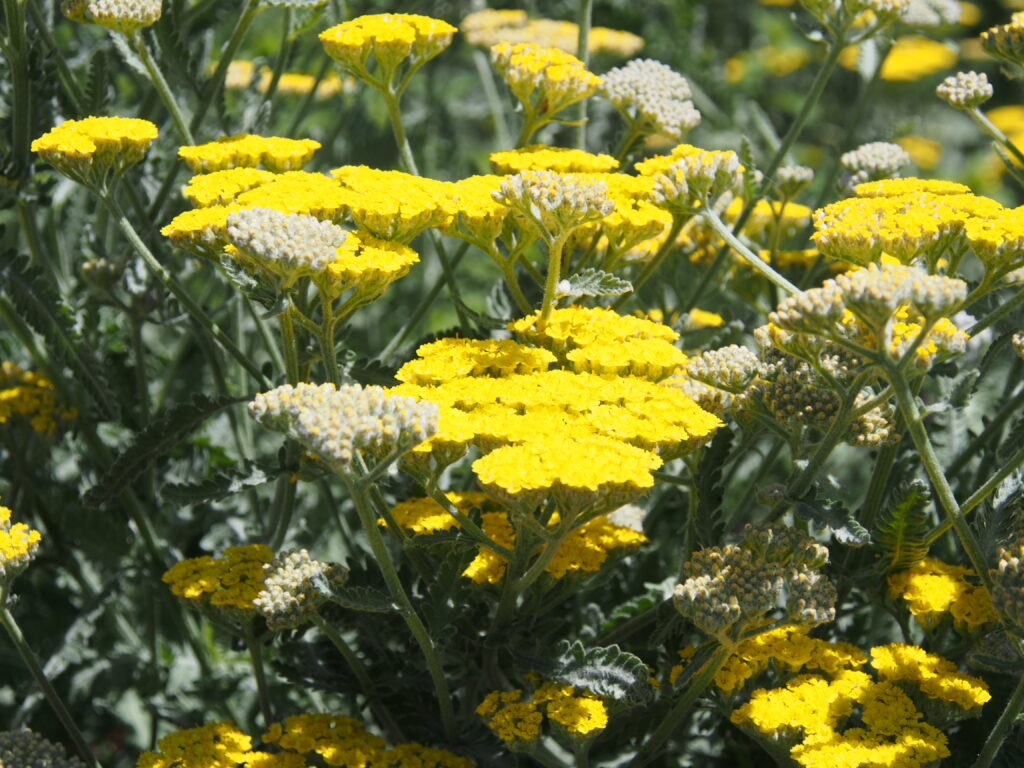
Yellow and white yarrow.

Achillea spp & cvs

Yarrow
Organization

Yarrows are variable low-growing, spreading herbaceous perennials with finely divided leaves that inhabit many temperate regions in the Northern Hemisphere. Flattish clusters of flowers form in spring and well into summer and provide an important nectar source for pollinators and insects. Yarrow can help to stabilize slopes and is a good addition to the upper level of rain gardens and swales. Colors include yellow, pink, and red.

California native spp & cvs: A. millefolium (common yarrow), A. m. ‘Calistoga’, A. m. ‘Island Pink’, A. m. ‘Sonoma Coast’, A. m. ‘Terracotta’.

Other yarrows: A. filipendulina (fern leaf yarrow), A. f. ‘Coronation Gold’, A. ‘Moonshine’, A. tomentosa (woolly yarrow).

  • Water: Low
  • Light: Full SunPartial Shade
  • Soil: Most Soils
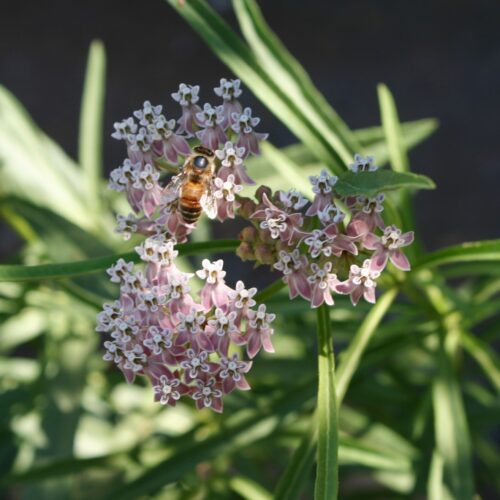
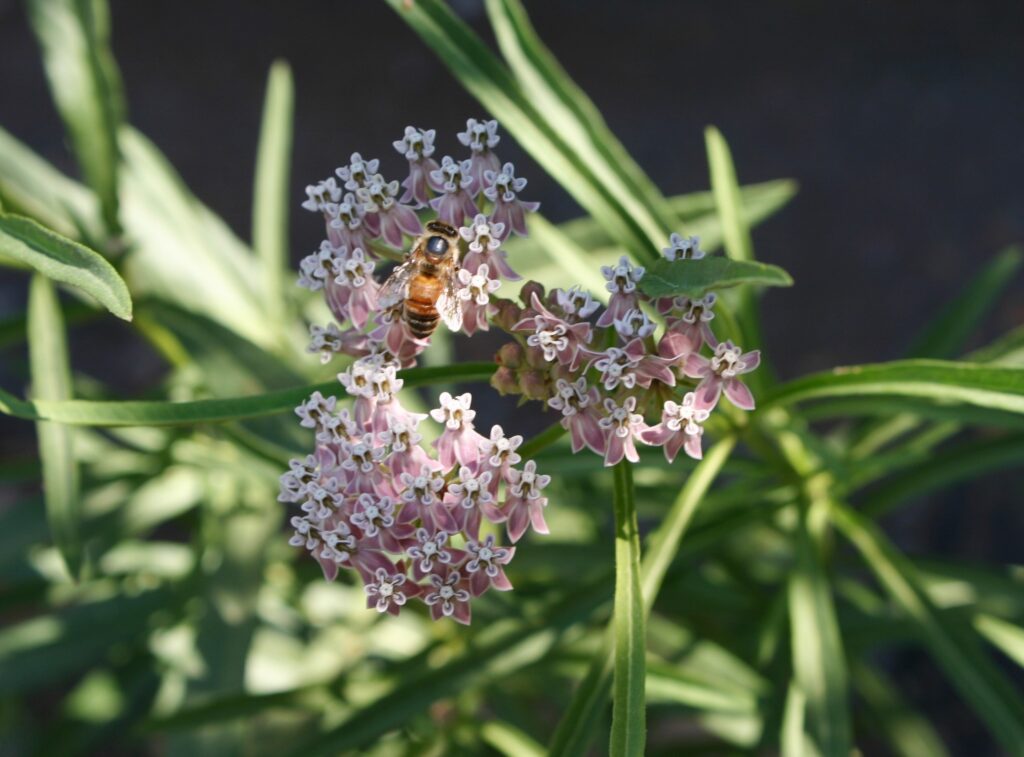
Three clusters of tiny, pink and white star-shaped flowers and long slender leaves

Asclepias spp

Milkweed
Organization

Colony-forming, herbaceous perennials with several species providing important habitat and larval food sources for the monarch butterfly while attracting a diverse array of insects.

California milkweeds remain dormant during the colder months. Stems that emerge in April or May bear clusters of small, star-like flowers in summer followed by silky-tailed seeds that are dispersed by wind. A. fascicularis (narrow-leaved milkweed, 1-3’) is the preferred food source for monarch larvae. A. speciosa (showy milkweed, 2-4’) has larger, soft foliage, showier flower clusters, and is also a food source for monarch larvae. A. cordifolia (heart leaf milkweed, 1-2′) has heart-shaped leaves and is also a food source for monarch larvae.

  • Water: Low
  • Light: Full SunPartial Shade
  • Soil: Most Soils
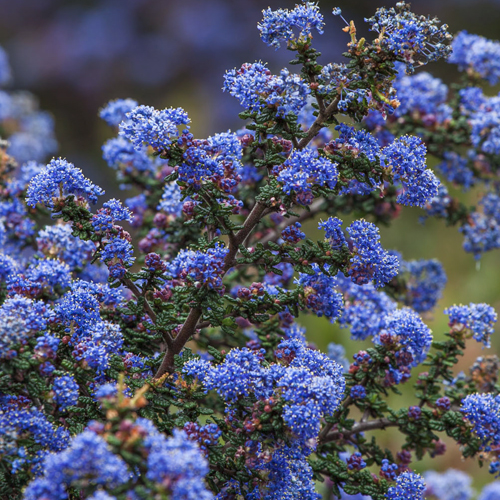
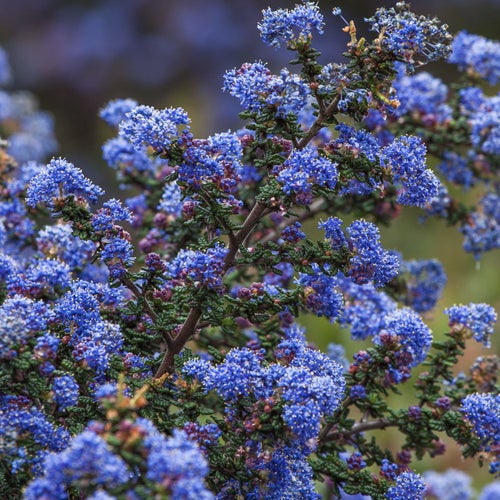
California Lilac ceanothus variety with clusters of small, vibrant blue flowers and dark green leaves

Ceanothus spp & cvs

Ceanothus
Organization

Ceanothus is a group of fast-growing, evergreen shrubs that vary from groundcovers to small trees, many of which are native to California. They provide a spectacular display of flowers in spring that will attract a multitude of pollinators. Flowers are followed by seeds that provide food for birds. The clusters of tiny flowers range from white to deep violet. Plants perform best with good drainage and minimal irrigation once established. Some do best in cooler coastal climates, but many thrive in hotter inland climates. Pay close attention to the mature size when selecting ceanothus to ensure that it has sufficient space for its natural form.

Groundcovers: C. ‘Centennial’ (1’ x 8’), C. gloriosus var. gloriosus ‘Anchor Bay’ (2’ x 8’), C. griseus var. horizontalis ‘Diamond Heights’ (variegated, 1’ x 4’), C. griseus var. horizontalis ‘Yankee Point’ (3’ x 12’), C. maritimus (2’ x 6’).

Shrubs: C. ‘Blue Jeans’ (6’ x 6’), C. Concha (6’ x 6’), C. ‘Dark Star’ (6’ x 8’), C. ‘Joyce Coulter’ (4’ x 12’), C. ‘Julia Phelps’ (8’ x 10’), C. cuneatus (8’ x 8’), C. thyrsiflorus ‘Skylark’ (4’ x 6’).

Large shrubs: C. ‘Frosty Blue’ (10’ x 12’), C. thyrsiflorus (20’ x 20’), C. t. ‘Snow Flurry’ (white flower, 20’ x 20’).

Trees: C. ‘Ray Hartman’ (15′ x 15′)

  • Water: Very LowLow
  • Light: Full SunPartial Shade
  • Soil: Well Drained
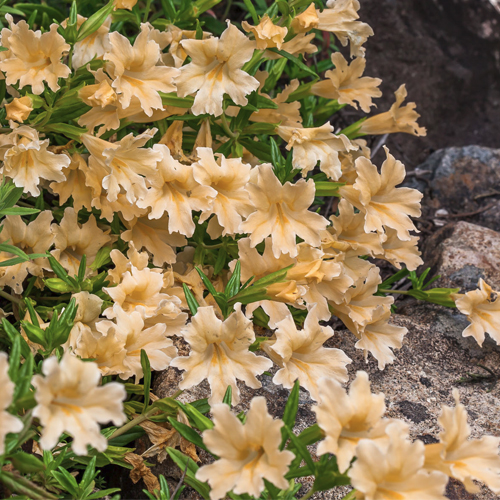
A group of small, peach-colored trumpet flowers with green leaves.

Mimulus aurantiacus and hybrids

Sticky Monkey Flower
Organization

The orange, tubular flowers of sticky monkey flower can be enjoyed in many locations throughout Sonoma and Marin counties in spring and summer, a testament to how well this plant is adapted to hot and dry conditions. The slightly sticky leaves benefit from light pinching and pruning to maintain an attractive appearance and support for the beautiful flowers. Many hybrids provide color variation. Do not confuse this plant with the red-flowered scarlet monkey flower (Mimulus cardinalis), an herbaceous riparian plant that requires regular water to thrive.

  • Water: Very Low
  • Light: Full SunPartial Shade
  • Soil: Sandy
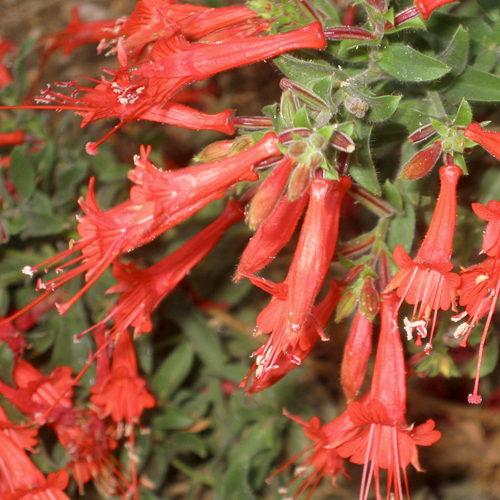
Red tubular flowers with white-tipped stamens sticking out

Zauschneria [Epilobium] spp

California Fuchsia
Organization

Group of highly variable, semi-evergreen subshrubs and herbaceous perennials distributed over a wide geographic area, including California. Epilobiums bloom in late summer with tubular flowers providing a food source for hummingbirds migrating south and are also attractive to bees and butterflies. Epilobiums range from low-growing groundcovers to upright plants of several feet. Flower colors include orange-red, white, pink, and salmon. Most can be pruned back in late autumn to maintain a more compact form and be rejuvenated for the following year.

Low-growing examples: E. ‘Schieffelin’s Choice’; E. canum ‘Calistoga’, a selection from Phil Van Soelen from California Flora Nursery from the Palisades east of Calistoga; E. canum ‘Cloverdale’, a selection from U.C. Santa Cruz Arboretum from along the Russian River north of Cloverdale with exceptionally orange flowers; E. c. ‘Everett’s Choice’, E. c. ‘Summer Snow’ with white flowers, and E. septentrionale ‘Select Mattole’, a somewhat redder flowering selection that is more shade-tolerant.

Upright examples: E. c. ‘Bowman’s Hybrid’ (2-3’), E. c. ‘Catalina’ (3-4’), E. c. ‘Liz’s Choice’ (3’) selected by Milo Baker Chapter CNPS Fellow Liz Parsons, E. c. ‘Marin Pink’ (2’) with pink flowers.

  • Water: Low
  • Light: Full Sun
  • Soil: Well Drained
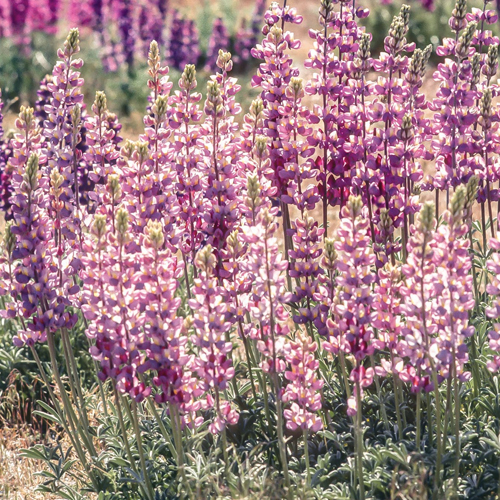
Pink-purple lupine raceme inflorescent flower clusters.

Lupinus spp

Lupine
Organization

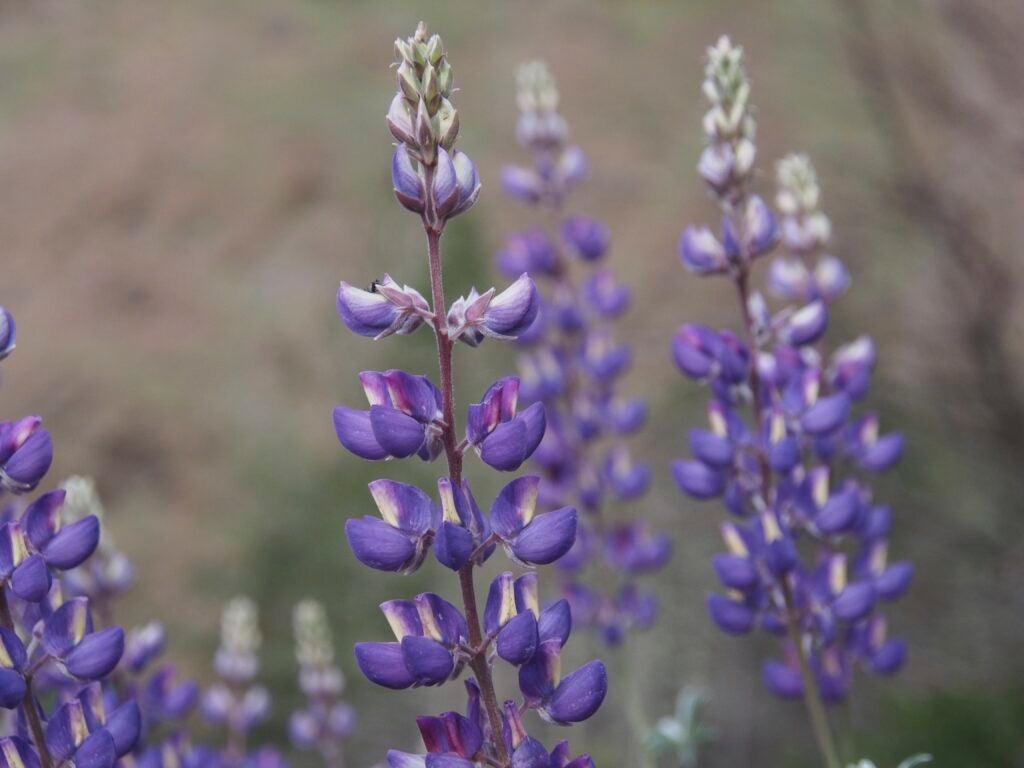
Popular group of annuals, perennials, and shrubs with distinctive divided leaves that are common throughout the western United States, including California. Pea-like flowers are displayed on spikes and are attractive to bees and other pollinators. Most native lupines are purple-flowered, while some are yellow. Provide full sun and good drainage and watch out for slugs and snails.

Examples: Silver bush lupine (L. albifrons, 3-4’ x 3-4’), prostate lupine (L. albifrons var. collinus, 12-18” x 12-18”), coastal bush lupine (L. arboreus) available with either blue or yellow flowers but can be invasive in some north coastal dunes, and blue-and-white lupine (L. bicolor) a low-growing, annual wildflower.

  • Water: Very Low
  • Light: Full Sun
  • Soil: Well Drained
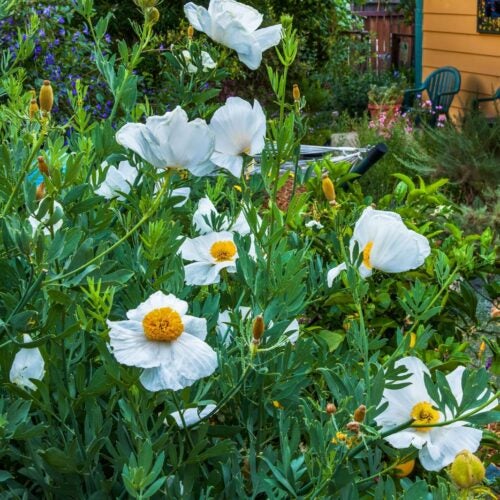
A shrub with vibrant green leaves and large, crinkled flowers with white flowers and yellow, spherical group of stamens.

Romneya coulteri

Coulter's Matilija Poppy
Organization

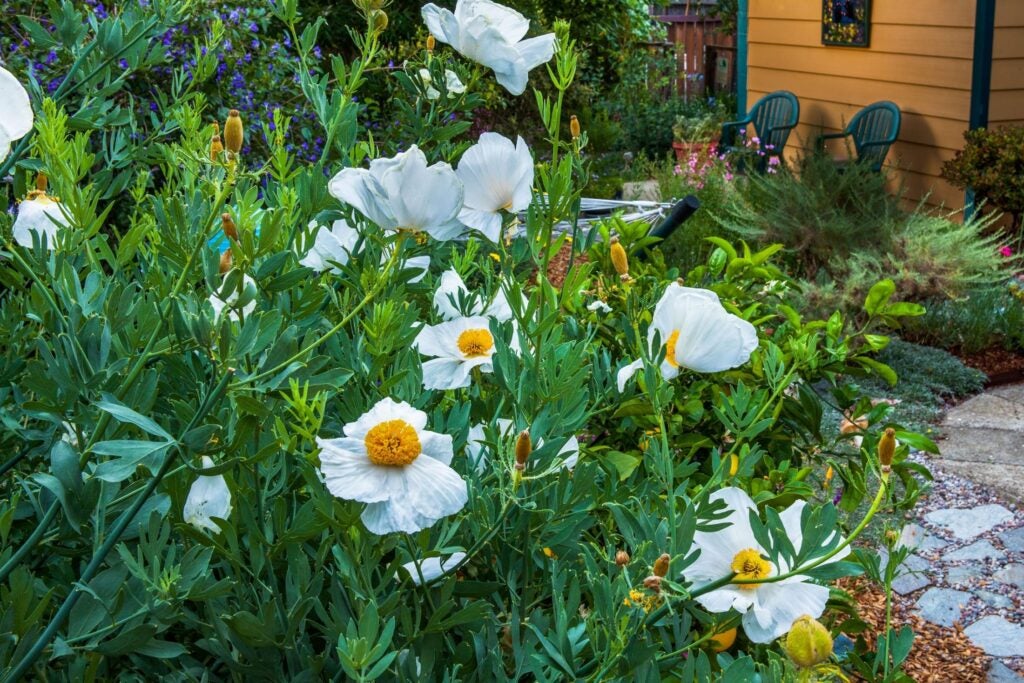
The Matilija poppy is a very large species of California poppy. Its flowers alone can grow to 7 inches in diameter. The shrub itself can be 6-10 feet tall and 2-4 feet wide. Plant near other shrubs that can outcompete it for space, such as ceanothus, coffeeberry, sugarbush, or flannelbush. Plant in sandy, well-drained soil and water carefully until established because it can suffer from both too much and too little once. Once established, however, the shrub is easy to grow and requires no watering at all. Can be cut back hard in late fall.

  • Water: Low
  • Light: Full Sun
  • Soil: Well Drained
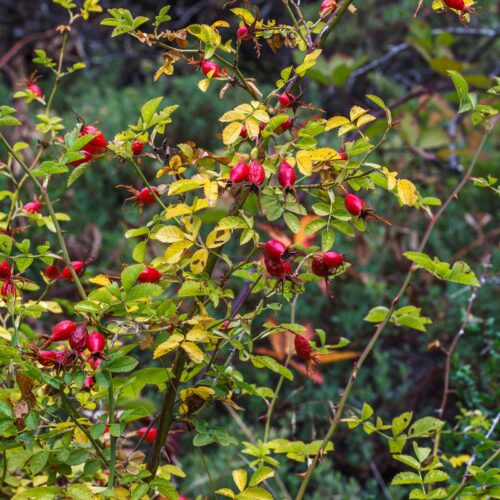
A shrub with small, scattered yellow-green leaves and deep, vibrant red bulbous flowers

Rosa californica

California Wild Rose
Organization

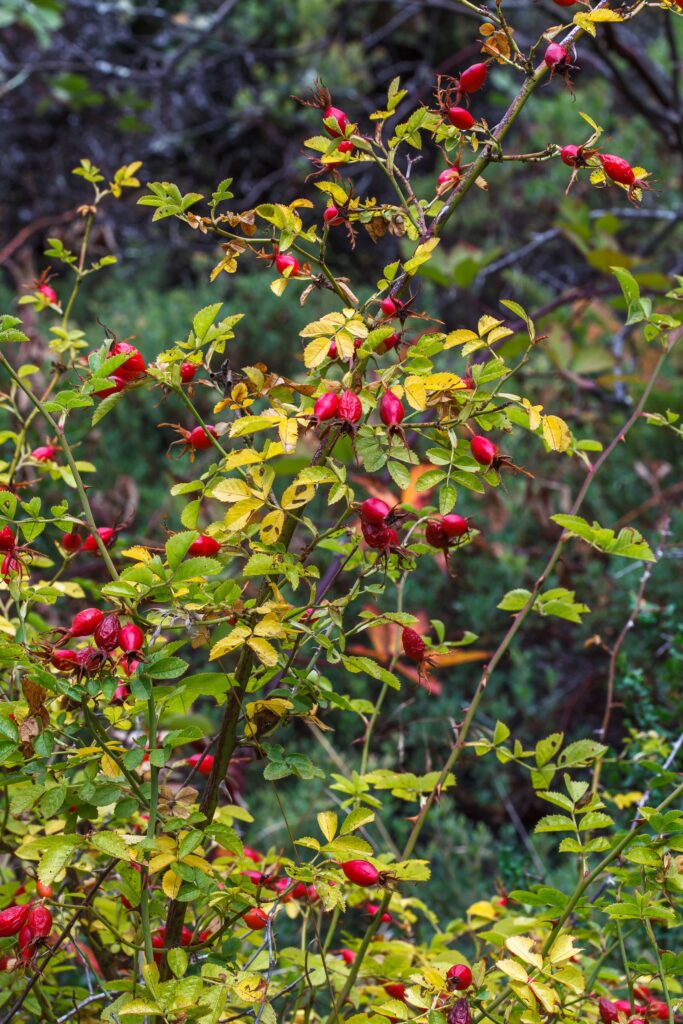
A native, perennial, deciduous shrub with dark green leaves divided into coarsely toothed leaflets. Rose to pink colored flowers containing yellow seeds and grows abundantly in moist soils. Natural habitat for birds and pollinator insects.

  • Water: Low
  • Light: Full SunPartial Shade
  • Soil: Loam

Favorite Plants

1

Sticky Monkey Flower

Diplacus aurantiacus

2

Matilija Poppy

Romneya coulteri

3

Cleveland Sage

Salvia clevelandii

4

Larkspur

Delphinium spp.

5

Bunchleaf/Foothill Penstemon

Penstemon heterophyllus

Favorite Garden Suppliers

O'Donnell's Fairfax Nursery

1700 Sir Francis Drake Boulevard Fairfax

Cottage Gardens of Petaluma

3995 Emerald Drive Petaluma

Larner Seeds

230 Grove Road Bolinas

Gardening Tips

1

Know your garden!

Inspect your garden at all hours, whether it be 4pm or 4am . . . You cannot know your garden without knowing its daily rhythms.

2

Study your garden soil ecosystem by scooping soil, leaf litter, gravel, etc. into a sealed, glass jar.

Open every 2-3 days to mist and then watch for roughly a month to better understand the various tiny critters that live in your garden and are needed to maintain a healthy soil ecosystem.

3

Use apps such as PlantNet to identify what is growing in your garden!

This app is great for helping me identify “volunteers” that arrive yearly courtesy of local wildlife.  I can’t stress enough how valuable it is to easily identify what’s popping up in your garden, as it will help you better understand why a plant thrives in certain areas, but is being “out-competed” by other plants just 5′ or 10′ away.

4

When your native flowers turn brown (in mid-Summer and Fall), LEAVE THEM BE!

Besides re-seeding your garden, these plants provide valuable forage for birds and insects, who in turn spread the native seeds to other gardens . . . and who bring new, native volunteers to your garden. It’s really cool to discover new plants every year!