Gardening for Biodiversity

BACK TO FULL TOUR

Garden Features

1

Drought Tolerant

2

Graywater System

3

California Natives

4

Drip Irrigation

5

Pesticide Free

6

Rainwater Harvesting System

7

Smart Irrigation Controller

8

Lawn Conversion

9

Lawn-Free Landscaping

10

Wildlife Habitat

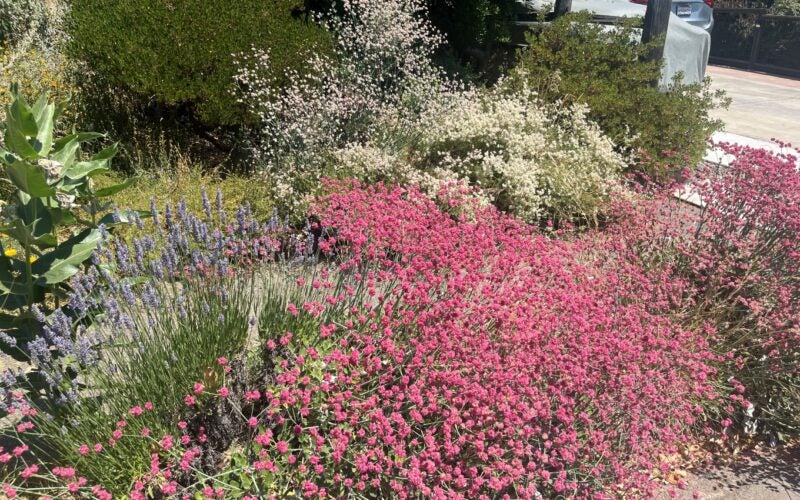
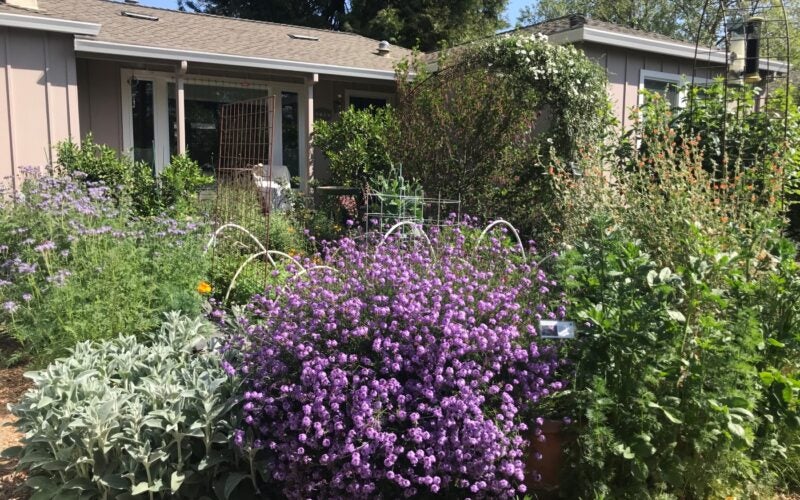
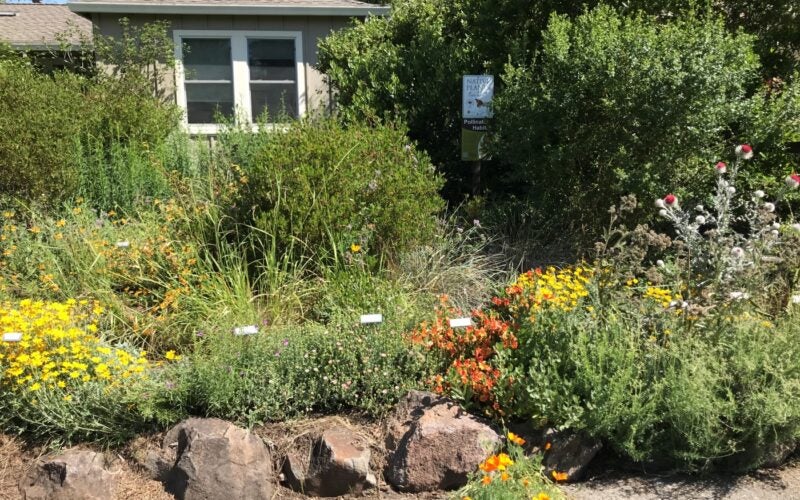
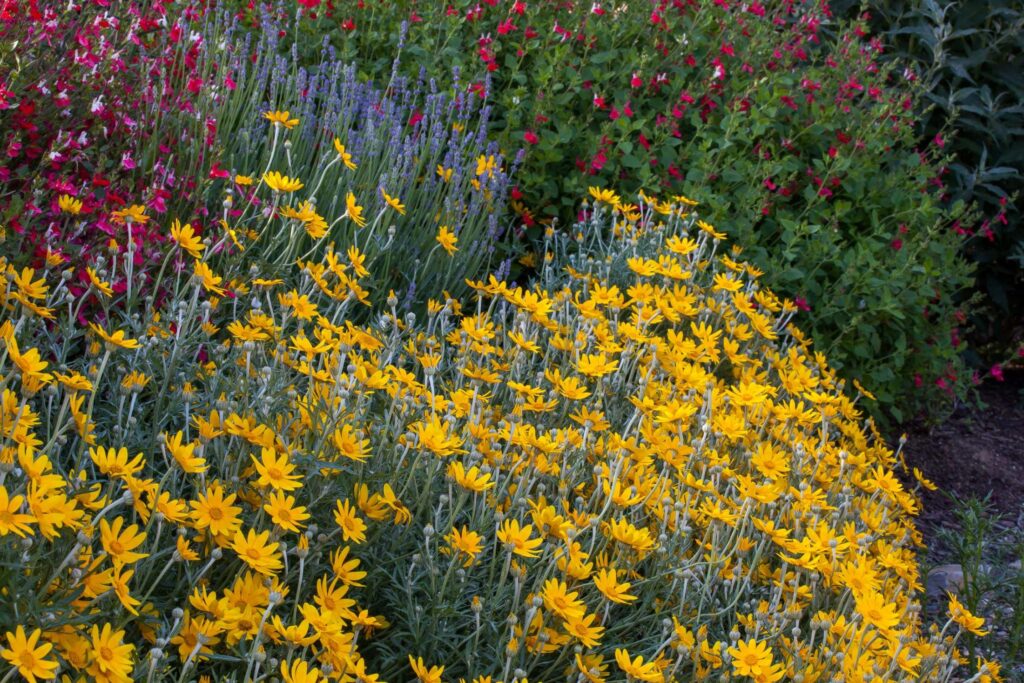
This garden has evolved to mostly native plants that do well in this region of Sonoma County. A variety of native plants increases biodiversity by creating habitats that attract and support insects, pollinators, butterflies, birds, and reptiles. Emphasis on creating pockets of same blooming native species providing quality nectar and pollen resources throughout the year.

Rain waters this garden except for the vegetable beds and ornamentals. With few impermeable surfaces, most rain percolates into the soil and is available to plants throughout the year. Native perennial grasses, shrubs, and trees have deep root systems that hold water in the soil. Native grasses can have roots up to twenty feet deep, bringing water up during the dry season and stabilizing soils.

Native plants in this garden are suited to California’s Mediterranean climate—they may go dormant in dry summers and revive with winter rain.

Water management includes a graywater system and a 3300 gallon pressurized rainwater system with multiple hose bibs. Rain water from the tanks provides summer water where needed and facilitates fall planting. Drip irrigation exists for drought periods or to augment the rain water system.

A layer of leaves are allowed to accumulate in the fall, providing habitat for overwintering invertebrates and protecting and enhancing soil health.

Plants in this Garden

Plant Picker
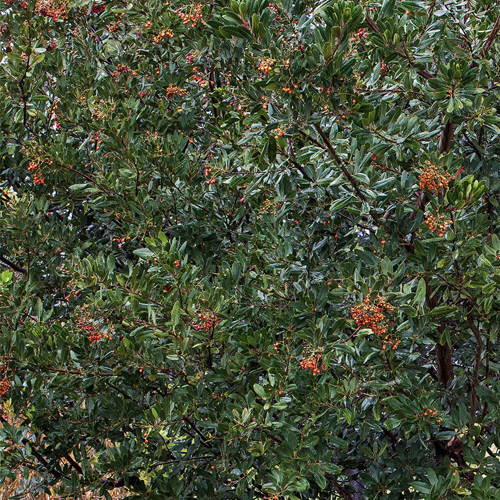
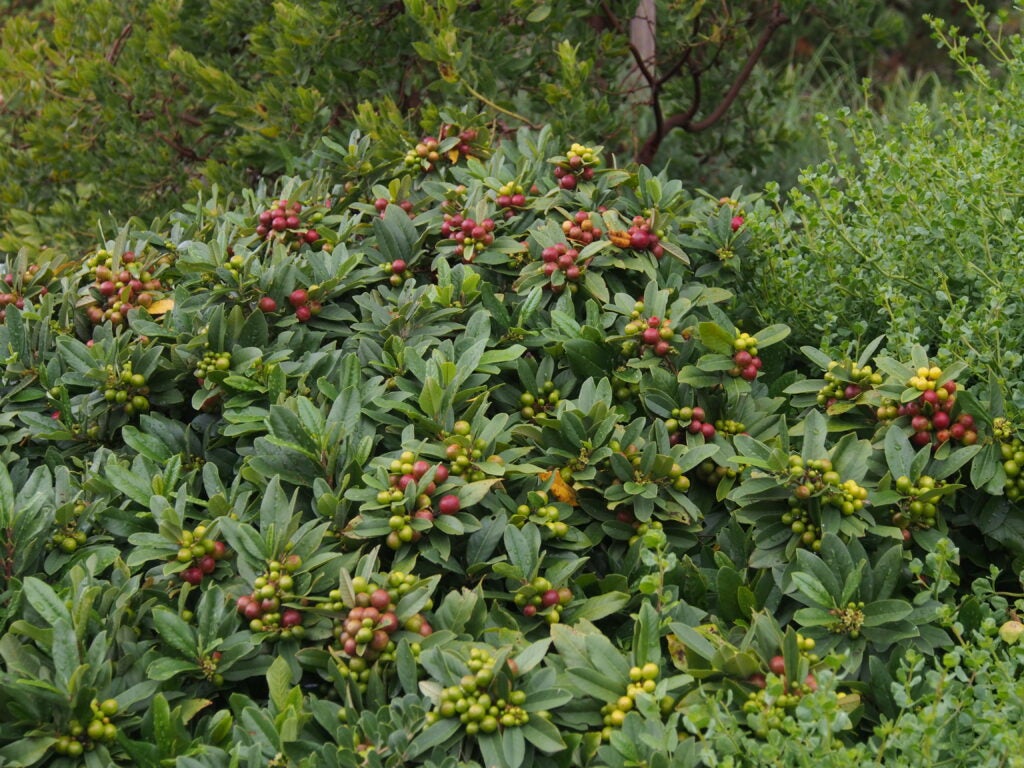
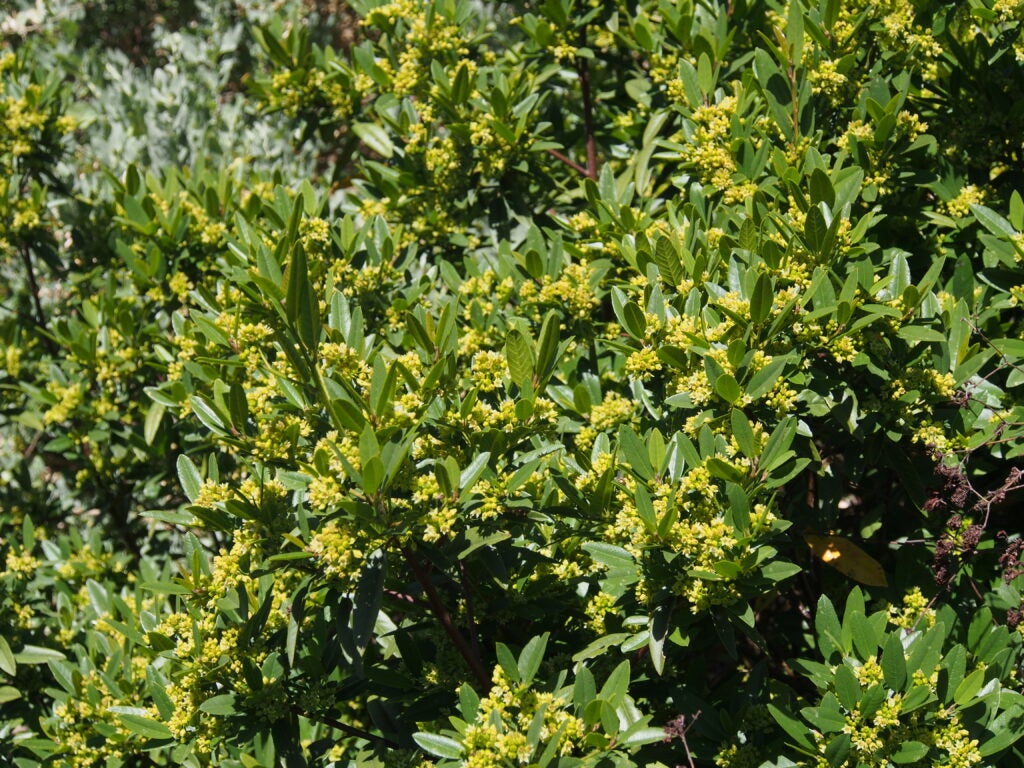
Dark green oval leaves and red berry clusters on dark brown branches

Heteromeles arbutifolia

Toyon
Organization

California native, evergreen shrub or small tree often seen growing in Sonoma and Marin county wildlands. Lacy, white flower clusters in spring attract pollinators; red berries in winter provide a splash of color and an important food source for birds. The name “Hollywood” was born from the abundance of toyon in the hills of southern California and its resemblance to European holly. The cultivar ‘Davis Gold’ has yellow berries and may be more disease-resistant than the species.

  • Water: Low
  • Light: Full SunPartial Shade
  • Soil: Well Drained
Manzanita bush with deep red fruits

Arctostaphylos spp & cvs

Manzanita, 'Dr. Hurd'
Organization

Manzanitas vary from carpet-forming groundcovers to small trees. Manzanitas have varying shades of striking, reddish brown bark and can provide structure to a garden. These plants have evergreen foliage, small white-to-pink, urn-shaped blossoms in late winter to early spring, and then small fruits that resemble tiny apples.

Groundcovers: A. ‘Emerald Carpet’ (1’ x 3-6’), A. ‘Pacific Mist’ (2-3’ x 6-8’), A. nummularia ‘Bear Belly’ (1’ x 3’), A. uva ursi ‘Radiant’ (6” x 4-6’), A. uva ursi ‘Wood’s Compct’ (1’ x 3’).

Shrubs: A. ‘Howard McMinn’ (5-7’ x 6-10’), A. ‘John Dourly’ (3-4’ x 5-6’), A. ‘Lester Rowntree’ (8-10’ x 10-15’), A. ‘Sunset‘ (5-7’), A. bakeri ‘Louis Edmunds’ (8-10’), A. manzanita ‘Sentinel’ (6-8’ x 5’), A. hookeri ‘Wayside’ (3′ x 8′).

Trees: A. manzanita ‘Dr. Hurd’ (10-15′)

  • Water: Very LowLow
  • Light: Full SunPartial Shade
  • Soil: Well Drained
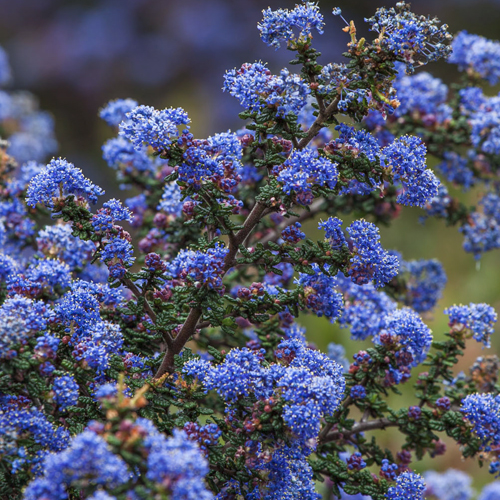
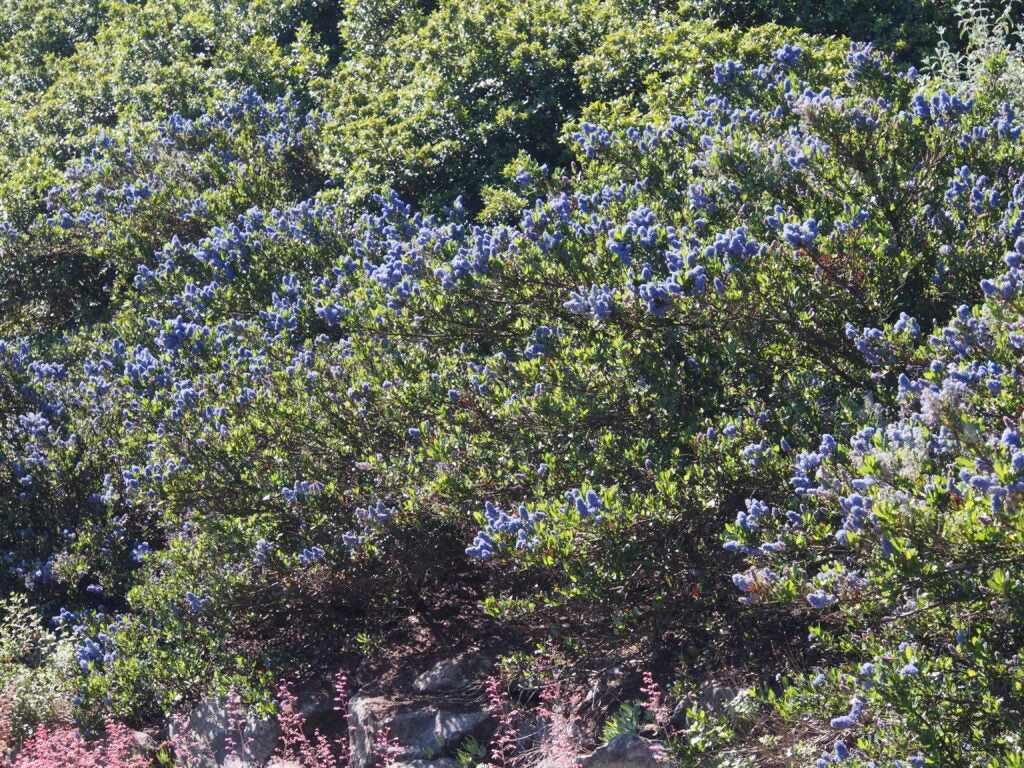
California Lilac ceanothus variety with clusters of small, vibrant blue flowers and dark green leaves

Ceanothus spp & cvs

Ceanothus
Organization

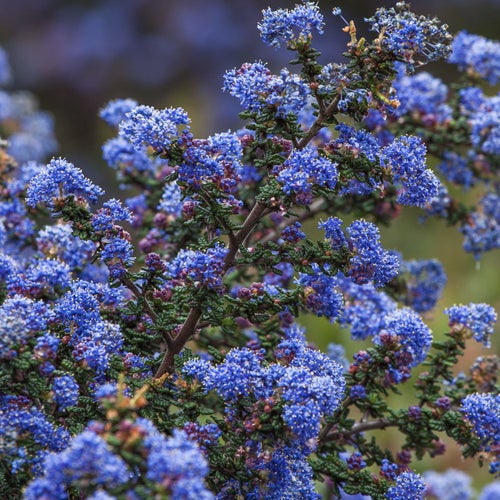
Ceanothus is a group of fast-growing, evergreen shrubs that vary from groundcovers to small trees, many of which are native to California. They provide a spectacular display of flowers in spring that will attract a multitude of pollinators. Flowers are followed by seeds that provide food for birds. The clusters of tiny flowers range from white to deep violet. Plants perform best with good drainage and minimal irrigation once established. Some do best in cooler coastal climates, but many thrive in hotter inland climates. Pay close attention to the mature size when selecting ceanothus to ensure that it has sufficient space for its natural form.

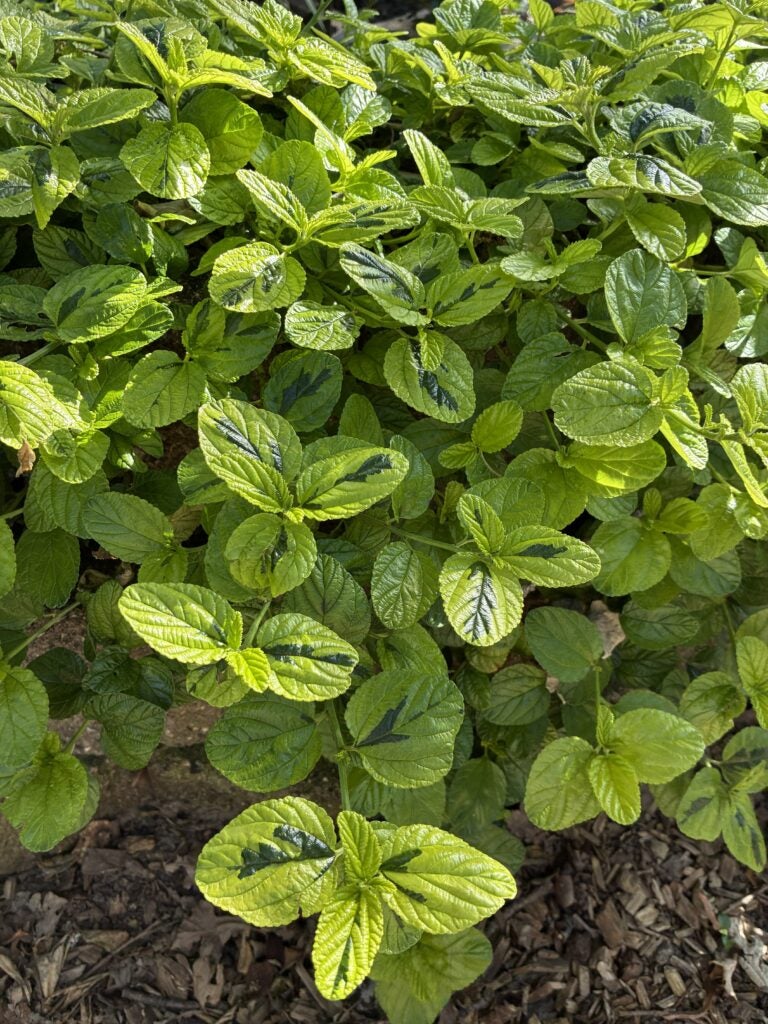
Groundcovers: C. ‘Centennial’ (1’ x 8’), C. gloriosus var. gloriosus ‘Anchor Bay’ (2’ x 8’), C. griseus var. horizontalis ‘Diamond Heights’ (variegated, 1’ x 4’), C. griseus var. horizontalis ‘Yankee Point’ (3’ x 12’), C. maritimus (2’ x 6’).

Shrubs: C. ‘Blue Jeans’ (6’ x 6’), C. Concha (6’ x 6’), C. ‘Dark Star’ (6’ x 8’), C. ‘Joyce Coulter’ (4’ x 12’), C. ‘Julia Phelps’ (8’ x 10’), C. cuneatus (8’ x 8’), C. thyrsiflorus ‘Skylark’ (4’ x 6’).

Large shrubs: C. ‘Frosty Blue’ (10’ x 12’), C. thyrsiflorus (20’ x 20’), C. t. ‘Snow Flurry’ (white flower, 20’ x 20’).

Trees: C. ‘Ray Hartman’ (15′ x 15′)

  • Water: Very LowLow
  • Light: Full SunPartial Shade
  • Soil: Well Drained
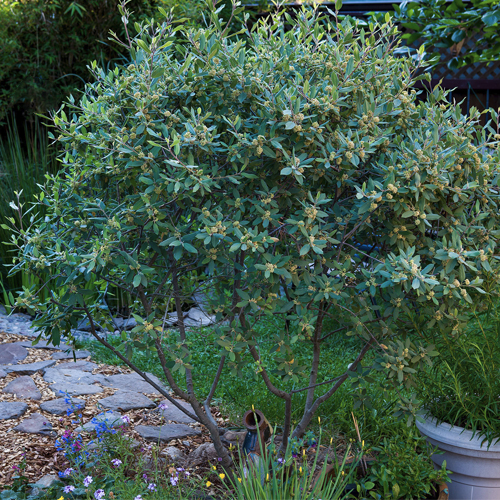
A small multi-trunked shrub with light brown bark, green leaves,, and clusters of tiny star-shaped light green flowers

Rhamnus [Frangula] californica

Coffeeberry
Organization

Evergreen shrub that has insignificant flowers followed by black berries. Flowers are attractive to pollinators, especially bees, and berries provide a food source for birds. Cultivars commonly sold in nurseries have differing growth habits and are often smaller than the species which grows 5-18’ x 10-18’.

Examples: F. c. ‘Eve Case’ (6-8’ x 6-8’), R. c. ‘Leatherleaf’ (5-6’ x 5-6’), R. c. ‘Mound San Bruno’ (6-8’ x 6-8’) with a dense, mounding growth habit.

Note: California coffeeberry was formerly classified as Rhamnus californica and is now classified as Frangula californica.

  • Water: Low
  • Light: Full SunPartial Shade
  • Soil: Most Soils
Large, round, green leaves and magenta tubular flowers insides of light pink honeysuckle petals

Lonicera spp

Honeysuckle
Organization

Honeysuckle is a varied group of evergreen and deciduous shrubs and vines with fragrant, tubular flowers. Several species are native to California and are well suited to gardens in Sonoma and Marin counties. Flowers are attractive to bees and hummingbirds and berries provide food for birds.

Examples: California honeysuckle (Lonicera hispidula) is a deciduous, vining shrub often seen growing in woodland environments. Cream and pink flower clusters in spring are followed by red berries in late summer. Twinberry (Lonicera involucrata, 6-10’ x 6-10’) is a deciduous shrub that typically grows along streams and other moist places. Tubular, red and yellow flowers grow in pairs, followed by dark pairs of berries. Provide light shade in warmer locations.

  • Water: Low
  • Light: Full SunPartial Shade
  • Soil: Well Drained
A dark green shrub with clusters of tiny white flowers with long stamens.

Holodiscus discolor

Ocean Spray
Organization

Also known as “Cream Bush,” “Arrowwood,” or “Ironwood,” this California native is known for its beautiful clusters of fragrant white flowers. Its wood is strong enough that it was historically used by indigenous peoples to fashion arrows, nails, and other tools. It grows up to 3-10 feet tall and wide at a quick pace. The plant is hardy, doing well in shade to part shade and most soils. It is a coastal plant that enjoys a bit of damp cold, but can also do well in dry climates.

  • Water: Low
  • Light: Partial ShadeShade
  • Soil: Most Soils
close up of yellow and red gooseberries with a dark brown spine on the bottom of each

Ribes spp

Currant, Gooseberry
Organization

Currants (without spines) and gooseberries (with spines) are grown for their graceful growth habit, attractive foliage, wonderful displays of pendulous flowers in winter-spring that are attractive to hummingbirds, and colorful fruit that provides a food source for birds. Most of the species listed are deciduous, going dormant in the summer months.

Examples: Some of the species suitable for California gardens, preferably with partial shade, are native to the Western United States:

  • aurem, golden currant (5-10’ x 3-6’), deciduous with small clusters of delicate yellow flowers and sprawling habit.
  • malvaceum, chaparral currant (4-8’ x 4-6’), deciduous with early clusters of pink flowers, a slightly vase-shaped habit, and more drought-tolerant than most species.
  • sanguineum var. glutinosum, pink-flowering currant (5-12’ x 5-12’), deciduous with maple-like leaves, a vase-shaped habit, and long pendulous clusters of pink, reddish, or white flowers in the spring; many available cultivars such as ‘Claremont’, ‘Tranquillon Ridge’, and ‘White Icicle’.
  • speciosum, fuchsia-flowered gooseberry (4-8’ x 6-10’), deciduous with spiny, arching stems and bright red fuchsia-like flowers along the stems in the spring that are attractive to hummingbirds.
  • viburnifolium, evergreen currant or Catalina perfume (2-4’ x 5-7’), evergreen groundcover that works well under oaks and can provide erosion control to slopes.
  • Water: Very LowLow
  • Light: Full SunPartial ShadeShade
  • Soil: Well Drained
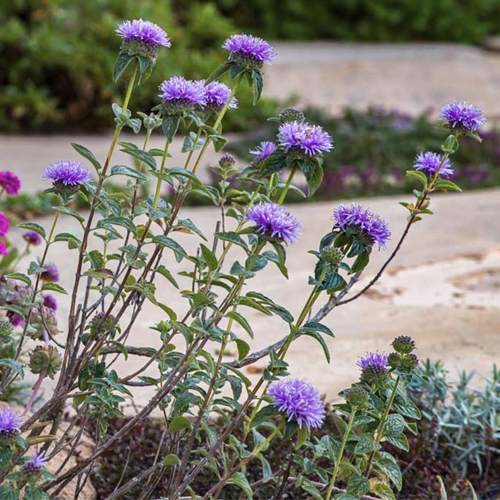
Dark brown stems with pointed green leaves and purple pompom flowers at the top of each stem

Monardella villosa

Coyote Mint
Organization

Coyote Mint is a compact perennial or sub-shrub with aromatic foliage and a sprawling habit. Dense heads of purple flowers form in spring-to-summer that are attractive to butterflies and other insects. The low-growth habit of coyote mint makes it an excellent choice for the front of a border, along the edge of a path, or beneath larger shrubs such as manzanita or ceanothus. Monardella villosa spp. franciscana ‘Russian River’ and Monardella villosa spp. villosa ‘Mark West’ are available selections from Sonoma County.

  • Water: Very Low
  • Light: Full Sun
  • Soil: Most Soils
Many small, dandelion-colored flowers poke off a small gumplant bush

Grindelia spp

Gumplant
Organization

Group of herbaceous perennials in the sunflower family that are native to the Americas. Grindelia stricta is native to the west coast of America, including California, with yellow daisy-like flowers in the dry summer months. Spreading gum plant (G. s. var. platyphylla) is a low-growing groundcover form that can reach 6-10’ across. Suitable for meadow plantings.

  • Water: Low
  • Light: Full SunPartial Shade
  • Soil: Well Drained
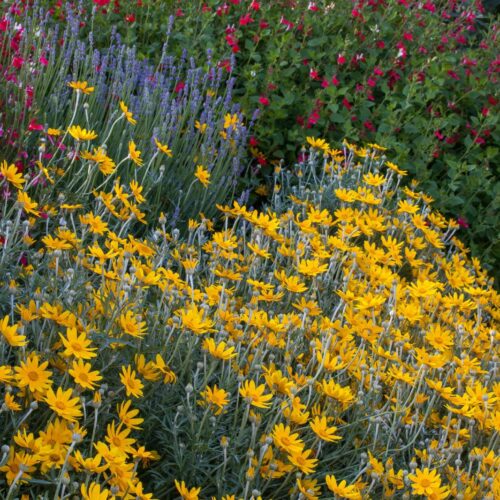
A small shrub with gray green lobed leaves and upright stems with a single yellow sunflower on top.

Eriophyllum lanatum

Common Woolly Sunflower
Organization

The Common Wooly Sunflower is native to northern California up to British Columbia and east to Wyoming. Many cultivars are available. Generally, they grow less than 1 foot to 2 feet tall and 2-3 feet wide. They have upright stems with wooly leaves and a singular sunflower atop each stem. It tolerates a wide variety of well-draining soils. Cut back in late winter to renew.

  • Water: Low
  • Light: Full SunPartial Shade
  • Soil: Well Drained
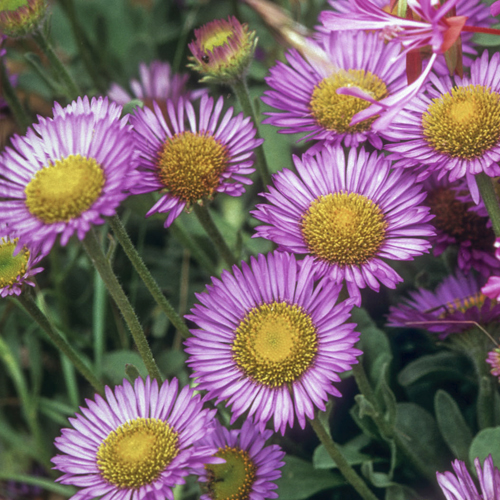
A collection of daisylike, purple flowers with large yellow disk florets and dark green stems

Erigeron spp

Beach Aster, Seaside Daisy
Organization

Group of flowering annuals and perennials mostly native to North America. Two species are commonly grown in California gardens. Beach aster (E. glaucus, 12” x 18”) is native to coastal California and Oregon and has purple flowers with yellow centers from spring into summer. Santa Barbara daisy (E. karvinskianus, 10-18” x 2-3’) has white and pink flowers with yellow centers. This plant can self-sow aggressively but is easily pulled.

Examples: E. g. ‘Wayne Roderick’ has deep purple flowers. E. g. ‘White Lights’ is a white- flowering form from Sonoma County.

  • Water: Low
  • Light: Full SunPartial Shade
  • Soil: Most Soils
Gray green spiney leaves with dark stems forming clusters of small, light pink flowers

Eriogonum spp

Buckwheat
Organization

Diverse group of flowering, evergreen shrubs and perennials and annuals found throughout the western United States. Most available in nurseries are native to California and generally prefer drier sites. Flowers colors include yellow, white, pink, and red and are held above foliage in umbels that dry over time and are popular in flower arrangements. Buckwheats provide pollen and nectar for bees and butterflies, larval food for butterflies, seeds for birds, and cover for many creatures.

Examples:

  • Santa Cruz Island buckwheat (E. arborescens, 3-4’ x 4-5’) densely mounded with white flowers.
  • Saffron buckwheat (E. crocatum, 1-2’ x 2-3’) with chartreuse-yellow flowers and pale leaves.
  • California buckwheat (E. fasciculatum, 2-3’ x 3’) and its low-growing cultivars such as E. f. ‘Warriner Lytle.’
  • Catherine’s lace (E. giganteum, 4-8’ x 6-10’) with delicate, white flowers and soft pale leaves.
  • Red-flowered buckwheat (E. grande var. Rubescens, 1-2’ x 2-3’) low-mounding perennial with rose-pink flowers, coastal bluff buckwheat (E. latifolium, up to 12” x 1-2’.)
  • Sulfur buckwheat (E. umbellatum, 6-18” x 1-3’) with intense yellow flowers and cultivars E. u. var. aureum ‘Kannah Creek’ and E. u. Var. ‘Shasta Sulphur’.
  • Water: Very LowLow
  • Light: Full SunPartial Shade
  • Soil: Well Drained
Desaturated green stems sway to one side with narrow leaves and vibrant purple trumpet flowers.

Penstemon heterophyllus

Blue Foothill Penstemon, California Penstemon
Organization

Penstemons are a large group of woody or herbaceous perennials with narrow leaves and tubular flowers. Foothill penstemon is a widely known and grown California native with iridescent purple-blue flowers during spring and early summer that are attractive to hummingbirds. The cultivar known as ‘Margarita BOP’ is widely available, reliable, and garden- tolerant. Remove spent flower spikes to encourage more flowers.

  • Water: Low
  • Light: Full SunPartial Shade
  • Soil: Well Drained
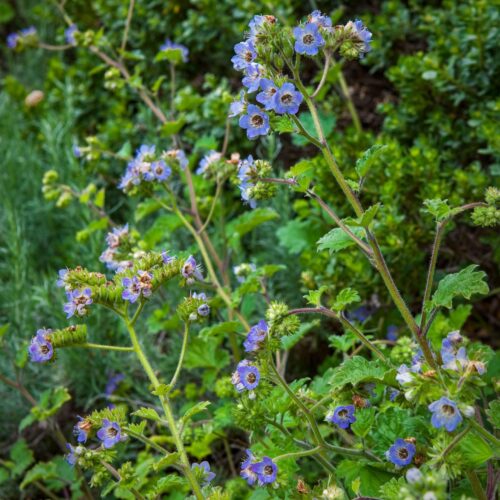
Gray green leaves along upright, brown and green stems with tiny blue-lavender flower clusters on top of each.

Phacelia californica

Rock Phacelia
Organization

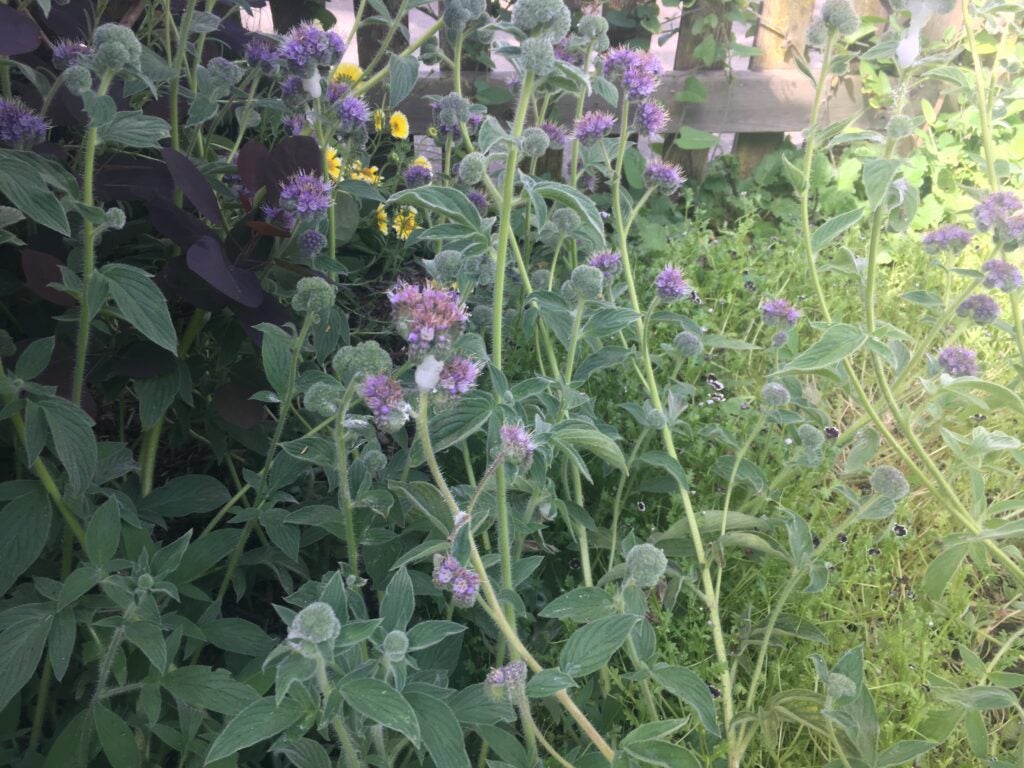
As a northern California coastal native, this plant is a favorite of many pollinators, including the endangered Mission blue butterfly from San Francisco. Its hairy leaves and stems give way to tiny blue or lavender flowers, each under a centimeter long. The funnel-shaped flowers grow in one-sided, coiled clusters that uncurl as the flowers open in sequence. It grows to about 1 foot tall and wide and prefers well-drained soil in sun to part shade.

  • Water: Low
  • Light: Full SunPartial Shade
  • Soil: Well Drained
Long, slightly pointed light gray-green sage leaves

Salvia spp

Sage
Organization

Salvias are a huge group of more than 900 species that include annuals, perennials, and shrubs adapted to a variety of climates and have varying water requirements. Salvias are attractive to hummingbirds, butterflies, and bees, and are generally ignored by deer. Sages that are native to California are generally drought-tolerant, prefer full sun, and little to no fertilizer. Annual pruning in late summer or fall generally helps to keep plants tidy and healthy.

CA native sages:

  • S. apiana, white sage (3-4’ x 4-6’), silvery-white, aromatic leaves with tall flower spikes of white flowers, popular for honey production and in bundles as a natural incense.
  • ‘Bee’s Bliss’ (1-2’ x 6-8’), superb, light gray groundcover with light purple flowers on long spikes; damp conditions can cause mildew which will clear with warm weather and sunny conditions.
  • S. clevelandii, Cleveland sage (3-5’ x 3-5’), medium-sized shrub for hot, dry locations known for pleasant fragrance and deep blue whorls of flowers; popular cultivars include S. c. ‘Allen Chickering’, S. c. ‘Pozo Blue’, and S. c. ‘Winnifred Gilman’.
  • S. leucophylla, purple sage, includes plants with both an upright growth habit, such as S. l. ‘Amethyst Bluff’ (3-5’ x 3-5’) and others with a sprawling form, such as S. l. ‘Point Sal’ (2-3’ x 6’), both of which are from Santa Barbara county.
  • S. sonomaensis, Sonoma sage (1-2’ x 3-4’), groundcover that prefers light shade and will not tolerate damp conditions; cultivars include S. s. ‘Dara’s Choice’, S. s. ‘Greenberg Gray’, and S. s. ‘Hobbit Toes’.
  • S. spathacaea, hummingbird sage (1-2’ spreading), herbaceous groundcover that grows well in dry shade and spreads slowly by underground rhizomes; large leaves have a wonderful fruity fragrance; the only red-flowered native sage.
  • S. mellifera, black sage (6′ x 10′), evergreen shrub that grows well in full sun and well drained soils. Dark green leaves with pale purple flowers in late spring and early summer.

Non-native sages:

  • S. chamaedryoides, germander sage (2-3’)
  • S. chiapensis, Chiapas sage (1-2’ x 3-4’)
  • S. greggii, autumn sage (1-4’ x 1-4’)
  • S. leucantha, Mexican bush sage (3-4’ x 3-6’)
  • S. microphylla, cherry sage (3-4’ x 3-6’)
  • S. officinalis, garden sage (1-3’ x 1-3’)
  • Water: Very LowLowModerate
  • Light: Full SunPartial Shade
  • Soil: Well Drained
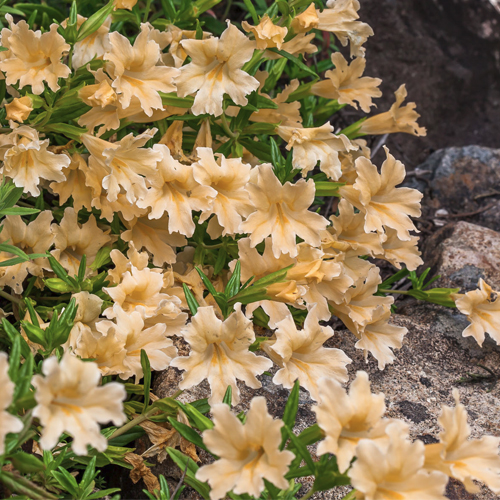
A group of small, peach-colored trumpet flowers with green leaves.

Mimulus aurantiacus and hybrids

Sticky Monkey Flower
Organization

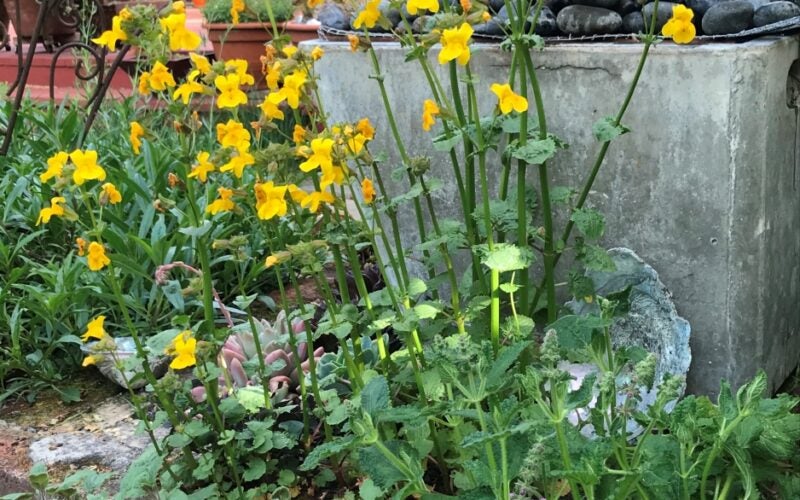
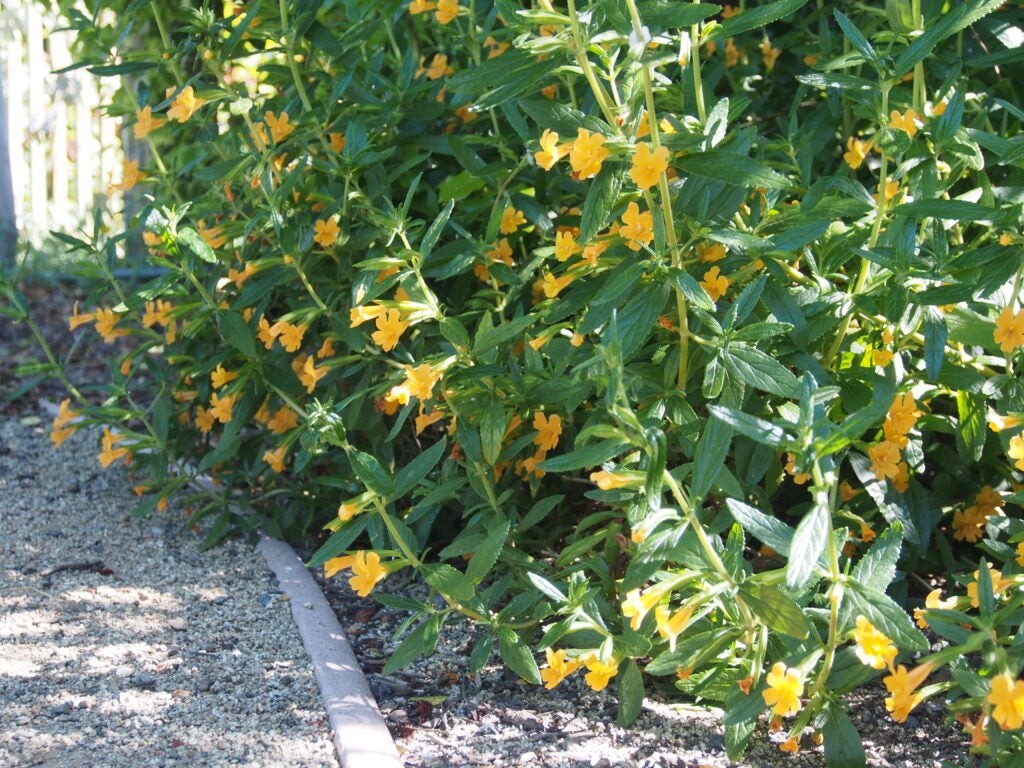
The orange, tubular flowers of sticky monkey flower can be enjoyed in many locations throughout Sonoma and Marin counties in spring and summer, a testament to how well this plant is adapted to hot and dry conditions. The slightly sticky leaves benefit from light pinching and pruning to maintain an attractive appearance and support for the beautiful flowers. Many hybrids provide color variation. Do not confuse this plant with the red-flowered scarlet monkey flower (Mimulus cardinalis), an herbaceous riparian plant that requires regular water to thrive.

  • Water: Very Low
  • Light: Full SunPartial Shade
  • Soil: Sandy