Firewise Oasis

BACK TO FULL TOUR

Garden Features

1

Drought Tolerant

2

California Natives

3

Deer Resistant

4

Drip Irrigation

5

Pesticide Free

6

Rain Garden

7

Sheet Mulching

8

Smart Irrigation Controller

9

Lawn Conversion

10

Lawn-Free Landscaping

11

Permeable Surfaces

12

Wildlife Habitat

Partner: California Native Plant Society - Milo Baker Chapter

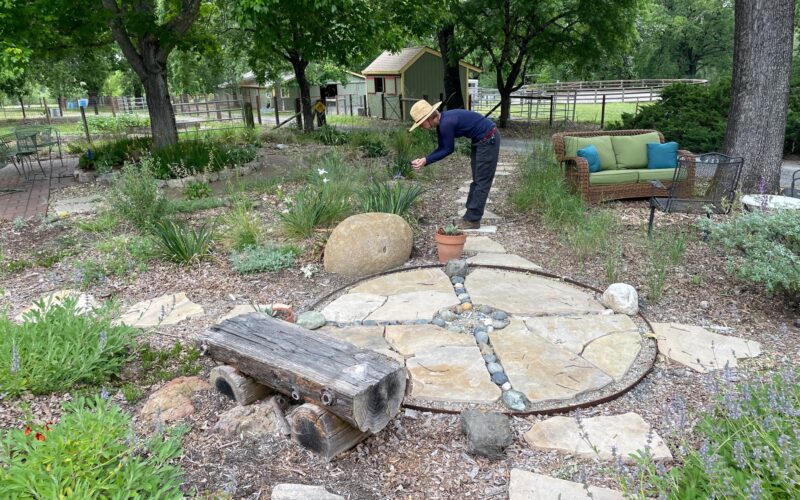
This garden was created in collaboration with April Owens Designs, Sonoma Ecology Center and the team at the Resilient Landscapes Coalition to feature native plants in a sustainable, biodiverse, firewise landscape. The Resilient Landscapes Coalition (Sonoma Ecology Center, Habitat Corridor Project, UC Master Gardeners, Fire Safe Sonoma) provides education about gardening in the Defensible Space and beyond, and this garden is a great demonstration of those principles.

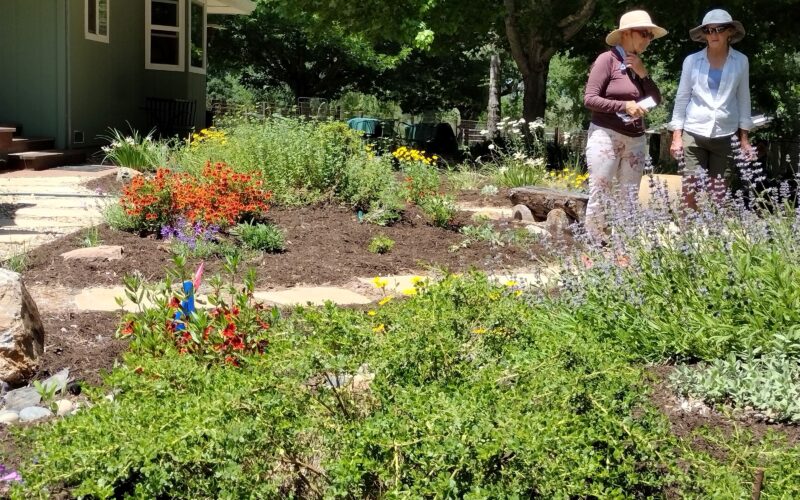
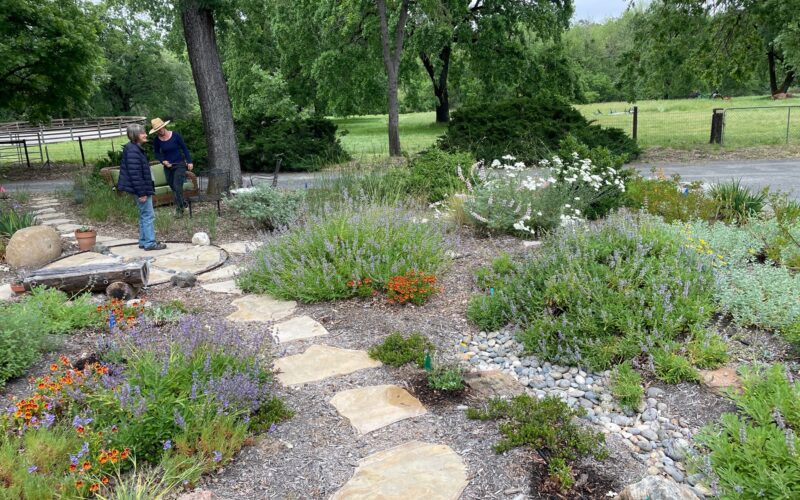
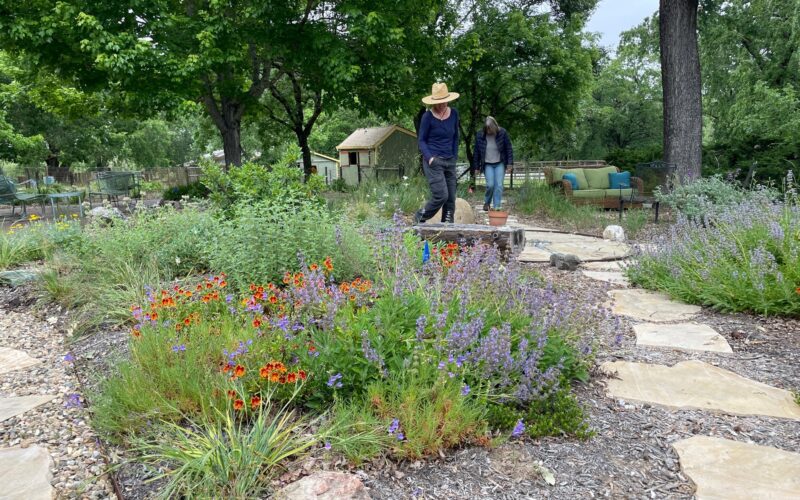
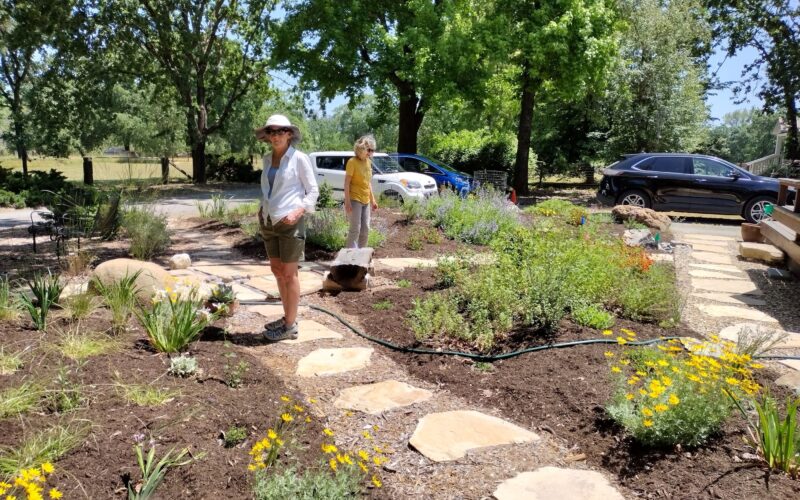
I LOVE native plants and the creatures drawn to them. This is a young and evolving garden, only 2 years old, an oasis of beautiful 100% native plants with a riot of textures and colors that attract humans, butterflies, birds, bumble bees, and other pollinators. A friend visited last spring and a hummingbird, initially interested in our California fuscia, hovered 12” from my guest’s face attracted to the red flower on her hat.

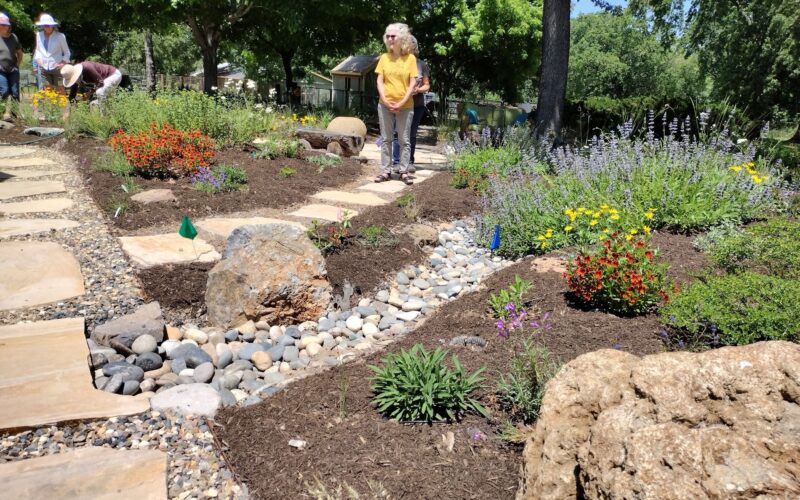
The garden is low maintenance, requiring a minimum amount of pruning and trimming a few times a year, and also uses very little water. Downspouts are directed into cobbled swales, which concentrate and conserve water in the soil well into the summer.

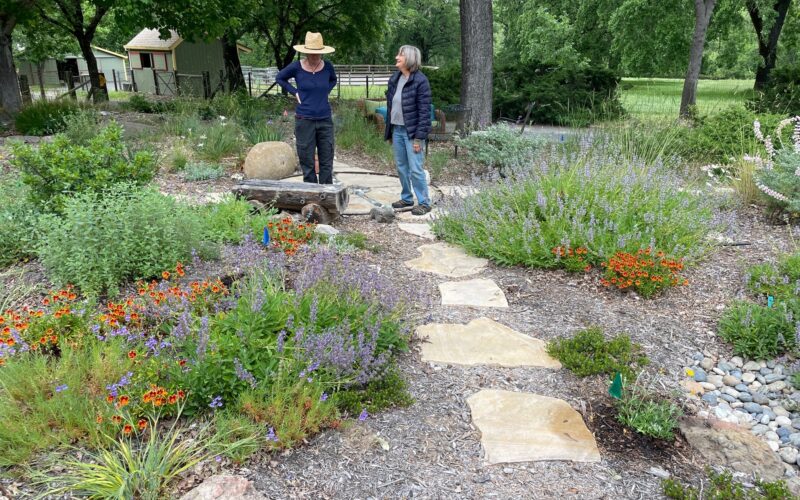
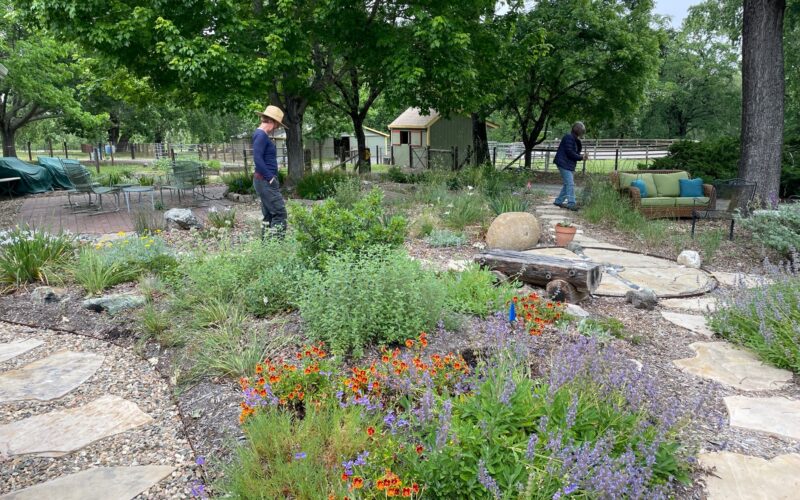
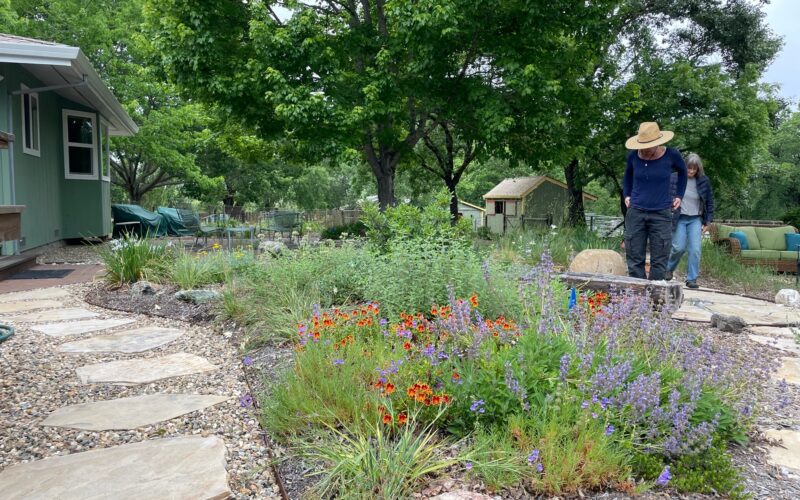
Our goals included creating defensible space to protect the home from burning during a wildfire. After “hardening the home” by installing 1/8” mesh over all vents and around the perimeter of the deck, to keep embers from entering, we installed a 5’ edging of decorative gravel around the home and deck, removing all flammable material. Without the traditional “foundation planting”, which can create a fire hazard, the edging of gravel is very attractive and integrates with the other firewise features, like islands of low native shrubs, perennials, grasses and annual plants in the 5-30’ zone around the home. The planting islands, filled with Salvia, Epilobium, Eriphyllum, Monardella, Baccharis pilularis, Arctostaphylos (prostrate and shrub), Penstemon, Diplacus (Mimulus), Lupinus, and a number of different native grasses, are separated by non-flammable flagstone and gravel pathways that allow you to meander through, with seating areas to afford different views of the plantings and surrounding valley oak savannah, and distant Atascadero Creek.

In the Graton area we have a wide temperature gradient in summer, with highs in the 100s on some summer days, and lows in the 40s. Fortunately much of the garden is partly shaded by a large valley oak, allowing us to experiment with part-shade loving plants like Festuca californica, Potentilla, and Heuchera.

Overall in two short years we have achieved our goal of creating a garden that is lush and attractive all year, provides food and shelter for a variety of wildlife and pollinators, and beauty and safety for humans. Please come join us!

Special Events
CNPS Information Table

Plants in this Garden

Plant Picker
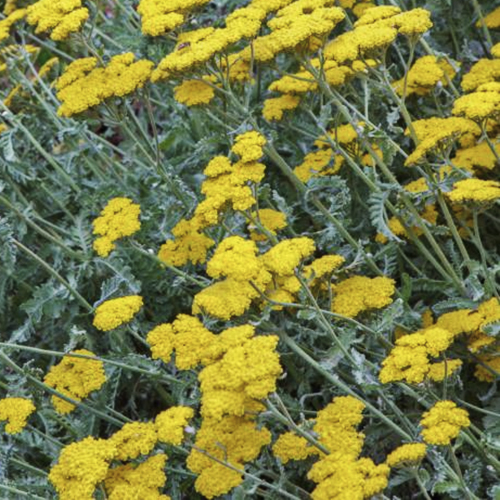
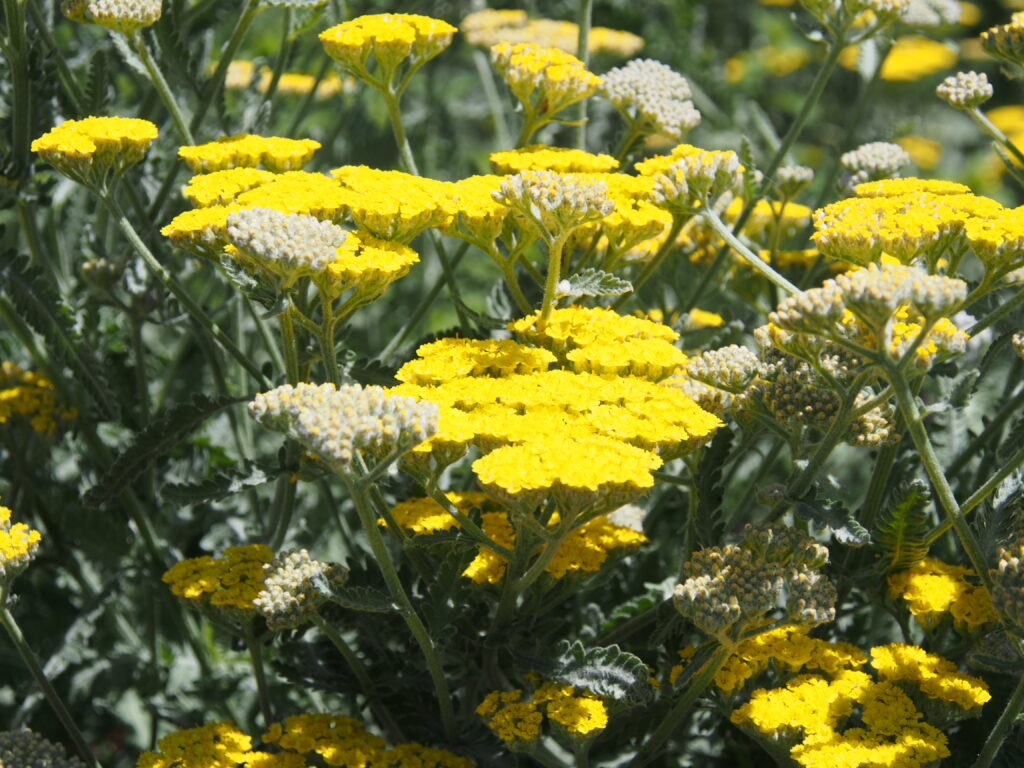
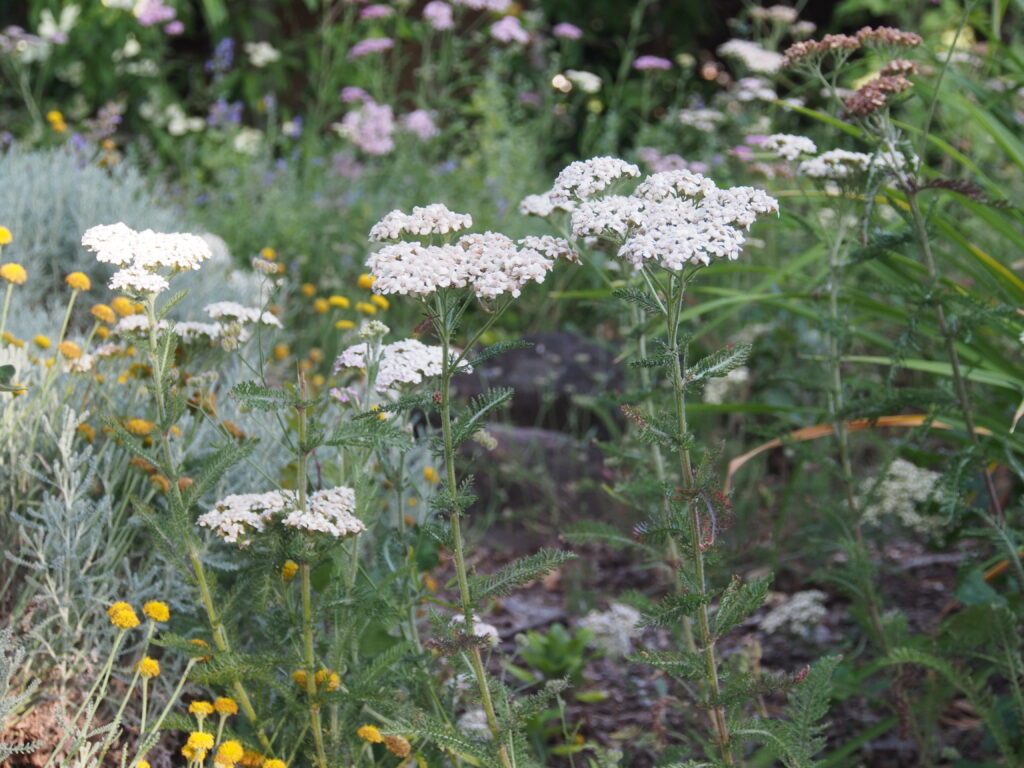
Corymb inflorescent yellow yarrow flowers on gray-green leaves and stems
White yarrow.
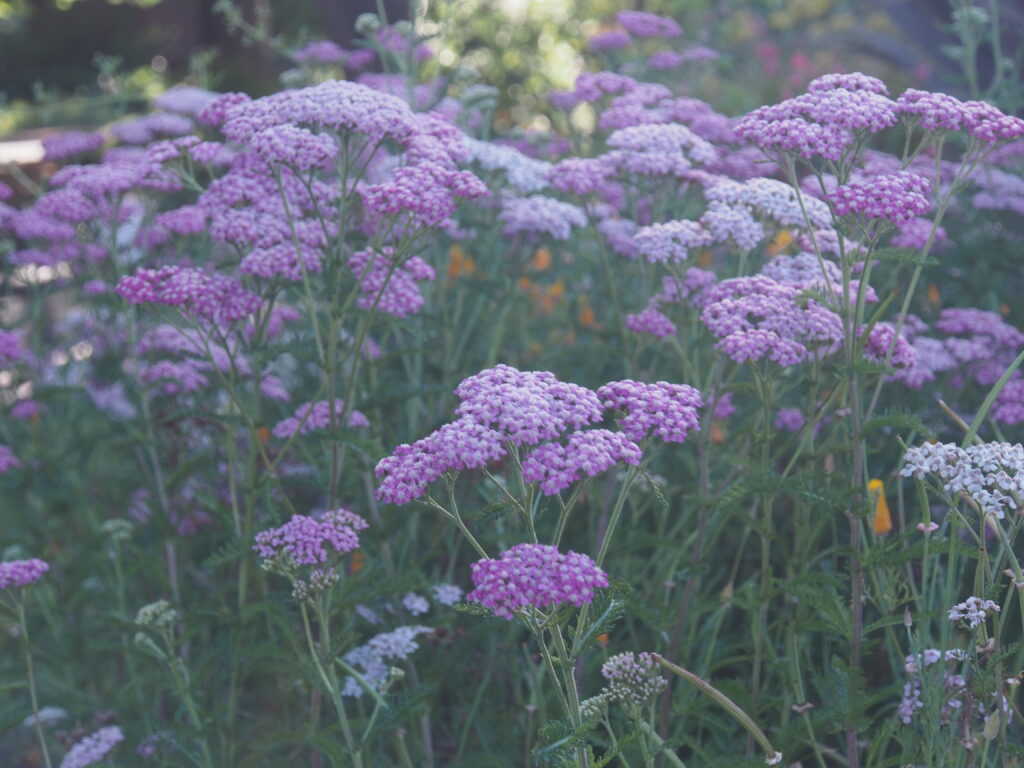
Purple yarrow.
Yellow and white yarrow.

Achillea spp & cvs

Yarrow
Organization

Yarrows are variable low-growing, spreading herbaceous perennials with finely divided leaves that inhabit many temperate regions in the Northern Hemisphere. Flattish clusters of flowers form in spring and well into summer and provide an important nectar source for pollinators and insects. Yarrow can help to stabilize slopes and is a good addition to the upper level of rain gardens and swales. Colors include yellow, pink, and red.

California native spp & cvs: A. millefolium (common yarrow), A. m. ‘Calistoga’, A. m. ‘Island Pink’, A. m. ‘Sonoma Coast’, A. m. ‘Terracotta’.

Other yarrows: A. filipendulina (fern leaf yarrow), A. f. ‘Coronation Gold’, A. ‘Moonshine’, A. tomentosa (woolly yarrow).

  • Water: Low
  • Light: Full SunPartial Shade
  • Soil: Most Soils
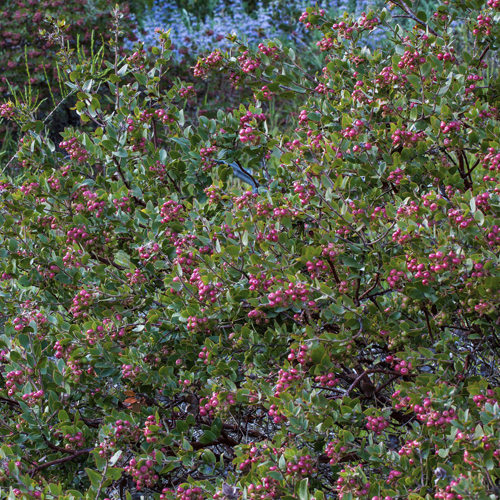
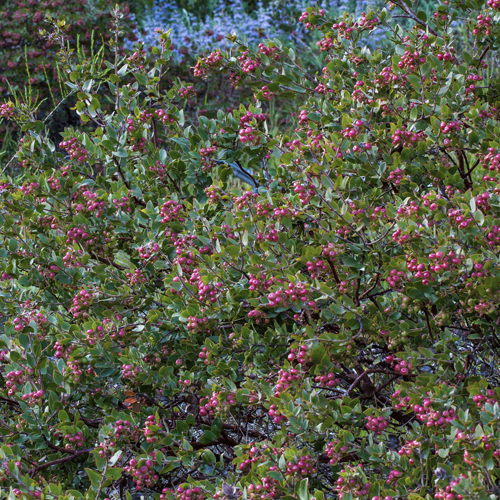
Manzanita bush with deep red fruits

Arctostaphylos spp & cvs

Manzanita, 'Dr. Hurd'
Organization

Manzanitas vary from carpet-forming groundcovers to small trees. Manzanitas have varying shades of striking, reddish brown bark and can provide structure to a garden. These plants have evergreen foliage, small white-to-pink, urn-shaped blossoms in late winter to early spring, and then small fruits that resemble tiny apples.

Groundcovers: A. ‘Emerald Carpet’ (1’ x 3-6’), A. ‘Pacific Mist’ (2-3’ x 6-8’), A. nummularia ‘Bear Belly’ (1’ x 3’), A. uva ursi ‘Radiant’ (6” x 4-6’), A. uva ursi ‘Wood’s Compct’ (1’ x 3’).

Shrubs: A. ‘Howard McMinn’ (5-7’ x 6-10’), A. ‘John Dourly’ (3-4’ x 5-6’), A. ‘Lester Rowntree’ (8-10’ x 10-15’), A. ‘Sunset‘ (5-7’), A. bakeri ‘Louis Edmunds’ (8-10’), A. manzanita ‘Sentinel’ (6-8’ x 5’), A. hookeri ‘Wayside’ (3′ x 8′).

Trees: A. manzanita ‘Dr. Hurd’ (10-15′)

  • Water: Very LowLow
  • Light: Full SunPartial Shade
  • Soil: Well Drained
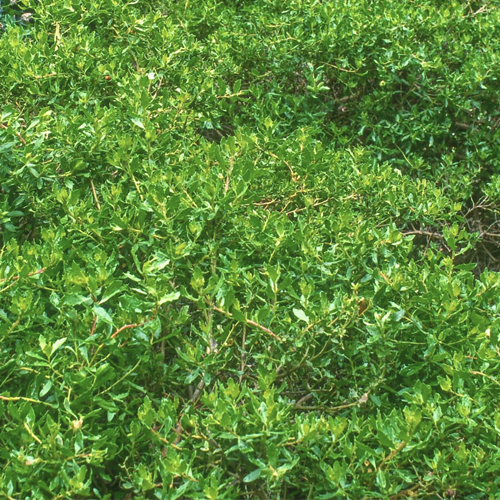
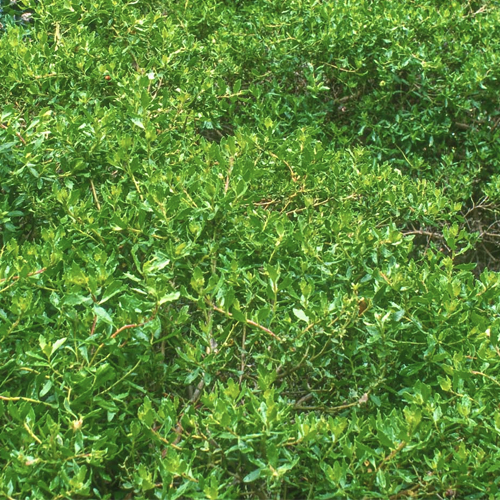
Vibrant, shiny, light green foliage of the dwarf coyote bush

Baccharis pilularis & cvs

Dwarf Coyote Bush
Organization

Flowers are inconspicuous but provide a source of pollen, nectar, and seeds for wildlife. Shrubby varieties can be cut back to maintain a more tidy and compact appearance. Perennial varieties can be divided in fall or early spring. Excellent choice as support for more showy plants in the garden.

  • Water: Low
  • Light: Full Sun
  • Soil: Most Soils
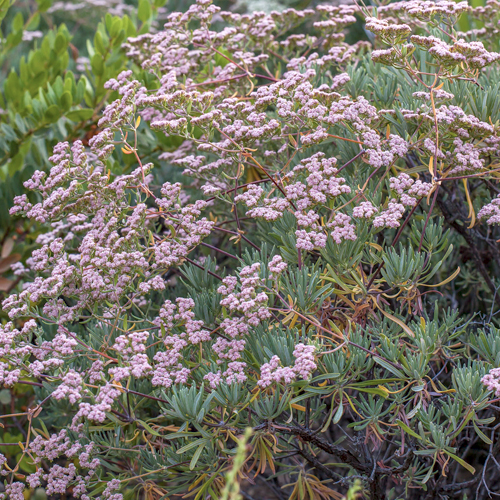
Gray green spiney leaves with dark stems forming clusters of small, light pink flowers

Eriogonum spp

Buckwheat
Organization

Diverse group of flowering, evergreen shrubs and perennials and annuals found throughout the western United States. Most available in nurseries are native to California and generally prefer drier sites. Flowers colors include yellow, white, pink, and red and are held above foliage in umbels that dry over time and are popular in flower arrangements. Buckwheats provide pollen and nectar for bees and butterflies, larval food for butterflies, seeds for birds, and cover for many creatures.

Examples:

  • Santa Cruz Island buckwheat (E. arborescens, 3-4’ x 4-5’) densely mounded with white flowers.
  • Saffron buckwheat (E. crocatum, 1-2’ x 2-3’) with chartreuse-yellow flowers and pale leaves.
  • California buckwheat (E. fasciculatum, 2-3’ x 3’) and its low-growing cultivars such as E. f. ‘Warriner Lytle.’
  • Catherine’s lace (E. giganteum, 4-8’ x 6-10’) with delicate, white flowers and soft pale leaves.
  • Red-flowered buckwheat (E. grande var. Rubescens, 1-2’ x 2-3’) low-mounding perennial with rose-pink flowers, coastal bluff buckwheat (E. latifolium, up to 12” x 1-2’.)
  • Sulfur buckwheat (E. umbellatum, 6-18” x 1-3’) with intense yellow flowers and cultivars E. u. var. aureum ‘Kannah Creek’ and E. u. Var. ‘Shasta Sulphur’.
  • Water: Very LowLow
  • Light: Full SunPartial Shade
  • Soil: Well Drained
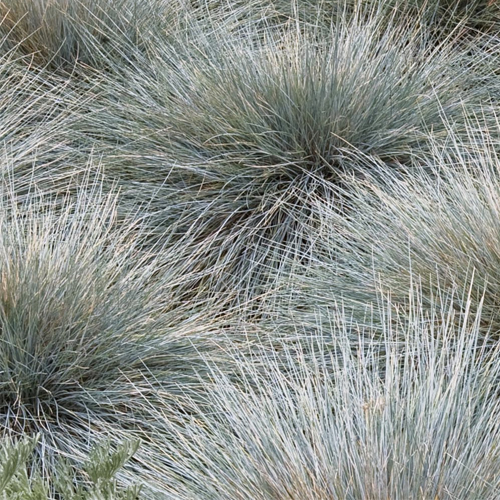
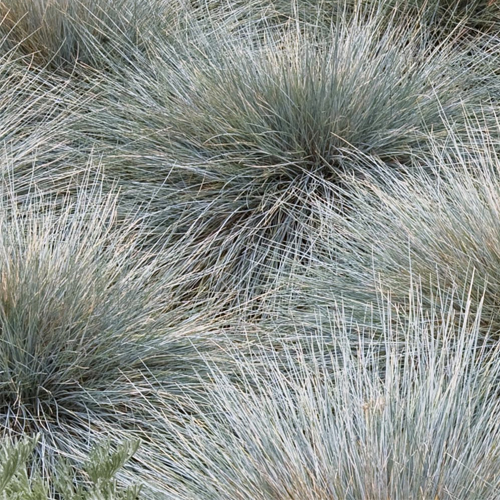
Grayish green bushes of long, thin grass

Festuca spp

Fescue
Organization

Large group of mostly cool-season, perennial, bunching or spreading grasses. Bunch grass varieties can be used as a no-mow lawn replacement, help to stabilize slopes, and have ornamental value. Festuca californica (California fescue, 1-2’ wide x 2’) prefers part shade and works wonderfully massed under the dry shade of native oaks. Festuca glauca (blue fescue, 1’ x 1’) is a small, clumping grass with bluish gray-green leaves. Festuca idahoenis (Idaho fescue, 1-2’ wide x 1’) also has bluish gray-green leaves and is more drought-tolerant and longer lived than blue fescue. Festuca rubra (red fescue) grows from rhizomes and has long, fine-textured leaves that lay over to form a pleasing drift effect as a no-mow lawn.

  • Water: Very LowLow
  • Light: Full SunPartial Shade
  • Soil: Well Drained
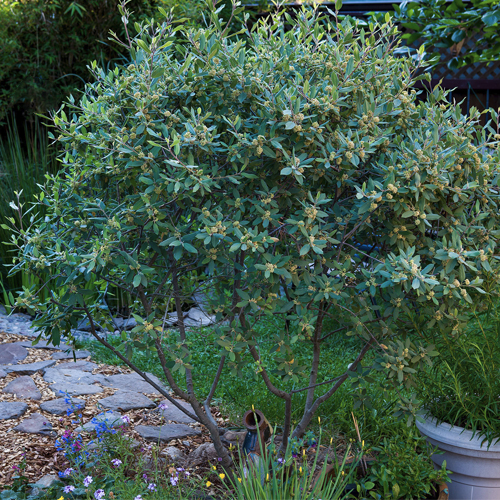
A small multi-trunked shrub with light brown bark, green leaves,, and clusters of tiny star-shaped light green flowers

Rhamnus [Frangula] californica

Coffeeberry
Organization

Evergreen shrub that has insignificant flowers followed by black berries. Flowers are attractive to pollinators, especially bees, and berries provide a food source for birds. Cultivars commonly sold in nurseries have differing growth habits and are often smaller than the species which grows 5-18’ x 10-18’.

Examples: F. c. ‘Eve Case’ (6-8’ x 6-8’), R. c. ‘Leatherleaf’ (5-6’ x 5-6’), R. c. ‘Mound San Bruno’ (6-8’ x 6-8’) with a dense, mounding growth habit.

Note: California coffeeberry was formerly classified as Rhamnus californica and is now classified as Frangula californica.

  • Water: Low
  • Light: Full SunPartial Shade
  • Soil: Most Soils
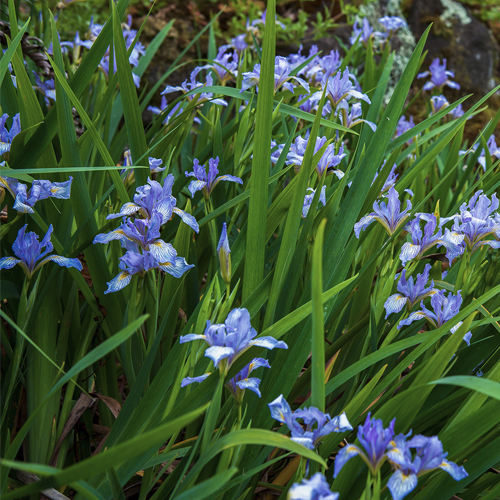
Dark green, grass-like leaves with deep blue flowers with pointy, ruffled petals

Iris douglasiana & cvs

Douglas Iris, Pacific Coast Hybrids
Organization

Iris are a large and diverse group of perennials that grow from either bulbs or rhizomes. The California native Douglas iris and cultivars known as Pacific Coast Hybrids are an excellent choice for summer-dry gardens and understory plantings. Fall rain brings new growth in the form of thin, upright leaves, followed in late winter to early spring by the first blossoms. Douglas iris commonly ranges in color from lavender to purple, but cultivars are available in a range of colors including white and yellow. Established plantings can be lifted and divided after the first significant fall rain and either replanted or put into containers to share with others.

  • Water: Low
  • Light: Partial ShadeShade
  • Soil: Most Soils
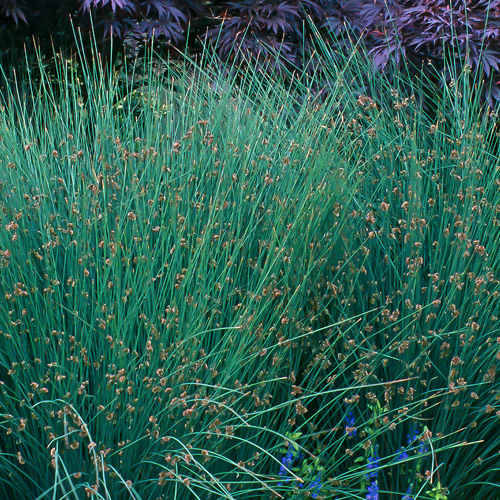
Tall blue-gray bushes of grass with small brown tips.

Juncus patens

California Grey Rush
Organization

California gray rush is a go-to species for the summer-dry rain garden. It will thrive in moist conditions and its roots will help stabilize soil and filter stormwater runoff. It is also tolerant of extended periods of drought. Clumps of stiff, upright foliage provide an interesting contrast among other perennials. ‘Elk Blue’ is a widely available selection from Mendocino County. Its bluish gray foliage is shorter than the typical gray rush.

  • Water: Low
  • Light: Full SunPartial Shade
  • Soil: Well Drained
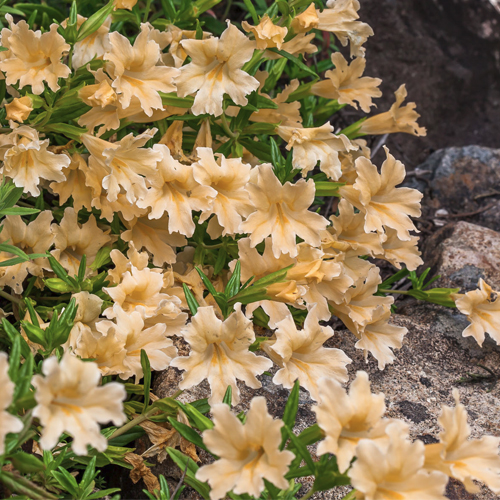
A group of small, peach-colored trumpet flowers with green leaves.

Mimulus aurantiacus and hybrids

Sticky Monkey Flower
Organization

The orange, tubular flowers of sticky monkey flower can be enjoyed in many locations throughout Sonoma and Marin counties in spring and summer, a testament to how well this plant is adapted to hot and dry conditions. The slightly sticky leaves benefit from light pinching and pruning to maintain an attractive appearance and support for the beautiful flowers. Many hybrids provide color variation. Do not confuse this plant with the red-flowered scarlet monkey flower (Mimulus cardinalis), an herbaceous riparian plant that requires regular water to thrive.

  • Water: Very Low
  • Light: Full SunPartial Shade
  • Soil: Sandy
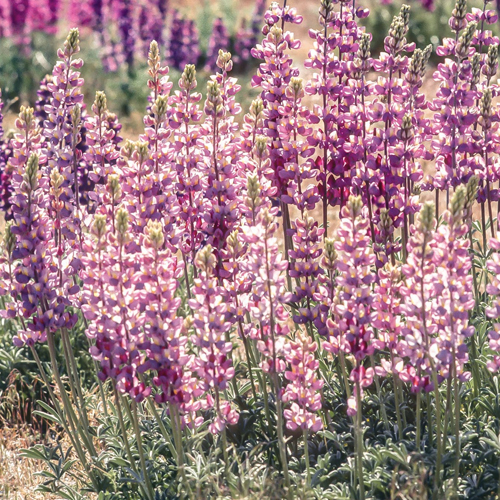
Pink-purple lupine raceme inflorescent flower clusters.

Lupinus spp

Lupine
Organization

Popular group of annuals, perennials, and shrubs with distinctive divided leaves that are common throughout the western United States, including California. Pea-like flowers are displayed on spikes and are attractive to bees and other pollinators. Most native lupines are purple-flowered, while some are yellow. Provide full sun and good drainage and watch out for slugs and snails.

Examples: Silver bush lupine (L. albifrons, 3-4’ x 3-4’), prostate lupine (L. albifrons var. collinus, 12-18” x 12-18”), coastal bush lupine (L. arboreus) available with either blue or yellow flowers but can be invasive in some north coastal dunes, and blue-and-white lupine (L. bicolor) a low-growing, annual wildflower.

  • Water: Very Low
  • Light: Full Sun
  • Soil: Well Drained
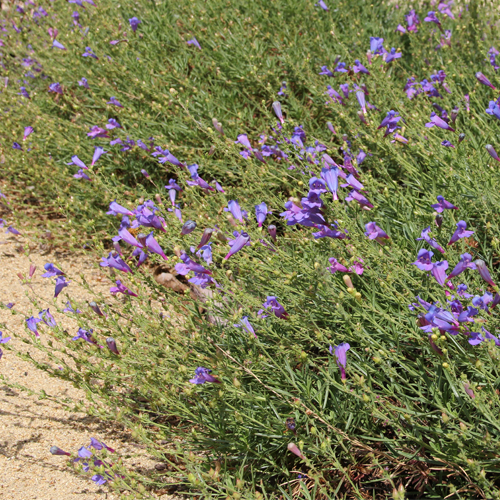
Desaturated green stems sway to one side with narrow leaves and vibrant purple trumpet flowers.

Penstemon heterophyllus

Blue Foothill Penstemon, California Penstemon
Organization

Penstemons are a large group of woody or herbaceous perennials with narrow leaves and tubular flowers. Foothill penstemon is a widely known and grown California native with iridescent purple-blue flowers during spring and early summer that are attractive to hummingbirds. The cultivar known as ‘Margarita BOP’ is widely available, reliable, and garden- tolerant. Remove spent flower spikes to encourage more flowers.

  • Water: Low
  • Light: Full SunPartial Shade
  • Soil: Well Drained
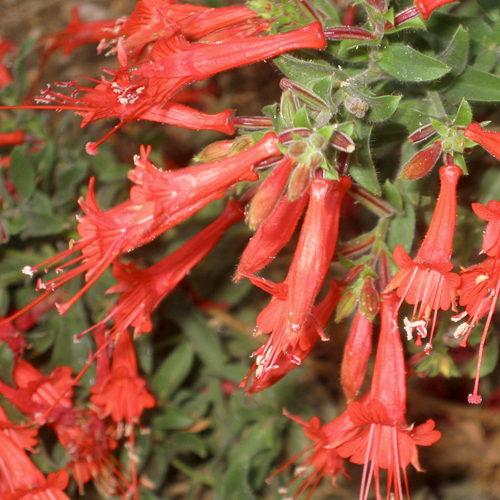
Red tubular flowers with white-tipped stamens sticking out

Zauschneria [Epilobium] spp

California Fuchsia
Organization

Group of highly variable, semi-evergreen subshrubs and herbaceous perennials distributed over a wide geographic area, including California. Epilobiums bloom in late summer with tubular flowers providing a food source for hummingbirds migrating south and are also attractive to bees and butterflies. Epilobiums range from low-growing groundcovers to upright plants of several feet. Flower colors include orange-red, white, pink, and salmon. Most can be pruned back in late autumn to maintain a more compact form and be rejuvenated for the following year.

Low-growing examples: E. ‘Schieffelin’s Choice’; E. canum ‘Calistoga’, a selection from Phil Van Soelen from California Flora Nursery from the Palisades east of Calistoga; E. canum ‘Cloverdale’, a selection from U.C. Santa Cruz Arboretum from along the Russian River north of Cloverdale with exceptionally orange flowers; E. c. ‘Everett’s Choice’, E. c. ‘Summer Snow’ with white flowers, and E. septentrionale ‘Select Mattole’, a somewhat redder flowering selection that is more shade-tolerant.

Upright examples: E. c. ‘Bowman’s Hybrid’ (2-3’), E. c. ‘Catalina’ (3-4’), E. c. ‘Liz’s Choice’ (3’) selected by Milo Baker Chapter CNPS Fellow Liz Parsons, E. c. ‘Marin Pink’ (2’) with pink flowers.

  • Water: Low
  • Light: Full Sun
  • Soil: Well Drained
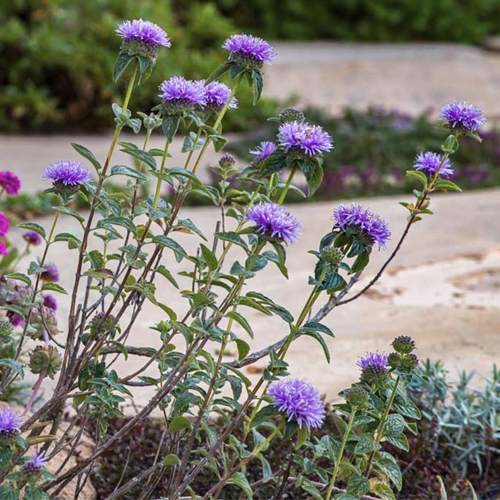
Dark brown stems with pointed green leaves and purple pompom flowers at the top of each stem

Monardella villosa

Coyote Mint
Organization

Coyote Mint is a compact perennial or sub-shrub with aromatic foliage and a sprawling habit. Dense heads of purple flowers form in spring-to-summer that are attractive to butterflies and other insects. The low-growth habit of coyote mint makes it an excellent choice for the front of a border, along the edge of a path, or beneath larger shrubs such as manzanita or ceanothus. Monardella villosa spp. franciscana ‘Russian River’ and Monardella villosa spp. villosa ‘Mark West’ are available selections from Sonoma County.

  • Water: Very Low
  • Light: Full Sun
  • Soil: Most Soils
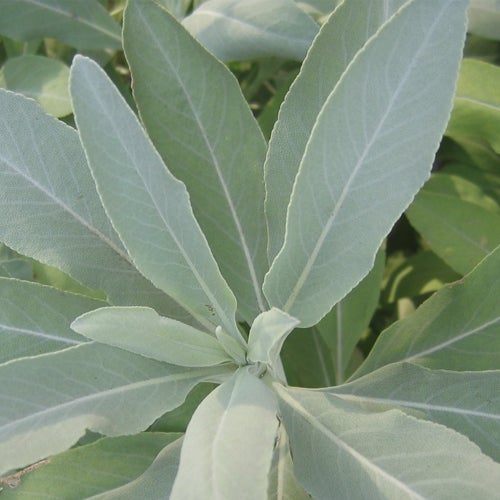
Long, slightly pointed light gray-green sage leaves

Salvia spp

Sage
Organization

Salvias are a huge group of more than 900 species that include annuals, perennials, and shrubs adapted to a variety of climates and have varying water requirements. Salvias are attractive to hummingbirds, butterflies, and bees, and are generally ignored by deer. Sages that are native to California are generally drought-tolerant, prefer full sun, and little to no fertilizer. Annual pruning in late summer or fall generally helps to keep plants tidy and healthy.

CA native sages:

  • S. apiana, white sage (3-4’ x 4-6’), silvery-white, aromatic leaves with tall flower spikes of white flowers, popular for honey production and in bundles as a natural incense.
  • ‘Bee’s Bliss’ (1-2’ x 6-8’), superb, light gray groundcover with light purple flowers on long spikes; damp conditions can cause mildew which will clear with warm weather and sunny conditions.
  • S. clevelandii, Cleveland sage (3-5’ x 3-5’), medium-sized shrub for hot, dry locations known for pleasant fragrance and deep blue whorls of flowers; popular cultivars include S. c. ‘Allen Chickering’, S. c. ‘Pozo Blue’, and S. c. ‘Winnifred Gilman’.
  • S. leucophylla, purple sage, includes plants with both an upright growth habit, such as S. l. ‘Amethyst Bluff’ (3-5’ x 3-5’) and others with a sprawling form, such as S. l. ‘Point Sal’ (2-3’ x 6’), both of which are from Santa Barbara county.
  • S. sonomaensis, Sonoma sage (1-2’ x 3-4’), groundcover that prefers light shade and will not tolerate damp conditions; cultivars include S. s. ‘Dara’s Choice’, S. s. ‘Greenberg Gray’, and S. s. ‘Hobbit Toes’.
  • S. spathacaea, hummingbird sage (1-2’ spreading), herbaceous groundcover that grows well in dry shade and spreads slowly by underground rhizomes; large leaves have a wonderful fruity fragrance; the only red-flowered native sage.
  • S. mellifera, black sage (6′ x 10′), evergreen shrub that grows well in full sun and well drained soils. Dark green leaves with pale purple flowers in late spring and early summer.

Non-native sages:

  • S. chamaedryoides, germander sage (2-3’)
  • S. chiapensis, Chiapas sage (1-2’ x 3-4’)
  • S. greggii, autumn sage (1-4’ x 1-4’)
  • S. leucantha, Mexican bush sage (3-4’ x 3-6’)
  • S. microphylla, cherry sage (3-4’ x 3-6’)
  • S. officinalis, garden sage (1-3’ x 1-3’)
  • Water: Very LowLowModerate
  • Light: Full SunPartial Shade
  • Soil: Well Drained
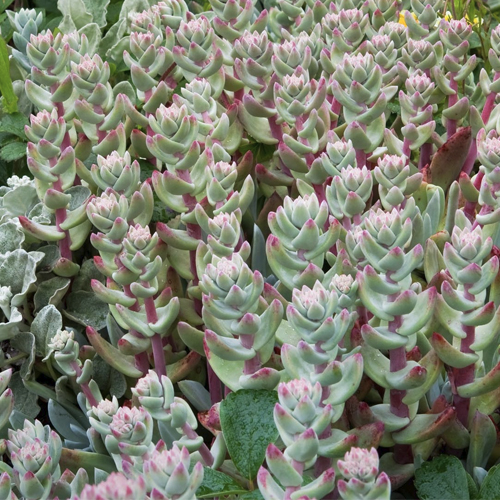
Succulent plant with many stems, each sprouting thick, fleshy gray-green leaves with light pink tips.

Dudleya spp

Cliff Lettuce, Live Forever
Organization

Group of succulent perennials with a characteristic rosette shape and chalky appearance that are mostly native to central and southern California where they grow on rocky outcroppings and coastal cliffs. Provide these plants with good drainage and afternoon shade in hotter areas. Larger forms can provide a striking accent plant in summer-dry gardens. Plant dudleyas at a slight angle to help water drain away.

Examples: giant chalk dudleya (D. brittonii, 12-18”), sand lettuce (D. caespitosa, up to 8”), bluff lettuce (D. farinosa, 4”, forms small colonies), chalk liveforever (D. pulverulenta, up to 2’).

  • Water: Low
  • Light: Full SunPartial Shade
  • Soil: Well Drained

Favorite Plants

1

California Fuchsia

Epilobium canum

2

California Buckeye

Aesculus californica

3

Coffeeberry

Frangula californica

4

Red Flowering Currant

Ribes sanguineum

5

Blue Eyed Grass

Sisyrinchium bellum

Favorite Garden Suppliers

Cal Flora Nursery

2990 Somers Street Fulton

Recommended Resources

Calscape

Calscape offers a database of plants native to California, along with details on their characteristics and habitat requirements. Additionally, it aims to promote the use of native plants in landscaping to support biodiversity and to conserve water.

Resilient Landscapes Coalition

Resilient Landscapes Coalition aims to promote fire-wise landscape design and management all while enhancing biodiversity and wildlife habitat, and conserving natural resources.

Gardening Tips

1

Start small, visit the plants often, and enjoy time with the birds and bees.