Opuntia spp.

Prickly Pear
Opuntia spp.
Succulent
Care:

Full Sun
Partial Shade

Very Low

Well Drained
Look:

Medium
size
Small
size

Blue Green
leaves
Green
leaves

Orange
flowers
Pink
flowers
Yellow
flowers
- Blooming seasons:
- Summer
- Life cycle:
- Perennial
- Foliage:
- Evergreen
- Wildlife habitat:
- Bee Habitat | Bird Habitat | Butterfly Habitat
- Animal resilience:
- Deer Resistant
Prickly Pear
Opuntia spp.
Succulent
Care:
Full Sun
Partial Shade
Very Low
Well Drained
Look:
Medium
size
Small
size
Blue Green
leaves
Green
leaves
Orange
flowers
Pink
flowers
Yellow
flowers
- Blooming seasons:
- Summer
- Life cycle:
- Perennial
- Foliage:
- Evergreen
- Wildlife habitat:
- Bee Habitat | Bird Habitat | Butterfly Habitat
- Animal resilience:
- Deer Resistant
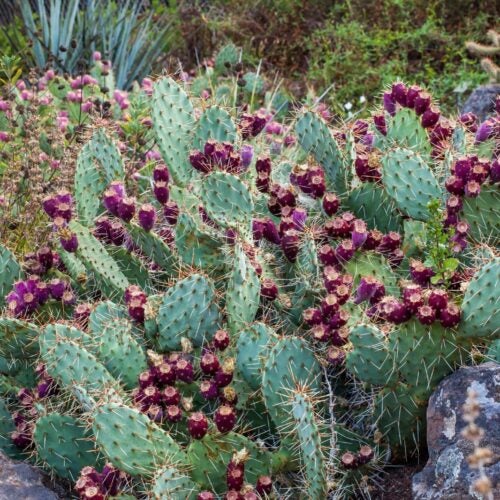
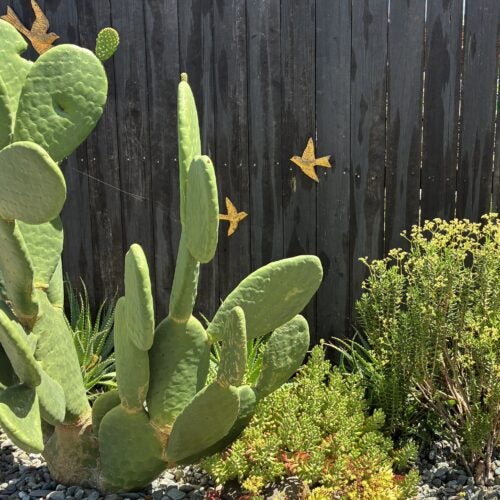
Group of cacti that grow in upright or spreading form, from low-growing to treelike. Covered with spines or small prickles. Showy yellow, orange, or pink, cup-shaped flowers in spring are followed by round, spiny fruits. Species are native to arid or semi-arid habitats throughout much of North, Central, and South America. Some species are native to California, including Beavertail Pricklypear (O. basilaris 1-2′ tall x 5′ wide) and Coast Prickly Pear (O. littoralis 3′ tall and wide). Most cultivars are plants selected for commercial food production (e.g., ‘Reyna’, ‘Roja Pelona’), but some species and hybrids are offered as ornamentals. ‘Baby Rita’ is a popular hybrid with blue-gray pads tinged with purple in winter. ‘Ellisiana’ and ‘Burbank Spineless’ are mostly spineless cultivars. Prefer full sun with great drainage.
 Print this plant card